
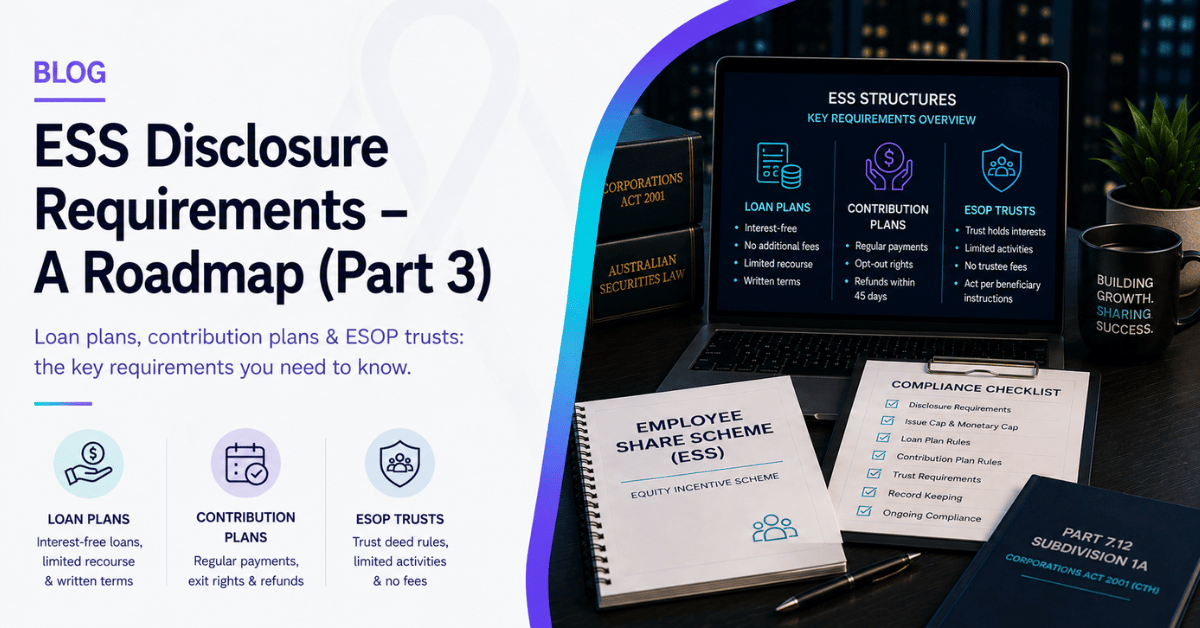
This article is Part 3 in a 3-part series on employee share scheme requirements under Part 7.12 Subdivision 1A of the Corporations Act 2001 (Cth) (the Act).
It covers requirements for private companies running ESS plans that involve loan plans, contribution plans, or ESOP trusts.
Read Part 1 for when Part 7.12 Subdivision 1A applies, and Part 2 for the general disclosure rules that apply once it does.
Introduction
An Employee Share Scheme (ESS), also called an ESOP, is when a company gives shares or options to employees.
Normally, issuing shares triggers heavy disclosure rules under Part 6D.2 of the Act, unless an exemption applies. Part 7.12 Subdivision 1A gives companies a lighter path.
But that doesn’t remove disclosure completely. If your offer falls under section 1100Q, you still need to follow sections 1100W, 1100X, 1100Y and 1100Z. Part 1 explains when section 1100Q applies. Meanwhile, Part 2 covers exactly what you need to disclose.
On top of all that, three specific setups come with their own extra rules: contribution plans, loan plans, and ESOP trusts. This article covers each one.
Contribution Plans
A contribution plan is when an employee acquires ESS interests by making regular payments, or by having regular deductions taken from their salary or wages.
Because the employee is paying something over time, this counts as an offer under section 1100Q. Therefore, disclosure applies (see Part 2 for the details).
To get the benefit of the Division, a contribution plan needs to meet the requirements in section 1100T:
- It must let the participant make regular payments, or have regular salary or wage deductions, to acquire the ESS interests.
- Any money contributed before the ESS interests are actually issued must be held with an Australian authorised deposit-taking institution (ADI) – basically, a proper bank or similar institution.
- The participant must be able to choose to stop contributing. If they do:
- any salary or wage deductions must stop right away
- any deductions taken after they opt out must be repaid within 45 days
- within 45 days, any money still sitting in the ADI account, not yet used to buy ESS interests, must be refunded, along with any interest it earned
- The participant must agree to the plan’s terms in writing before joining.
For disclosure, the company needs to give the participant either the full terms of the contribution plan or a summary with a note that the full terms are available on request. If only a summary is given, the full terms must follow within 10 business days of the participant asking for them.
Loan Plans
Some companies set up a loan funded share plan (LFSP) as part of their ESS. Here, the company loans the participant money to buy the ESS interests.
To rely on the Division’s relief, an LFSP needs to meet the requirements in section 1100U:
- The loan must be interest-free, with no extra fees.
- If the participant defaults, the company’s only recourse is to take back the ESS interests bought with the loan. It can’t chase the participant for anything more.
- The borrower has to be the ESS participant themselves, not some other entity acting on their behalf.
- The participant must not already be a shareholder of the company.
For disclosure, the same approach applies: give the participant the full loan terms, or a summary with a note that full terms are available on request. If only a summary is given, the full terms must follow within 10 business days of a request.
Trust Requirements
Many companies manage their ESS through a trust. The trustee holds the ESS interests on behalf of participants, who are beneficiaries of the trust. One of the main benefits: it keeps the company’s cap table simple and tidy.
To rely on the Division’s relief when using a trust, the arrangement needs to meet the requirements in section 1100S:
- The trustee must acquire the ESS interest with the purpose of eventually transferring it to the participant.
- The trust deed must set out that:
- the trustee’s activities are limited to managing the company’s ESS, which is why a special purpose entity is normally set up just to act as trustee
- the trustee keeps written records of how it administers the trust
- the trustee can’t charge fees for acting as trustee, other than reasonable disbursements (like accountant’s fees), or amounts charged to the company itself rather than to beneficiaries
- if the trustee is connected to the company (which it usually is), it can only exercise voting rights attached to the ESS interests as instructed by the beneficiaries
For disclosure, the trust deed itself needs to be given to the participant, or a summary with a note that the full deed is available on request. If only a summary is given, the full trust deed must follow within 10 business days of a request.
When Relief Can Be Revoked
The Division also allows a company’s access to this relief to be taken away. This happens if a loan plan, contribution plan, or ESS trust stops meeting the requirements above.
In other words, this isn’t a “set and forget” situation. Ongoing compliance is what keeps the relief available.
Key Takeaway
Loan plans, contribution plans and ESOP trusts each come with their own extra set of rules on top of the general disclosure requirements.
Miss them, and you risk losing access to the relief under Part 7.12 Subdivision 1A altogether. This means falling back to the much heavier Part 6D.2 process.
Start with Part 1 to understand when the Division applies. Then read Part 2 for the general disclosure rules, before layering on any of the specific structures covered here.
Frequently Asked Questions
1. What is a contribution plan under an ESS?
A plan where employees acquire ESS interests through regular payments or salary and wage deductions, rather than a single upfront payment.
2. What happens if an employee wants to stop contributing to a contribution plan?
Deductions must stop immediately, and any money already deducted or sitting unused in the account must be refunded within 45 days, along with any interest earned.
3. Can a company charge interest on an ESS loan plan?
No. Under section 1100U, the loan must be interest-free with no additional fees, and the company’s only recourse on default is to take back the ESS interests bought with the loan.
4. Why do companies use an ESOP trust?
It lets a trustee hold ESS interests on behalf of employees, which keeps the company’s cap table simpler and easier to manage.
5. Can a company lose access to the disclosure relief under the Division?
Yes. If a loan plan, contribution plan or ESOP trust stops meeting the requirements set out in the Division, the company’s relief can be revoked, meaning full Part 6D.2 disclosure obligations may apply instead.
Reach Out
If you’re implementing an ESS involving a loan plan, contribution plan, or ESOP trust, our team at Allied Legal can help. We regularly assist startups with structuring and disclosure compliance for these arrangements.
Call us on (03) 8691 3111 or email hello@alliedlegal.com.au.
Related reading: Employee Share Option Plans: A Simple Guide · Company Secretarial Services – useful if you’re setting up a special purpose trustee entity and need ongoing administration support.
This article is for general information only and isn’t legal advice. Please seek specific advice before acting on anything discussed here.


Employment Articles
Understanding Employment Types in Australia: Full-Time, Part-Time, and Casual

Employment Articles
Embracing Flexibility: Reforms in Australia’s Fair Work Act Enhances Access to Flexible Work Arrangements
Employment Articles
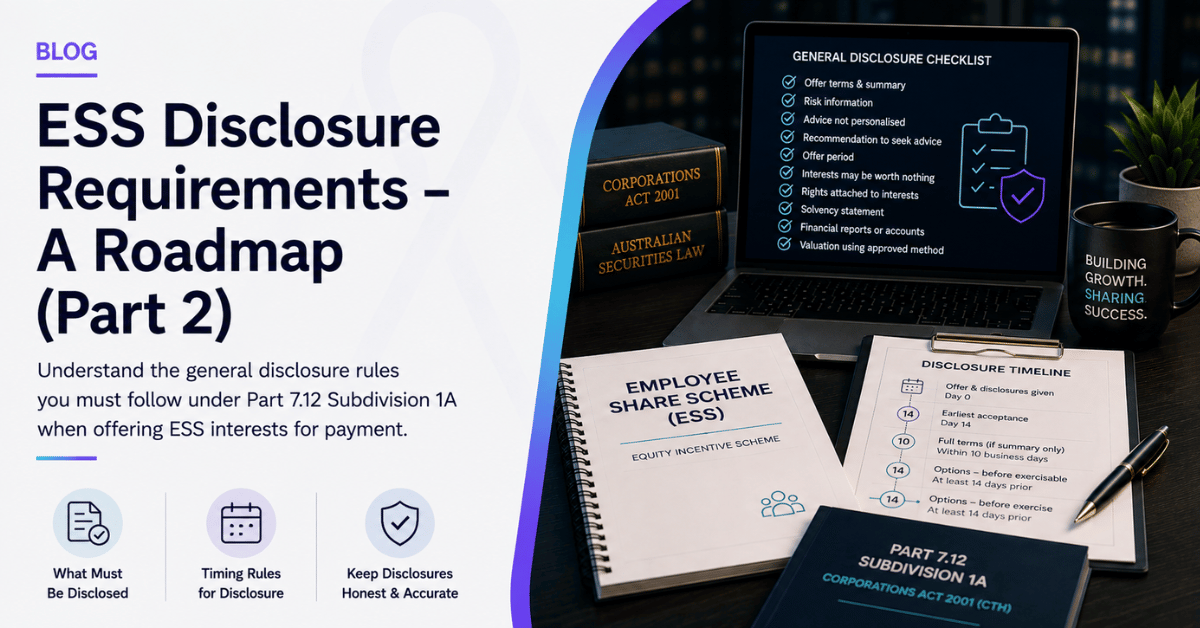
ESS Disclosure Requirements – A Roadmap (Part 2 – General Disclosure Requirements)
Employment Articles
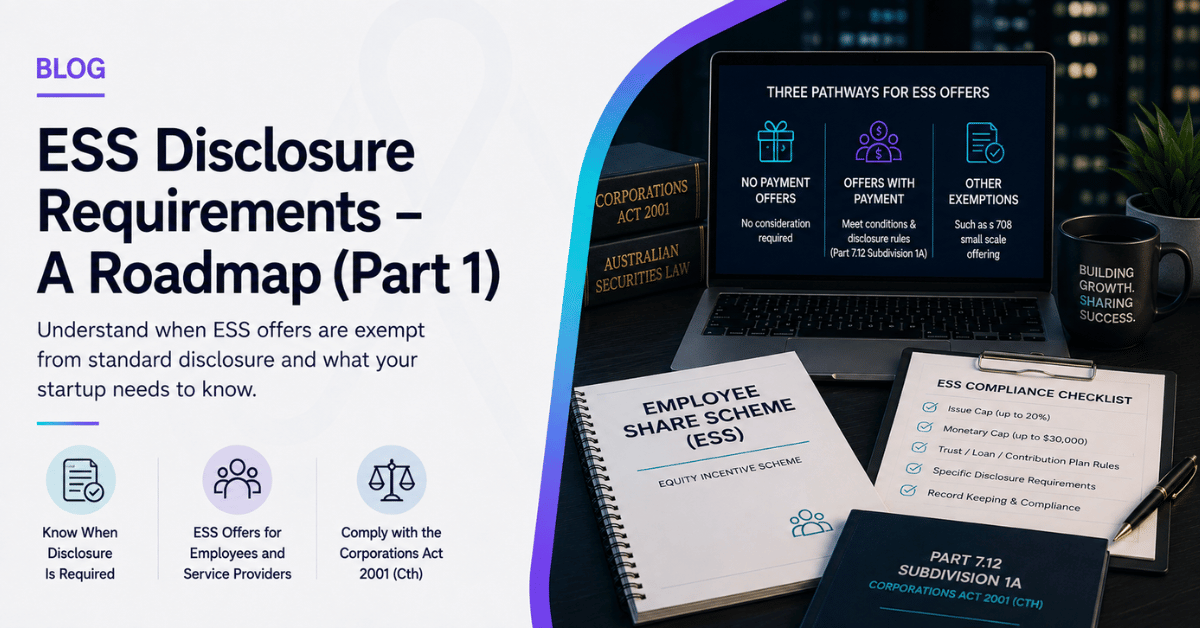
ESS Disclosure Requirements – A Roadmap (Part 1)

Employment Articles