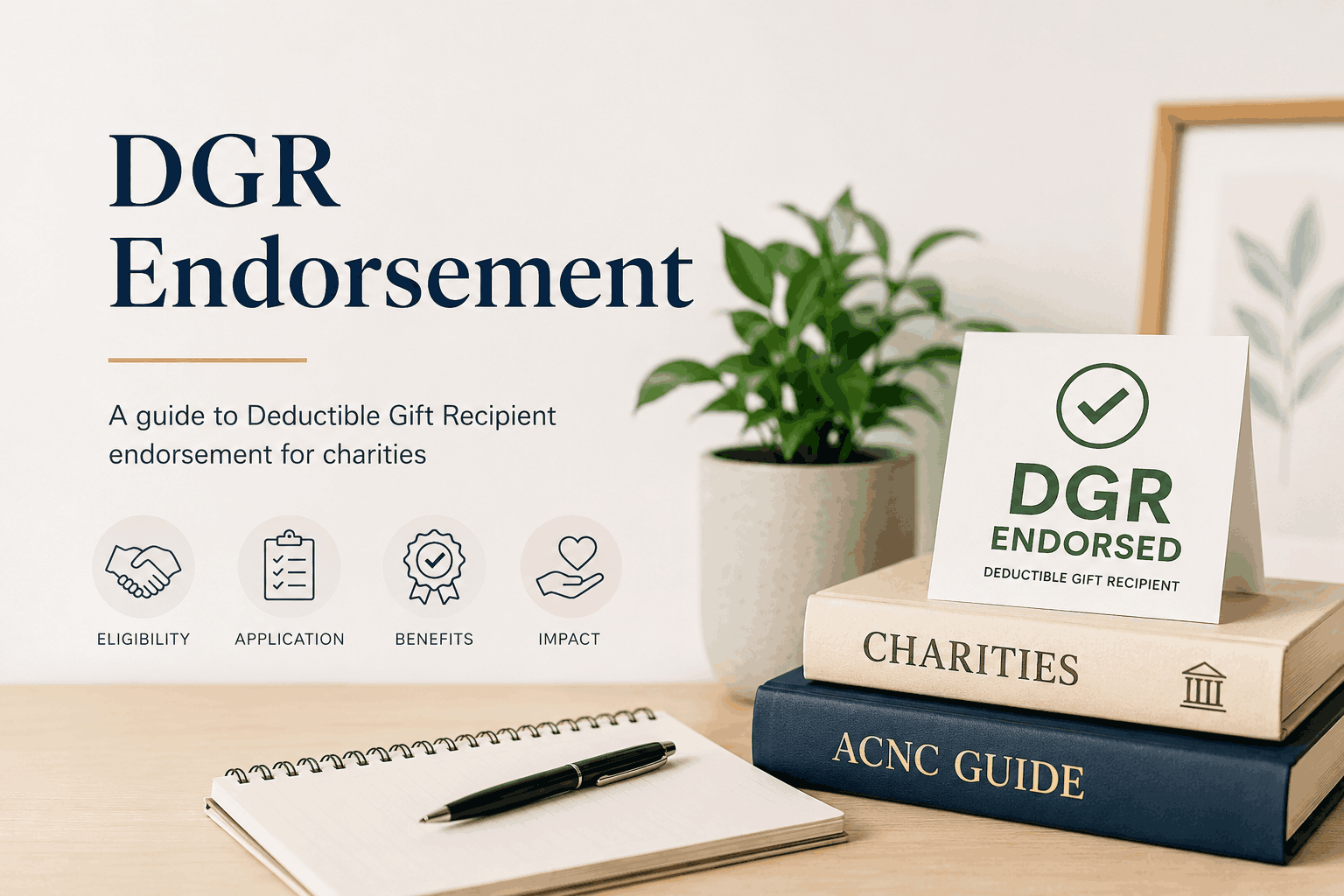
Every charity wants the same thing: greater support, stronger funding, and a bigger impact. One of the most effective ways to achieve this is through DGR endorsement.
Deductible Gift Recipient (DGR) status allows eligible charities and not-for-profit organisations to receive donations that supporters can generally claim as a tax deduction. This can make fundraising more attractive to donors, improve credibility, and open access to grants and philanthropic funding opportunities.
In this guide, we explain what DGR endorsement is, who qualifies, how the application process works, and the ongoing compliance obligations Australian charities need to understand.
What Is DGR Endorsement?
DGR endorsement is granted by the Australian Taxation Office (ATO) and allows eligible organisations, funds, authorities, and institutions to receive tax-deductible gifts.
For donors, this means eligible donations can generally be claimed as a tax deduction. For charities and not-for-profits, DGR endorsement can significantly enhance fundraising efforts and improve access to funding opportunities.
However, not every charity automatically qualifies. Organisations must satisfy specific legislative requirements and fall within an approved DGR category. (See: Australian Taxation Office)
Who Is Eligible for DGR Endorsement?
To obtain DGR endorsement, an organisation will generally need to:
- Be operated on a not-for-profit basis.
- Hold an Australian Business Number (ABN).
- Satisfy the requirements of a recognised DGR category.
- Meet the relevant “in Australia” requirements.
- Be registered as a charity with the Australian Charities and Not-for-profits Commission (ACNC), unless an exception applies.
Since 14 December 2021, most non-government organisations must be registered with the ACNC before DGR endorsement can be granted. (See: Australian Taxation Office)
Common DGR Categories
Some of the most common DGR categories include:
- Public Benevolent Institutions (PBIs)
- Health Promotion Charities (HPCs)
- Environmental organisations
- Cultural organisations
- School building funds
- Scholarship funds
- Public libraries, museums and art galleries
- Overseas aid organisations and funds
Eligibility depends on the organisation’s structure, governing documents, activities, and charitable purpose rather than simply the nature of the cause itself.
Governance Requirements for DGR Endorsement
A successful DGR application requires more than a charitable purpose.
The ATO expects organisations to demonstrate strong governance and compliance frameworks.
Governing Documents Must Be Compliant
Your constitution, trust deed, or governing rules should clearly identify:
- The organisation’s charitable purposes.
- How funds will be applied.
- Appropriate winding-up provisions.
- Required revocation clauses where applicable.
(See: Australian Taxation Office)
Gift Funds and Donation Management
Many DGR categories require organisations to establish a dedicated gift fund.
Donations received through the gift fund must generally be used exclusively for the approved charitable purpose. Organisations must also maintain appropriate records demonstrating compliance with these requirements.
How to Apply for DGR Endorsement
While requirements vary between categories, the application process generally follows five key steps.
1. Confirm Eligibility
The first step is determining which DGR category applies to your organisation and assessing whether you satisfy the legislative requirements.
(See: Australian Taxation Office)
2. Establish the Appropriate Legal Structure
Your legal structure, governing documents, and operational activities should align with the DGR category you intend to apply under.
This may involve updating constitutions, establishing gift funds, or reviewing governance arrangements.
3. Obtain ACNC Registration
Most organisations must first obtain charity registration with the ACNC before DGR endorsement can be granted.
(See: ACNC)
4. Lodge Your Application
If your organisation is not yet registered as a charity, you can generally apply for charity registration and DGR endorsement as part of the same ACNC application process.
If your organisation is already registered with the ACNC, you can apply directly to the ATO for DGR endorsement.
The ATO will assess whether all legislative requirements have been satisfied.
(See: ACNC)
5. Receive DGR Endorsement
Once approved, the organisation can begin receiving tax-deductible donations and issuing donation receipts in accordance with the applicable rules.
Common Reasons DGR Applications Are Refused
Many DGR applications experience delays or rejection due to avoidable issues.
Common problems include:
- Applying under the wrong DGR category.
- Non-compliant constitutions or trust deeds.
- Activities that do not align with the stated charitable purpose.
- Failure to establish required gift funds.
- ACNC registration issues.
Seeking professional advice before lodging an application can often prevent costly delays and improve the likelihood of approval.
Ongoing Compliance Obligations After DGR Approval
Obtaining DGR endorsement is only the beginning.
To maintain endorsement, organisations must continue satisfying both ATO and ACNC requirements.
Key Ongoing Obligations
Organisations should:
- Maintain appropriate governance practices.
- Keep accurate financial records.
- Properly manage donation funds.
- Meet annual reporting obligations.
- Notify regulators of significant organisational changes.
- Comply with winding-up and revocation requirements where applicable.
Failure to comply with ongoing obligations can result in the loss of DGR endorsement and associated tax concessions.
Why Professional Advice Matters
DGR endorsement involves much more than completing an application form.
Organisations must carefully assess eligibility, establish compliant governance structures, prepare appropriate governing documents, and implement ongoing compliance systems.
Errors at the application stage can lead to delays, additional costs, and missed funding opportunities.
Obtaining legal advice early can help ensure the process runs smoothly while reducing regulatory risk.
How Allied Legal Can Help
At Allied Legal, we regularly assist charities and not-for-profits with DGR endorsement, ACNC registration, charity structuring, constitution reviews, governance compliance, and ongoing regulatory obligations.
Whether you are establishing a new charity, seeking DGR endorsement, or reviewing your existing compliance framework, our experienced charity and not-for-profit lawyers can provide practical and strategic guidance tailored to your organisation.
Contact Allied Legal today to discuss your DGR endorsement requirements and take the next step towards securing tax-deductible fundraising status for your organisation.