
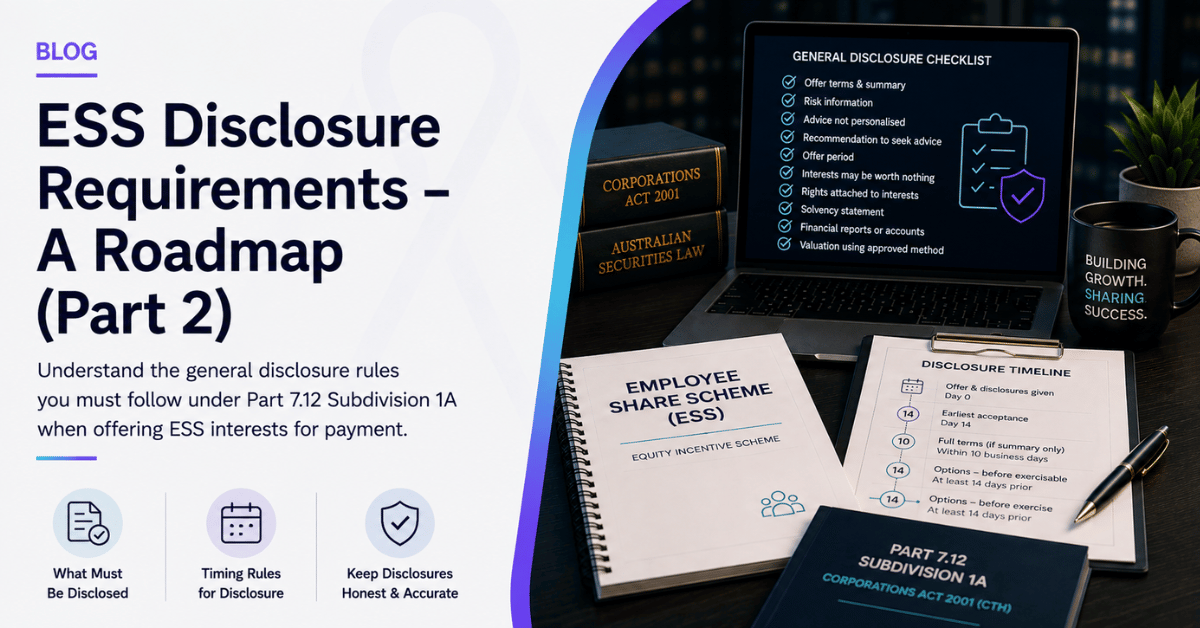
This article is Part 2 in a 3-part series on employee share scheme requirements under Part 7.12 Subdivision 1A of the Corporations Act 2001 (Cth) (the Act). It covers general disclosure requirements.
This article looks specifically at the disclosure rules for private companies caught by section 1100Q of the Act. To see when that section actually applies, read Part 1 of this series. For loan plans, contribution plans, or plans using an ESOP trust, read Part 3 here.
Introduction
An Employee Share Scheme (ESS), sometimes called an ESOP, is when a company gives shares or options to its employees.
Normally, whenever a company issues shares, Part 6D.2 of the Act kicks in – a heavy set of disclosure rules, unless an exemption applies. Part 7.12 Subdivision 1A gives companies a way around that.
But here’s the important part: avoiding Part 6D.2 doesn’t mean avoiding disclosure altogether. If your offer falls under section 1100Q (covered in detail in Part 1), you still need to disclose certain things – just under a lighter set of rules, found in sections 1100W, 1100X, 1100Y and 1100Z.
This article walks through what those rules actually require.
What Must Be Disclosed?
To comply with sections 1100W and 1100X, your ESS offer generally needs to include the following. (This list covers what’s most relevant for startups and private companies – for the complete list, check the sections directly.)
- the full terms of the offer, or a summary with a note that full terms are available on request
- general information about the risks of acquiring and holding the shares or options
- a statement that any advice given isn’t personally tailored to the recipient
- a recommendation that the recipient get their own personal advice
- how long the offer stays open for acceptance
- a statement that the interests may end up being worth nothing, since their value depends on future events that aren’t guaranteed
- if the interests aren’t ordinary shares, a description of what rights come with them
- a statement confirming the company is solvent
- a copy of the company’s most recent report lodged with ASIC, if one exists
- if no such report exists, a balance sheet and profit and loss statement prepared to proper accounting standards
- a valuation of the ESS interest, done using a method approved by the Commissioner of Taxation
Timing Rules for Disclosure
It’s not just what you disclose – timing matters too, under section 1100Y:
- Participants can’t acquire their interests until at least 14 days after the offer and disclosures above are given.
- If you only gave a summary of the offer at first, the full terms need to follow within 10 days. Our advice: just include the full terms from the start – it’s simpler, and avoids any risk of missing this deadline.
- If the interests are options, and the participant needs to pay money to exercise them, there’s an extra step. At least 14 days before the option can be exercised, and again at least 14 days before it’s actually exercised, the participant must be given:
- a copy of the company’s most recent ASIC-lodged report, or a balance sheet and profit and loss statement if none exists
- a valuation of the ESS interest, using a method approved by the Commissioner of Taxation
- a statement confirming the company is solvent
Keeping Disclosures Honest
Under section 1100Z, any disclosure or offer must not be misleading or deceptive. That includes leaving out information in a way that ends up misleading someone, even without saying anything false outright.
Companies also need to keep participants updated. If disclosed information becomes outdated or wrong, the company must issue a fresh version.
Get this wrong, and the consequences are real: participants can seek monetary compensation from the company, or from its directors – including “shadow directors” (people who aren’t formally appointed but effectively control decisions).
Key Takeaway
Avoiding Part 6D.2 doesn’t mean avoiding disclosure. If your ESS offer falls under section 1100Q, you still need to meet the requirements in sections 1100W, 1100X, 1100Y and 1100Z – covering what you disclose, when you disclose it, and keeping everything accurate and up to date.
Get the structure right from the start under Part 1 of this series, and check Part 3 if your plan involves a loan, contribution plan, or ESOP trust.
Frequently Asked Questions
1. What has to be disclosed in an ESS offer under section 1100Q?
Things like the offer terms, risk information, a solvency statement, recent financial reports (or accounts if none exist), and a valuation prepared using a method approved by the Commissioner of Taxation.
2. How long before an employee can accept an ESS offer?
At least 14 days after the offer and required disclosures are given.
3. What happens if I only give a summary of the offer terms?
You must provide the full terms within 10 days – though it’s simpler to just include the full terms from the outset.
4. Are there extra disclosure steps for options?
Yes. If money is needed to exercise the option, participants must get updated financials, a valuation and a solvency statement at least 14 days before the option becomes exercisable, and again 14 days before it’s exercised.
5. What happens if a disclosure turns out to be misleading?
Participants can seek monetary compensation from the company or its directors, including shadow directors. Companies must also proactively update participants if disclosed information becomes outdated.
Reach Out
If you’re implementing an ESS, or you’ve received an offer and want to understand your disclosure rights, our team at Allied Legal can help. We regularly assist startups with ESS structuring and disclosure compliance.
Call us on (03) 8691 3111 or email hello@alliedlegal.com.au.
Related reading: Employee Share Option Plans: A Simple Guide
This article is for general information only and isn’t legal advice. Please seek specific advice before acting on anything discussed here.


Employment Articles
Budget Reforms to Employee Share Scheme Reveals Boost for Local Startups

Employment Articles
Understanding Employment Rights in Australia: A Guide to Full-Time, Part-Time and Casual Employment
Employment Articles
Genuine Redundancy vs Unfair Dismissal: Key Differences

Employment Articles
Embracing Flexibility: Reforms in Australia’s Fair Work Act Enhances Access to Flexible Work Arrangements

Employment Articles