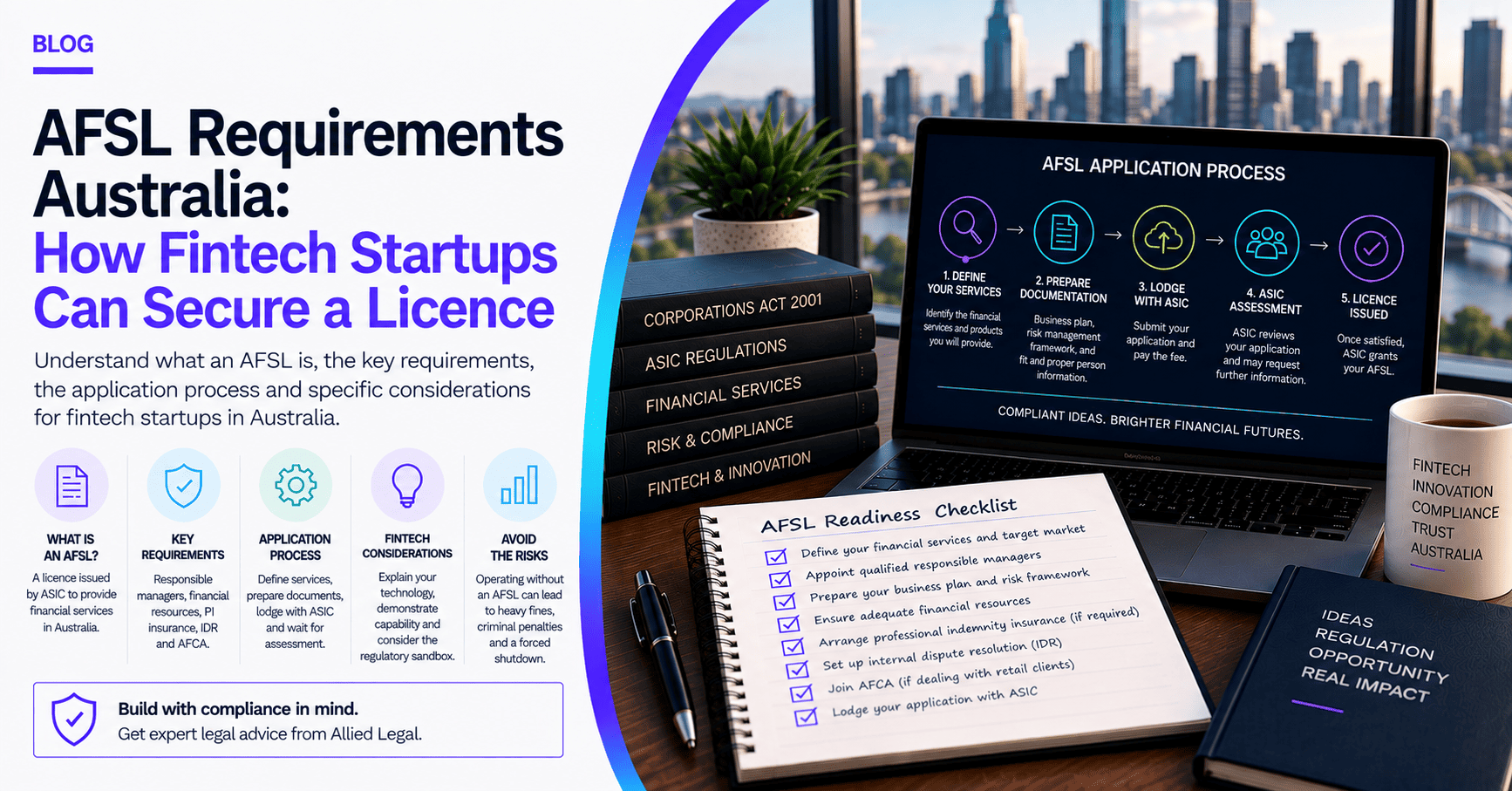
An Australian Financial Services Licence (AFSL) is a cornerstone of Australia’s financial services industry. The Australian Securities and Investments Commission (ASIC) administers it. It is a mandatory requirement for individuals and businesses that provide financial services in Australia. For fintech startups, understanding AFSL requirements Australia-wide is essential before you launch, not after. This guide covers what an AFSL involves, how to apply, and the specific issues fintech startups need to plan for.
What Is an AFSL and Why Does It Matter?
An Australian Financial Services Licence exists to keep financial services transparent and accountable. Holding one shows that a provider meets ASIC’s standards for competence, integrity, and financial soundness. This matters for every provider. It matters even more for fintech startups working with new technology and unfamiliar business models, where consumer trust is harder to establish from scratch.
Offering financial services without an AFSL is illegal in Australia. ASIC actively monitors the sector and can impose significant fines or pursue criminal penalties for unlicensed activity. Operating without a licence also damages consumer trust. It can lead to a forced shutdown, which is a far more costly outcome than getting the licence right from the start.
Key AFSL Requirements
ASIC assesses several core requirements before granting a licence. Under Regulatory Guide 1, applicants need responsible managers with the right knowledge and experience. These managers oversee the business day-to-day. Applicants must also show they hold sufficient financial resources to run the business as proposed. Providers dealing with retail clients need adequate professional indemnity insurance. They also need internal dispute resolution processes and membership of the Australian Financial Complaints Authority (AFCA). Meeting these requirements properly the first time avoids delays later in the application.
How to Apply for an AFSL
The application process generally follows five steps. First, identify the specific financial services and products your business will provide. This defines the scope of licence you need. Second, prepare supporting documentation. This includes a business plan, a risk management framework, and statements of personal information for each responsible manager. Third, submit your application and pay the applicable fee, which varies by licence type. Fourth, ASIC assesses the application and may request further information to confirm compliance. Finally, ASIC issues the licence once it is satisfied with the application.
Timing matters here. ASIC aims to decide 70% of complete applications within 150 days. It aims to decide 90% within 240 days. Realistically, budget four to eight months rather than a few weeks. Engaging a lawyer experienced in AFSL applications, such as Allied Legal, can help you avoid the common gaps that extend this timeline.
AFSL Considerations Specific to Fintech Startups
Fintech startups face a few extra hurdles that traditional financial service providers generally do not. You need to explain your technology, business model, and operational practices clearly. ASIC needs enough detail to assess an offering that may not fit neatly into existing categories. You also need to demonstrate real capability. This means the qualifications, resources, and systems to actually deliver what you propose, including compliance systems for risk management, customer privacy, and dispute resolution.
Not every fintech needs a full AFSL immediately. ASIC’s Enhanced Regulatory Sandbox lets eligible fintechs test new financial services for up to 24 months without a full licence. This is subject to exposure limits and mandatory consumer protections, including disclosure, dispute resolution, and PI insurance. It can be a useful bridge for a genuinely new product before committing to the full licensing process.
Operating Without an AFSL: The Real Risk
Operating without a required AFSL exposes a fintech startup to ASIC enforcement. This can mean fines and, in serious cases, criminal penalties. It also risks a forced shutdown once discovered. That is a far worse outcome for a growing business than the time an application takes. Consumers and partners are also far less likely to trust or engage with an unlicensed provider. This can undermine growth even before ASIC gets involved.
Frequently Asked Questions
1. What is an Australian Financial Services Licence?
An Australian Financial Services Licence, or AFSL, is a licence ASIC issues to businesses that provide financial services in Australia. It confirms the holder meets ASIC’s standards for competence, financial soundness, and consumer protection.
2. How long does an AFSL application take to process?
ASIC aims to decide 70% of complete applications within 150 days, and 90% within 240 days. Most applicants should budget four to eight months. A well-prepared application generally moves faster than an incomplete one.
3. Do all fintech startups need a full AFSL to operate?
Not necessarily straight away. ASIC’s Enhanced Regulatory Sandbox lets eligible fintechs test new financial services for up to 24 months without a full licence. This is subject to exposure limits and mandatory consumer protections.
4. What happens if a business operates without a required AFSL?
ASIC can impose significant fines, and in serious cases, pursue criminal penalties. It can also force an unlicensed business to stop operating. Unlicensed providers tend to struggle to earn consumer and partner trust as well.
5. Do fintech startups need to hold professional indemnity insurance for an AFSL?
Yes, if they deal with retail clients. Adequate professional indemnity insurance is one of ASIC’s core compensation requirements. Internal dispute resolution processes and AFCA membership are required alongside it.
6. What documents does ASIC require for an AFSL application?
The core documents are a comprehensive business plan, a risk management framework, and statements of personal information for each responsible manager. You also need the completed application form and the applicable fee.
7. Can a business hold an AFSL and still use ASIC’s Enhanced Regulatory Sandbox?
No. ASIC designed the sandbox as an alternative to holding a full AFSL during a limited testing period. Once a fintech outgrows the sandbox’s exposure limits, or the 24 month window ends, it needs a full licence to keep operating.
Navigating an AFSL application is genuinely complex. Staying compliant once you hold one is too, particularly for a fintech startup building something new. Allied Legal helps businesses assess which licence type they need. We also help prepare and submit supporting documentation, and put compliance systems in place to meet ASIC’s ongoing requirements.
If you are ready to start your AFSL application, or want to understand your obligations before you do, contact Allied Legal today. Call 03 8691 3111 or email hello@alliedlegal.com.au.
This article is provided for general information only and does not constitute legal advice. You should obtain legal advice specific to your circumstances before acting on any information contained in this article.