
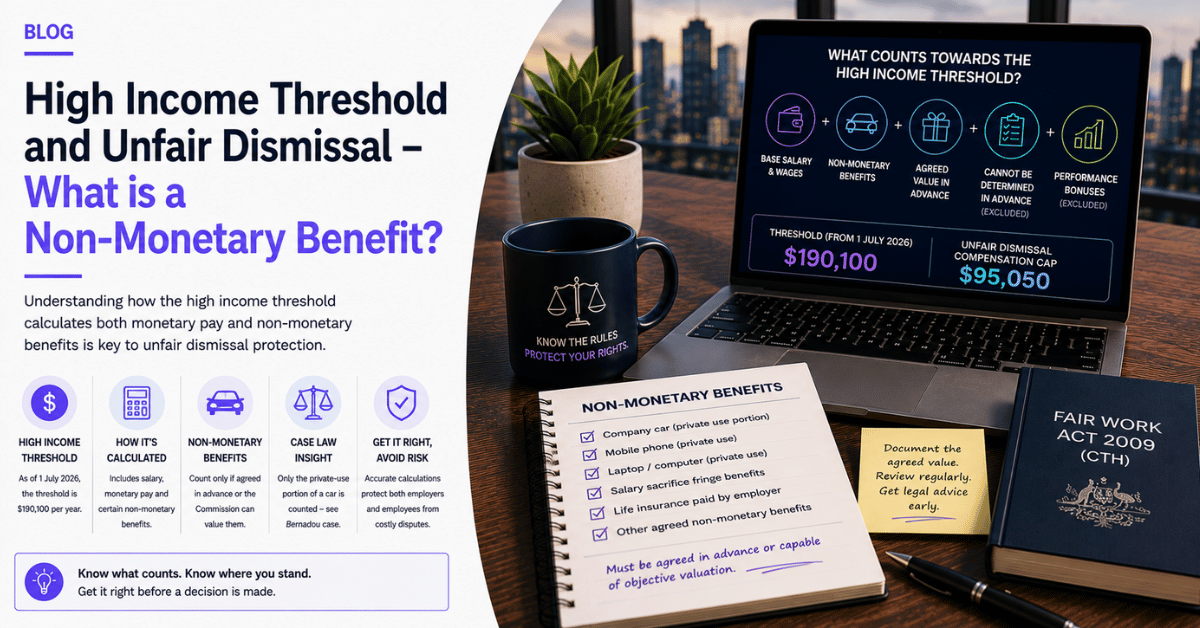
Understanding the Fair Work Act’s high income threshold is essential for both employees and employers, particularly when it comes to unfair dismissal protection. The threshold accounts for both monetary pay and non-monetary benefits, and it is the non-monetary side that trips people up most often.
This guide explains how the high income threshold operates, how the law treats non-monetary benefits when calculating earnings, and what recent cases reveal about getting the calculation right.
When Is an Employee Protected from Unfair Dismissal?
Under the Fair Work Act 2009 (Cth), an employee gains protection from unfair dismissal after completing the minimum employment period. This period is generally six months for businesses with 15 or more employees and 12 months for smaller businesses. The employee must also satisfy at least one additional requirement: a modern award covers their employment, an enterprise agreement covers their employment, or their earnings fall below the high income threshold.
As of 1 July 2026, the high income threshold is $190,100 per year, adjusted annually on 1 July. The related unfair dismissal compensation cap is $95,050.
If an employee has unfair dismissal protection, an employer will generally need to follow a fair managing-out process before terminating their employment. This process often takes six weeks or longer and commonly includes a formal performance improvement plan to meet procedural fairness requirements.
How the High Income Threshold Is Calculated
Working out whether someone sits under the threshold is rarely straightforward, since it needs to account for every element of an employee’s earnings, not just their salary.
- Earnings include wages and salary.
- The law excludes mandatory superannuation guarantee contributions, although employers can count superannuation contributions above the minimum guarantee.
- Parties can only count non-monetary benefits at their agreed monetary value, and they cannot count payments whose value they cannot determine in advance.
- The law generally excludes performance-based and discretionary bonuses.
Non-monetary benefits create most of the complexity because employers must properly value and document them before they can include them in the earnings calculation.
When Do Non-Monetary Benefits Count?
Fair Work Commission guidance indicates that a non-monetary benefit will generally only count towards earnings if the employer and employee agreed on its value in advance. Regulation 3.05(6) of the Fair Work Regulations 2009 creates a limited exception. The Commission may still include a non-monetary benefit if an agreement gives the employee an entitlement to that benefit, if the benefit is relevant to the high income threshold calculation, and if the Commission can realistically estimate a real or notional value for it.
The Commission has significant discretion in this area, but the case law has established several consistent principles. The benefit must have an objective and stable monetary value because the legislation excludes amounts that the parties cannot determine in advance. The parties must provide the benefit under a genuine agreement rather than through informal or undocumented use of company property. The benefit must also remain in effect on the termination date, rather than having changed or ended beforehand.
The Full Bench of the Fair Work Commission illustrated this principle in Sam Technology Engineers Pty Ltd v Bernadou.The Commission held that only the private-use component of a company vehicle counted as earnings. It also found that employers must properly apportion that component rather than rely on assumptions.
Recognised Non-Monetary Benefits
The Fair Work Commission has recognised several categories of non-monetary benefit over time, including the private use of a company vehicle, valued using an accepted formula, certain fringe benefits arising from salary sacrifice arrangements, the private use of phones and computers provided for work, and employer-paid life insurance held on the employee’s behalf.
Each benefit must still satisfy the underlying requirements. The parties must agree to it through a genuine agreement, they must be able to estimate its value objectively, and it must continue to apply on the termination date.
Why This Matters for Employers and Employees
For employers, a mistake when calculating the high income threshold can force them to defend an unfair dismissal claim that should not have proceeded. It can also lead them to mishandle a termination because they incorrectly assume the employee lacks protection. For employees, understanding what counts as earnings can determine whether they can access unfair dismissal protections.
Given the discretion built into the regulations, and the fact-specific nature of the case law, getting early advice before finalising a termination, or before assessing your own eligibility to bring a claim, is worth the time it takes.
Getting the Calculation Right
A few practical habits reduce the risk of getting this wrong.
Document the value of any non-monetary benefit in writing when it is offered. This is easier than trying to determine its value later.
Review benefits such as vehicles, phones, and laptops before termination. Check that they are still being provided and that the terms have not changed. A benefit that has ended or changed may be excluded from the calculation.
If the value of a benefit is genuinely uncertain, take a cautious approach. This often applies to equity interests and discretionary bonuses. In these situations, it is safer to assume the benefit will be excluded rather than relied upon to push an employee over the threshold.
Frequently Asked Questions
1. What is the current Fair Work high income threshold?
As of 1 July 2026, the high income threshold is $190,100 per year, with a corresponding unfair dismissal compensation cap of $95,050. Both figures are adjusted annually on 1 July.
2. Do non-monetary benefits count toward the high income threshold?
Yes, but only if the employer and employee agreed on the value in advance, or the Fair Work Commission can estimate a real or notional value under regulation 3.05(6) of the Fair Work Regulations 2009.
3. Does a company car count as earnings for the high income threshold?
Yes, but only the private-use portion counts towards earnings. Employers must properly apportion that portion from business use rather than include the full value of the vehicle or allowance. The Full Bench confirmed this approach in Sam Technology Engineers Pty Ltd v Bernadou.
4. Are bonuses included when calculating the high income threshold?
Generally, no. The law excludes performance-based and discretionary bonuses from the earnings calculation. It also excludes payments whose value the parties cannot determine in advance.
5. Why does the high income threshold matter for unfair dismissal claims?
An employee who earns above the threshold, and is not covered by a modern award or enterprise agreement, is generally not protected from unfair dismissal, so an accurate calculation directly affects who can bring a claim.
Our team of commercial law experts at Allied Legal can help, with experience acting for both employers and employees. Call us on (03) 8691 3111 or email hello@alliedlegal.com.au.
Related Reading:
Useful Resources:
- Fair Work Ombudsman: High Income Threshold Amounts
- Fair Work Regulations 2009, Reg 3.05 (AustLII)
- Fair Work Act 2009, s.382 (AustLII)
- Sam Technology Engineers Pty Ltd v Bernadou [2018] FWCFB 1767
This article is provided for general information only and does not constitute legal advice. You should obtain legal advice specific to your circumstances before acting on any information contained in this article.


Employment Articles
Understanding Employment Types in Australia: Full-Time, Part-Time, and Casual

Employment Articles
Understanding Employment Rights in Australia: A Guide to Full-Time, Part-Time and Casual Employment

Employment Articles
Embracing Flexibility: Reforms in Australia’s Fair Work Act Enhances Access to Flexible Work Arrangements
Employment Articles
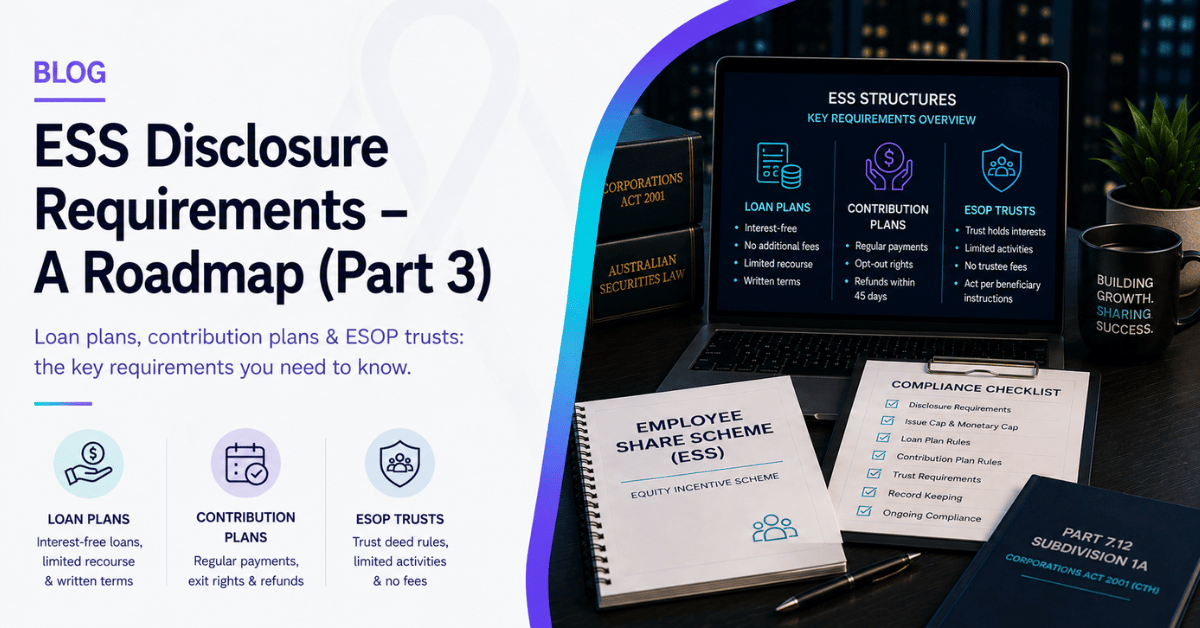
ESS Disclosure Requirements – A Roadmap (Part 3 – Loan Plans, Contribution Plans, Plans Involving ESOP Trusts)

Employment Articles