- Home
- About
- Services
- Links
- Advisory Board Services
- Business Sales & Purchases
- Business Set Up
- Commercial Law
- Consumer Law
- Contracts & Agreements
- Corporate Governance
- Corporate Law
- Data & Privacy
- Dispute Resolution
- Employee Incentive Schemes
- Employment Lawyer
- Franchising
- Fundraising
- Intellectual Property
- International Business
- Not-for-Profits & Charities
- Regulatory Compliance
- Startup Advisory
- Venture Capital & Investing
- Grant Services
- Image

- Links
- Industries
- Links
- Startups & Scaleups
- SME’s
- Ecommerce & Retail
- Energy & Resources
- Professional Services & Consulting
- Agriculture & Agribusiness
- Health & Wellness
- Construction and Real Estate
- Creative Entertainment
- Education and Training
- Hospitality and Tourism
- Marketing and Advertising
- Travel & Tourism
- Technology & Software Development
- More Links
- Links
- Startups
- Resources
- Contact

Starting a Business in Australia: Your Complete Legal Guide
On this page
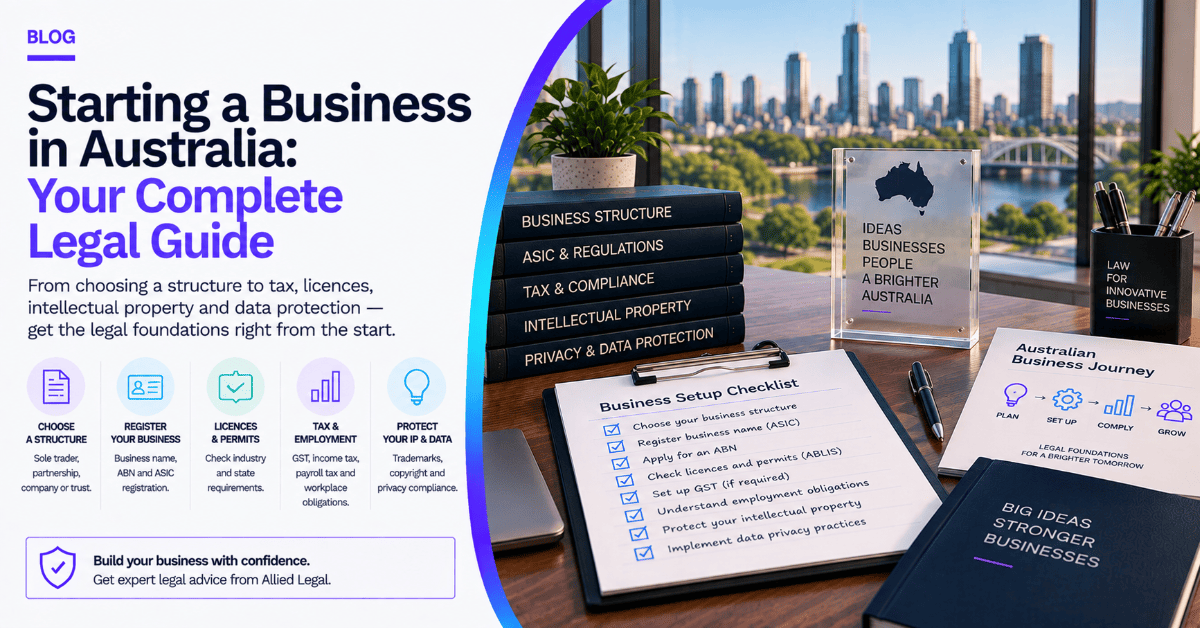
ToggleStarting a business in Australia means working through a set of legal, tax, and regulatory steps. Getting these right early avoids compliance problems later. It also gives your business a solid legal foundation to grow from. The process of establishing a business in Australia stays the same whether you are a first-time founder or expanding an existing venture. This guide walks through each step involved, from choosing a structure through to protecting your data and intellectual property.
Age Requirements for Business Owners
There is no minimum age to start a business in Australia. Anyone with the legal capacity to enter into a contract can start one. If you are under 18, the law treats you as a minor. Contracts you sign personally may not be enforceable against you, which makes some structures impractical for younger founders. A company director must be at least 18 years old under the Corporations Act 2001 (Cth), with no exceptions. Younger founders often work around this. A parent or guardian can act as sole trader or director on their behalf. They can also form a partnership with an adult, or hold shares through a trustee while an adult director runs the company. Getting this structure right from the outset avoids problems with enforceability and personal liability later.
Step 1: Choose Your Business Structure
When establishing a business in Australia, your structure affects your liability, your tax obligations, and your ability to raise capital. It is worth getting right from the start. A sole trader structure gives you full control, but you are personally responsible for all debts and liabilities of the business. A partnership involves two or more people sharing ownership, profits, losses, and risk. A written partnership agreement is essential to avoid disputes later. A company is a separate legal entity that limits your personal liability.
It can also raise capital in its own name, though it comes with more reporting and compliance obligations. A trust involves a trustee holding assets for beneficiaries. Businesses often use this structure for asset protection or tax planning, but it needs more setup and ongoing administration than the other options.
If you are planning to incorporate a company, our guide to incorporating a company in Australia covers the registration process and ongoing obligations in more detail. Getting advice before you commit to a structure is worth the cost, since changing structure later can trigger tax consequences.
Step 2: Register Your Business Name
Once you have chosen a structure, you generally need to register a business name. This is done with the Australian Securities and Investments Commission (ASIC), unless you trade under your own personal name. Registering your name establishes your legal identity and supports your branding. It also stops others in your industry from registering the same name. Note that registering a business name differs from registering a company, and differs again from securing a trademark. Check which of these your business actually needs.
Step 3: Obtain Licences and Permits
Many industries require specific licences or permits before you can legally operate. Common examples include trade qualifications, environmental compliance, food safety, and the sale of alcohol. The Australian Business Licence and Information Service (ABLIS) lets you search for the licences and permits your business needs, based on your industry and location. Operating without a required licence can expose you to fines or forced closure. Check this before you start trading rather than after.
Step 4: Meet Your Tax and Employment Obligations
Every business needs an Australian Business Number (ABN) to deal with the ATO and other businesses. You must register for GST once your turnover reaches 75,000 dollars, or if you expect to reach that threshold in your first year. Registration must happen within 21 days of becoming required to register. Taxi and limousine services must register for GST regardless of turnover, as do many businesses earning income through sharing economy platforms. You will also need to lodge an annual income tax return based on your business profits. Payroll tax is not a single national tax. Each state and territory sets its own threshold and rate, so check the current thresholds for your state once your wage bill grows. If you give employees non-cash benefits, such as a car or a gym membership, fringe benefits tax will generally apply on top of income tax.
Step 5: Protect Your Intellectual Property
Your business name, logo, and product designs can usually gain protection through a registered trademark. Original creative or written works may attract copyright protection automatically. Securing your intellectual property early stops competitors from trading on your brand. It also gives you a clear legal basis to act if someone infringes it. This is easy to overlook in the early stages of a business, but far more expensive to fix after a dispute has already started.
Step 6: Get Data Protection Right From the Start
If your business collects any customer or employee data, you need a compliant approach to consent and data handling under the Privacy Act 1988 (Cth). This applies even if your business currently sits under the small business turnover exemption. Our guide to the role of consent in data privacy explains what counts as valid consent, and when Australian and international privacy laws apply to a growing business. Building this in from day one is far easier than retrofitting it once you have customers and systems in place.
Other Legal Obligations to Keep in Mind
Most businesses also need to meet workplace health and safety obligations once they have staff. They must also comply with the Australian Consumer Law in how they advertise, price, and sell to customers. These obligations apply regardless of your business structure. The Fair Work Ombudsman and the ACCC are useful starting points for the specific rules in your industry.
Frequently Asked Questions
1. Is there a minimum age to start a business in Australia?
No. Anyone with the legal capacity to enter a contract can start a business. If you are under 18, contracts you sign personally may not be enforceable. A company director must be at least 18 under the Corporations Act.
2. Do I need to register a business name?
Generally yes, unless you trade under your own personal name. You register a business name with ASIC. This is separate from registering a company or securing a trademark.
3. When do I need to register for GST?
Once your turnover reaches 75,000 dollars, or if you expect to reach that threshold in your first year. Taxi, limousine, and some sharing economy businesses must register regardless of turnover.
4. Is payroll tax the same across Australia?
No. Each state and territory sets its own payroll tax threshold and rate. Check the rules that apply where your business operates.
5. Does the Privacy Act apply to a new small business?
Businesses with turnover under 3 million dollars are generally exempt, but common exceptions apply, including health service providers and businesses that trade in personal information. Building good data handling practices early is worth doing regardless of the exemption.
6. What licences or permits might my business need?
This depends on your industry and location. The Australian Business Licence and Information Service lets you search for the licences and permits that apply to your business.
7. Is establishing a business in Australia different for foreign founders?
The core steps are the same, but foreign founders may face extra requirements, such as visa conditions or foreign company registration rules. It is worth getting advice on your specific situation before you commit to a structure.
How Allied Legal Can Help
Starting or establishing a business in Australia involves more legal decisions than most founders expect. The right structure, registrations, and compliance settings depend on your specific plans and industry. Our team at Allied Legal helps founders choose the right business structure, register their business correctly, and draft partnership and shareholder agreements. We also help put data protection and IP protections in place before they become a problem. Whether you are just starting out or restructuring an existing business, we can guide you through the legal requirements so you can focus on building it. Contact us at 03 8691 3111 or email hello@alliedlegal.com.au to discuss your business needs.
This article is provided for general information only and does not constitute legal advice. You should obtain legal advice specific to your circumstances before acting on any information contained in this article.

Rahul Kumar
Rahul Kumar is the founder of Allied Legal and a seasoned corporate lawyer with over 19 years of experience advising on complex corporate law matters. A recognised specialist in the startup and scaleup space, Rahul has a deep understanding of the legal and commercial challenges faced by high-growth businesses.
Having worked at both national and international firms, his expertise spans corporate structuring, capital raising, shareholder arrangements, mergers and acquisitions, and strategic governance.

COMMERCIAL LAW
Exit Clause in Shareholders Agreement: A Complete Guide


COMMERCIAL LAW
How to Protect Your Business from Contract Repudiation: Essential Steps and Strategies

Commercial Law