
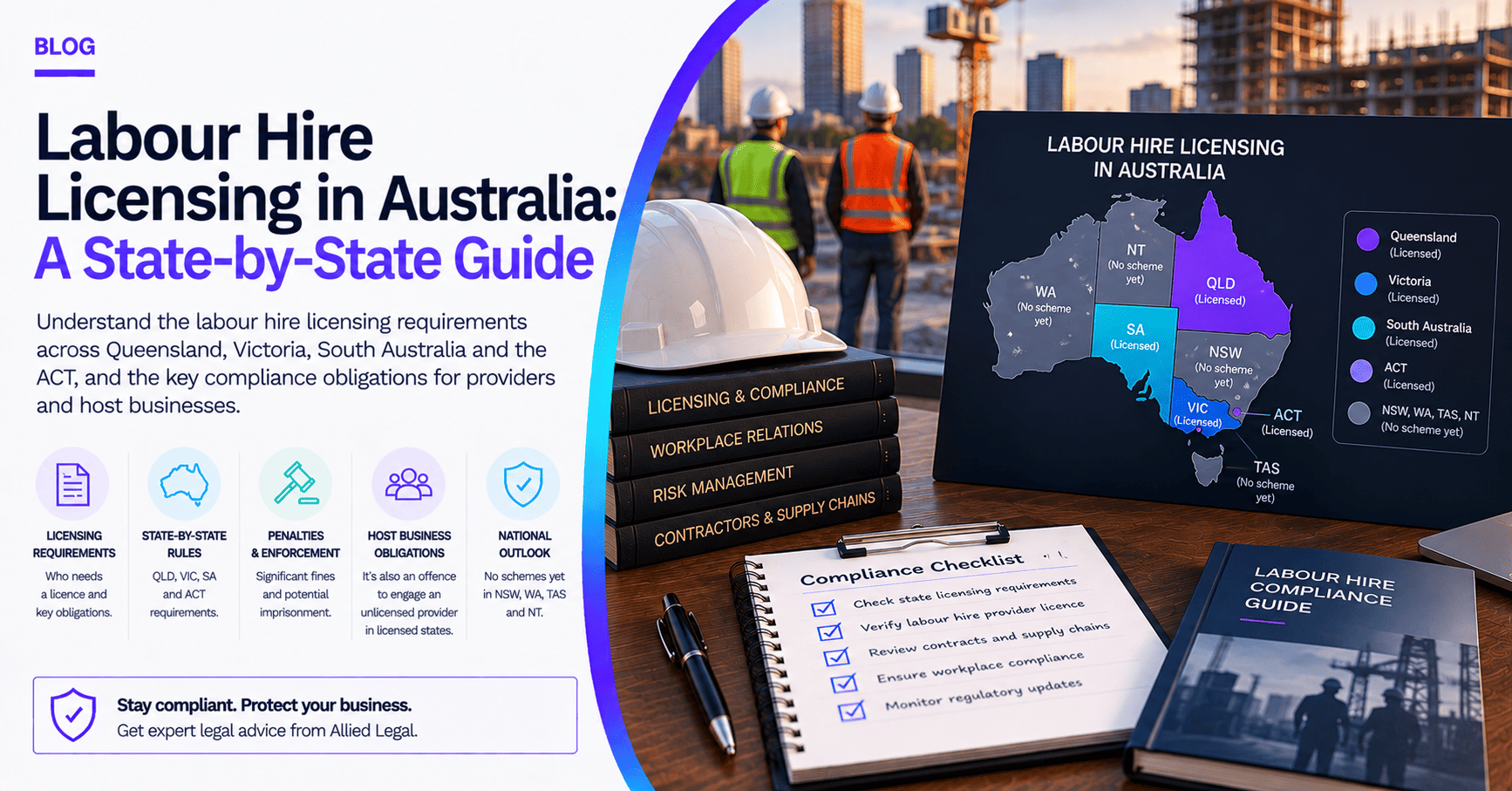
Labour hire licensing is one of the most commonly misunderstood compliance obligations for businesses that supply or use contingent workers. Four Australian jurisdictions currently run their own licensing schemes: Queensland, Victoria, South Australia, and the Australian Capital Territory. Each scheme requires labour hire providers to hold a licence before supplying workers. Each one also makes it an offence for a host business to engage an unlicensed provider. New South Wales, Western Australia, Tasmania, and the Northern Territory have no licensing scheme yet. NSW has said it is working with other jurisdictions on a nationally consistent framework, but nothing is confirmed. This guide sets out the current requirements in each licensed state. It also covers a separate federal compliance layer that applies no matter where you operate.
Quick Comparison Across States
| State | Regulator | Governing Act | Standard Licence Term | Application Fee | Max Penalty, Individual | Max Penalty, Corporation |
|---|---|---|---|---|---|---|
| Queensland | Labour Hire Licensing Compliance Unit | Labour Hire Licensing Act 2017 (Qld) | 12 months | From $1,120, tiered by wages paid | Around $178,500 or 3 years imprisonment | Around $518,100 |
| Victoria | Labour Hire Authority | Labour Hire Licensing Act 2018 (Vic) | Up to 3 years | From $1,865, tiered by turnover | $167,280 | $669,120 |
| South Australia | Consumer and Business Services | Labour Hire Licensing Act 2017 (SA) | No fixed term, annual fee applies | $1,005 individual, $2,285 body corporate | $140,000 | $400,000 |
| ACT | WorkSafe ACT | Labour Hire Licensing Act 2020 (ACT) | 12 months | $3,461 | $128,000 | $2,430,000 |
Most states index these fees and penalty figures each year. Confirm the current figures with each regulator before relying on them.
Queensland
The Labour Hire Licensing Compliance Unit runs Queensland’s scheme under the Labour Hire Licensing Act 2017 (Qld). You need a licence if you supply a worker to another business to do work for them, as part of running your own business. This covers recruitment agencies placing temporary staff. It also covers group training organisations placing apprentices, and labour contractors in agriculture and horticulture.
Applicants must pass a fit and proper person test. The regulator checks your character and your history of complying with relevant laws. It also looks at any past licence cancellations, relevant convictions, and any insolvency or director disqualification history. You need to show financial viability too, meaning you can meet your operating costs and pay workers on time. Bank statements, financial statements, and cash flow projections can support this.
Application fees are tiered by the wages you pay labour hire workers. Fees start from roughly $1,120 for smaller providers. Queensland usually decides simple applications within 28 business days, and a licence lasts 12 months before renewal. Exemptions apply to genuine subcontracting, in-house secondments, and intra-group supply. They also cover sole director arrangements, volunteers, and workers earning above the high income threshold outside an award or agreement.
Unlicensed providers and hosts who engage them face the same maximum penalty. For individuals, this is over 1,000 penalty units or three years imprisonment. For corporations, it is up to 3,000 penalty units. Enforcement is active. A North Queensland fruit-picking operator copped a 25,000 dollar fine in 2025 for unlicensed supply. An earlier case penalised both the unlicensed provider and the host business.
Victoria
The Labour Hire Authority, an independent statutory body, runs Victoria’s scheme under the Labour Hire Licensing Act 2018 (Vic). You need a licence if your arrangement is wholly or mainly about supplying labour. You also need one if you recruit and place workers while providing their accommodation. Employers in commercial cleaning, horticulture, and meat or poultry processing count as labour hire providers automatically. Supplying even one worker can trigger the requirement.
Providers who arrange transport or accommodation face extra declaration and compliance obligations. These cover transport safety standards and minimum accommodation standards, rather than a separate licence category. The fit and proper person test covers integrity and criminal history. It also checks licensing history, compliance with workplace, tax, and migration law, and any insolvency or disqualification history. Providers must now declare financial viability and keep evidence on hand, following law changes that took effect in mid-2026.
Fees are tiered by turnover, starting from roughly $1,865. Processing typically takes around 60 days. A licence can run for up to three years, but you must still lodge annual reports within 28 days of each 12 month period. Exemptions cover secondees, intra-group arrangements, and small body corporates supplying a director. They also cover public sector transfers, students, and sole traders supplying only their own labour.
Providers and hosts both face penalties of up to $167,280 for individuals and $669,120 for corporations for unlicensed supply or engagement. Enforcement has been significant. Construction companies and directors faced a $759,674 total penalty in one case. A separate case penalised a company and its director $264,352 for engaging unlicensed providers.
South Australia
Consumer and Business Services runs South Australia’s scheme under the Labour Hire Licensing Act 2017 (SA). This is the state to watch closely, since the scheme changed significantly in 2026. It originally applied only to specific industries, including horticulture, meat and seafood processing, cleaning, and trolley collection. From 29 January 2026, the Act reverted to covering all industries. Every labour hire provider in South Australia now needs a licence, regardless of sector. A six month grace period for newly captured providers ran until 29 July 2026.
Applicants need at least two nominated responsible persons, each with a current national police certificate. You also need a solvency letter from a qualified accountant, dated within six months of applying. Fees sit at $1,005 for an individual and $2,285 for a body corporate. Processing generally takes four to six weeks, and a 14 day public objection period follows lodgement. Under the Act, a licence has no fixed expiry, but an annual fee and reporting cycle keeps it in force. Treat it as an ongoing annual obligation, not a one-off approval.
Exemptions cover sole traders supplying only their own labour, and small partnerships or companies supplying a partner or director. They also cover intra-group supply, seconded public sector employees, registered group training organisations, and high income earners outside awards or agreements. Unlicensed providers and hosts who engage them both face penalties of up to $140,000 for individuals and $400,000 for corporations.
Australian Capital Territory
WorkSafe ACT runs the territory’s scheme, through a Labour Hire Licence Commissioner, under the Labour Hire Licensing Act 2020 (ACT). The requirement applies broadly. It covers ACT businesses supplying workers locally or interstate, and interstate providers supplying into the ACT. The fit and proper person test looks at character, compliance history, and prior licence actions. It also covers relevant convictions and insolvency or disqualification history, and extends to anyone with real influence over a corporate applicant.
The current application fee is $3,461, notably higher than the other three states. Processing generally takes up to three weeks. A licence runs for a maximum of 12 months, and WorkSafe ACT notifies holders around four weeks before expiry. Common exemptions include ACT public service employees and small corporations supplying a director or senior manager. In-house employees temporarily placed elsewhere are also exempt, as are high income earners outside awards or agreements.
Penalties here are the highest of the four states for corporations. Unlicensed supply and hosts engaging an unlicensed provider both carry a maximum of $128,000 for individuals. Corporations face up to $2,430,000, though hosts can raise a reasonable excuse defence.
A Separate Federal Obligation: Same Job, Same Pay
State licensing is not the only compliance layer labour hire providers need to track. Under the Fair Work Legislation Amendment (Closing Loopholes) Act, the Fair Work Commission can make regulated labour hire arrangement orders. People often call these same job, same pay orders. These provisions have applied since December 2023, and orders have taken effect since November 2024. Where an order applies, a labour hire provider must pay placed workers no less than the host’s own employees would receive for the same work. This includes relevant incentives, allowances, and penalty rates. Exemptions exist for small hosts with fewer than 15 employees, genuine service contracts, short placements of three months or less, and training arrangements. This rule applies no matter which state you operate in. It sits on top of your state licensing obligations, not instead of them.
Common Exemptions and What They Do Not Cover
Each state uses its own wording, but most schemes exclude similar categories. These include genuine subcontracting arrangements, recruitment and permanent placement services, and volunteer placements. Intra-group transfers within a single corporate structure are usually exempt too, along with small business owners or directors supplying their own labour. These exemptions are narrower than many businesses assume. A genuine secondment or a one-off contractor arrangement can look exempt on paper. It can still meet the legal definition of labour hire in practice. Check your specific arrangement against the relevant Act rather than relying on a general description.
Frequently Asked Questions
1. Which states currently require a labour hire licence?
Queensland, Victoria, South Australia, and the ACT each run their own scheme. New South Wales, Western Australia, Tasmania, and the Northern Territory do not require one yet, though this may change.
2. Can a host business be penalised for using an unlicensed labour hire provider?
Yes. In all four licensed states, engaging an unlicensed provider is an offence for the host business, not just the provider. Penalties can reach hundreds of thousands of dollars.
3. Does a labour hire licence in one state work in another?
No. The schemes are not reciprocal. A provider operating across Queensland, Victoria, South Australia, and the ACT generally needs a separate licence in each state where it supplies workers.
4. What is the fit and proper person test?
It assesses an applicant’s character, compliance history, prior licensing issues, relevant convictions, and insolvency or disqualification history. Each state applies its own version of this test.
5. Does same job, same pay replace state labour hire licensing?
No. It is a separate federal obligation under the Fair Work Act. It can require labour hire providers to match a host’s pay rates for placed workers, on top of state licensing requirements.
6. Are there any exemptions from labour hire licensing?
Yes, though they are narrower than many businesses expect. Common exemptions include genuine subcontracting, intra-group transfers, and small business owners supplying their own labour. Check your specific arrangement against the relevant state Act rather than relying on a general description.
How Allied Legal Can Help
Labour hire licensing carries real financial and reputational risk. This applies to providers and to the businesses that engage them. The rules differ enough between states that a compliance approach built for one jurisdiction will not necessarily work in another. Our team at Allied Legal helps labour hire providers work out whether they need a licence, and prepares and reviews licence applications. We also help host businesses carry out due diligence on the providers they engage. On top of this, we advise on how the federal same job, same pay regime interacts with your existing arrangements. Contact us at 03 8691 3111 or email hello@alliedlegal.com.au to discuss your labour hire compliance.
This article is provided for general information only and does not constitute legal advice. You should obtain legal advice specific to your circumstances before acting on any information contained in this article.


Employment Articles
In the Balance: Employee or Contractor – Recent Court Ruling in Australia Reinforces Contract Importance
Employment Articles
ESS Disclosure Requirements – A Roadmap (Part 3 – Loan Plans, Contribution Plans, Plans Involving ESOP Trusts)

Employment Articles
Budget Reforms to Employee Share Scheme Reveals Boost for Local Startups
Employment Articles