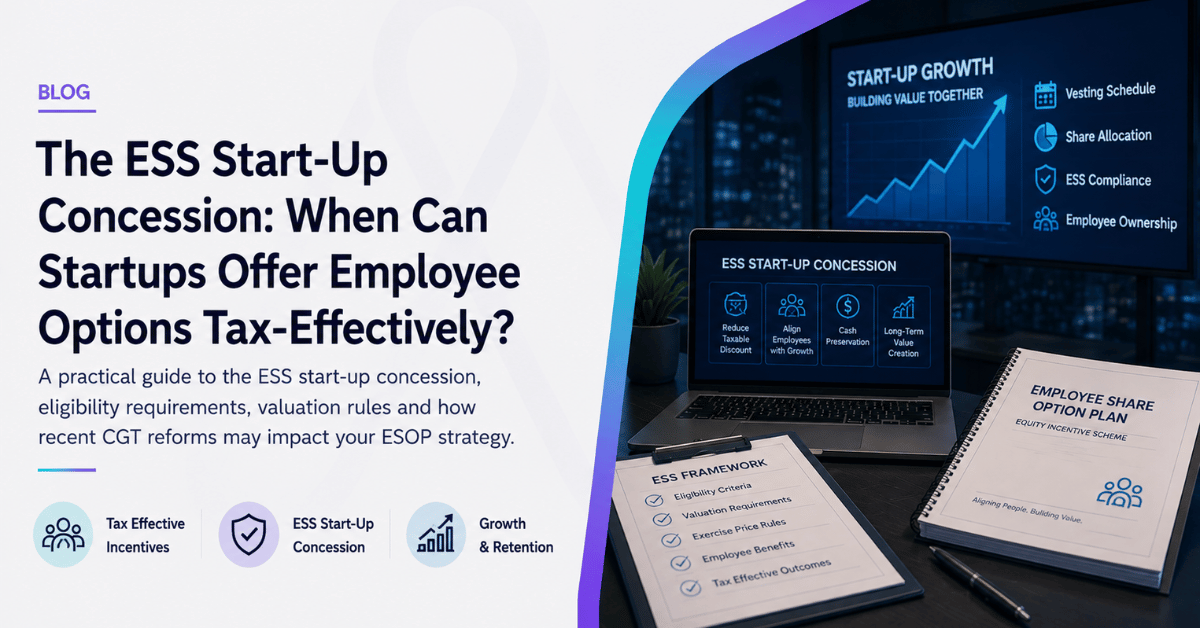
For many early-stage companies, the ESS start-up concession is the first tax pathway to consider when offering employee options or shares. It can be highly valuable because it may reduce the taxable discount for eligible employee share scheme interests, potentially to nil.
However, the concession is often misunderstood. It is not the same as tax deferral. It is a separate concessional regime with its own eligibility criteria.
For companies considering employee equity, this distinction matters. If the start-up concession is available, it may produce a more favourable employee outcome than a standard tax-deferred plan. If it is not available, the company will usually need to compare upfront taxation against tax deferral.
What Is the ESS Start-Up Concession?
The ESS start-up concession is contained in Division 83A of the Income Tax Assessment Act 1997 (Cth). It is designed to help eligible start-up and early-stage companies provide equity incentives to employees in a more tax-effective way.
Where the concession applies, the taxable discount on eligible ESS interests may be reduced. This is different from tax deferral, which generally changes when tax is payable rather than reducing the taxable discount itself.
Why the Distinction Matters
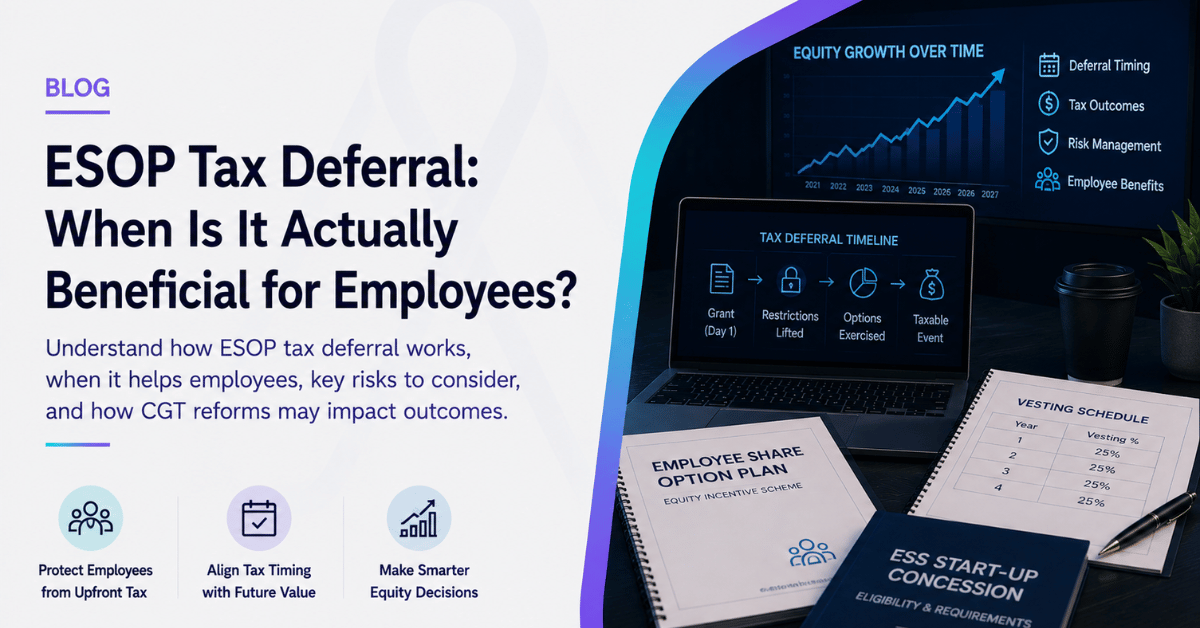
Tax deferral is primarily a timing mechanism. It can defer the employee’s taxing point until a later time, but the employee may still be taxed on a larger value at that later point.
The start-up concession is different because it may reduce the amount taxed under the ESS rules. That is why, where available, it will often be the preferred pathway.
When the Concession Is Most Useful
The ESS start-up concession is generally most useful for genuine early-stage companies that want to issue options with an exercise price at least equal to the market value of ordinary shares at the time of grant.
This can allow employees to participate in future growth while reducing the immediate tax burden that might otherwise arise on grant.
Key Eligibility Issues
Companies should not assume the concession applies merely because they are early-stage or privately held. The rules include a number of eligibility requirements. These include requirements relating to:
- Company age;
- Aggregated turnover;
- Listing status;
- Residency;
- The type of ESS interest being offered;
- Employee shareholding and voting power limits;
- Minimum holding periods;
- Broad availability requirements for some share schemes; and
- Exercise price requirements for options.
For options, a key requirement is that the exercise price must be at least equal to the market value of an ordinary share in the company at the time the option is granted.
Why Valuation Still Matters
Even where the start-up concession may be available, valuation remains important. The company needs a defensible basis for the market value of the ordinary shares at the time of grant, particularly where options are being issued with an exercise price intended to satisfy the start-up concession requirements.
A weak or unsupported valuation can create risk for the company and for employees. It can also undermine employee confidence in the plan.
What if the Company Does Not Qualify?
Many companies will not qualify for the ESS start-up concession. They may be too mature, have aggregated turnover above the relevant threshold, be listed, or otherwise fail one of the statutory conditions.
Where the concession is unavailable, the company generally needs to compare upfront taxation against tax deferral. That comparison is different because it is usually a timing question rather than a substantive concession question.
How the CGT Reforms and Start-Up Carve-Outs Affect the Analysis
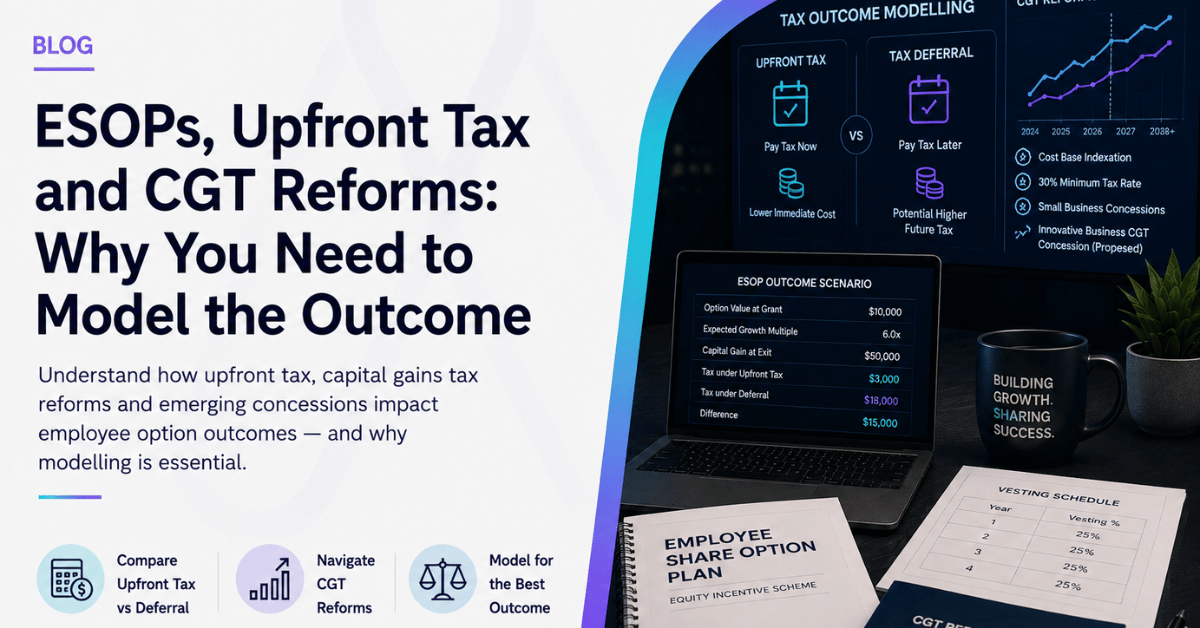
The capital gains tax treatment of later growth may also be relevant. From 1 July 2027, the general CGT reforms replace the 50 per cent CGT discount for individuals, trusts and partnerships with cost base indexation and a minimum 30 per cent tax rate on capital gains. The new arrangements apply to capital gains accruing from 1 July 2027 when realised.
However, the Government has also announced further support for small businesses and start-ups. For small businesses, the existing four small business CGT concessions are retained, and the turnover threshold for the 50 per cent active asset reduction is increasing from $2 million to $10 million from 1 July 2027.
For start-ups, Treasury is consulting on a proposed Innovative Business CGT Concession. The proposal is intended to provide a targeted 50 per cent CGT discount for early-stage investors, including founders and employee share scheme participants of qualifying innovative start-up businesses, subject to eligibility criteria and future legislation.
This means the start-up concession should not be considered in isolation. The employee’s overall outcome may depend not only on the ESS treatment at grant, but also on how later capital gains are treated when the employee ultimately disposes of the shares or options.
Tax reform note: The proposed Innovative Business CGT Concession is not yet settled. It is subject to consultation and future legislation. Until the final rules are enacted, companies should treat this as a planning uncertainty rather than a confirmed outcome for employees.
Allied Legal’s Perspective
From Allied Legal’s perspective, the start-up concession should usually be considered first where a company is eligible. However, eligibility should not be assumed. The company should confirm the statutory criteria, document the valuation basis, and ensure the offer terms align with the tax position.
The concession can be highly effective, but only where the company’s stage, valuation, plan rules and employee offer terms are properly aligned. For companies that may also fall within the proposed innovative start-up carve-out, the position should be revisited once the final CGT rules are settled.
Frequently Asked Questions
1. What Is the ESS Start-Up Concession?
The ESS start-up concession is a tax concession available to eligible early-stage companies under Division 83A of the Income Tax Assessment Act 1997 (Cth). It may reduce the taxable discount on qualifying employee share scheme interests.
2. Is the ESS Start-Up Concession the Same as Tax Deferral?
No. Tax deferral changes when tax is payable, whereas the ESS start-up concession may reduce the taxable discount itself.
3. Who Can Access the ESS Start-Up Concession?
Eligibility depends on several factors, including company age, turnover, residency, listing status, the type of ESS interest offered and employee ownership limits.
4. Why Is Valuation Important for Employee Options?
A defensible valuation helps demonstrate that option exercise prices meet the requirements of the ESS start-up concession and reduces tax-related risks for both the company and employees.
Key Takeaway
The ESS start-up concession is not tax deferral. It is a separate concessional regime that may reduce the taxable discount itself. Where available, it may be the preferred pathway for early-stage companies issuing employee options.
However, recent CGT reforms and proposed start-up carve-outs mean companies should also consider the capital gains treatment of later growth. Where the start-up concession is unavailable, companies need to move to the next question: should employees be taxed upfront or under a tax-deferred scheme?
In the next article in this series, we examine when ESOP tax deferral is actually beneficial.
Related reading: Employee Share Option Plans: A Simple Guide
This article is intended for general information only and does not constitute legal advice. Specific advice should be obtained before acting or relying on any information discussed above.