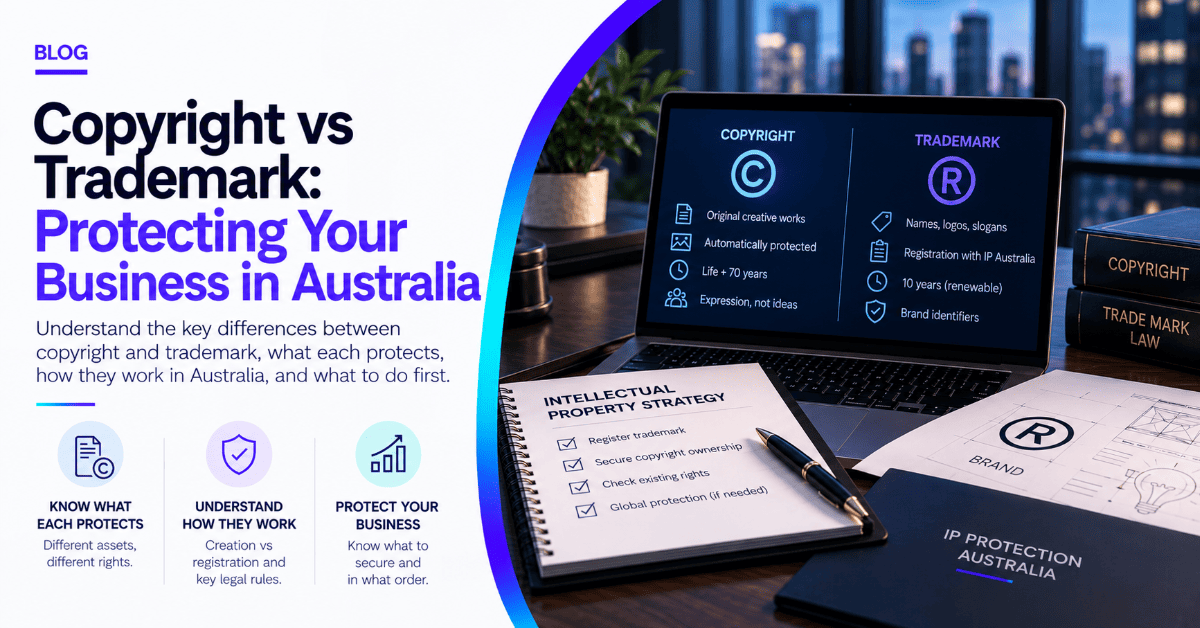
Copyright and trademarks both protect intellectual property, so business owners often mix them up. They protect different things, last for different periods and arise in different ways. Knowing the difference between copyright and trademark helps you protect the right asset and avoid infringing someone else’s. This guide explains how each works under Australian law, where they overlap, and what to do first. The legislation spells it “trade mark”, but we use “trademark” because most people search for it.
What Is Copyright?
Copyright protects original creative work. The Copyright Act 1968 (Cth) governs it in Australia. Protection starts automatically when you create the work in material form, such as writing it down or saving a file. Australia has no copyright registration system, as the Attorney-General’s Department explains.
The Act protects literary works, including books, articles and software. It also protects dramatic works, musical works and artistic works such as paintings, drawings and photographs. A separate group covers sound recordings, films, broadcasts and published editions.
Copyright protects the expression of an idea, not the idea itself. A particular illustration of a cat can attract copyright. The general idea of drawing a cat cannot. Names, titles and short slogans also usually fall outside copyright.
What Rights Does Copyright Give You?
The owner holds exclusive rights over the work. For literary, musical and dramatic works, these include the right to reproduce, publish and perform the work in public. They also include the right to communicate the work to the public and make an adaptation. For artistic works, the rights cover reproducing, publishing and communicating the work.
Someone infringes copyright when they do one of these acts without the owner’s permission. A licence or a legal exception can change that outcome. Exceptions include fair dealing for research or study, criticism or review, parody or satire, and news reporting.
Creators also hold moral rights. These include the right to credit and the right against false attribution. They also include the right to object to derogatory treatment of the work. You cannot assign or license moral rights.
Who Owns Copyright, and How Long Does It Last?
The creator is usually the first owner, but there are exceptions. An employer generally owns works that an employee creates under a contract of service. A person who commissions work does not own it by default. The creator keeps copyright unless both sides sign a written assignment. A narrow exception covers some private photographs and portraits. Commissioned films and sound recordings follow a different default rule, so check your contract. Our guide to intellectual property assignment and licensing explains how to transfer or license these rights.
For most works, copyright lasts for the life of the author plus 70 years. Sound recordings and films generally last 70 years after their first release. Broadcasts last 50 years, and published editions last 25 years. Special rules apply to unpublished works and unknown authors.
What Is a Trademark?
A trademark identifies the source of your goods or services. The Trade Marks Act 1995 (Cth) governs registered trademarks, and IP Australia examines and registers them.
The Act covers any “sign”, including words, names, logos, numerals, shapes, colours, sounds and scents. IP Australia lists the kinds of trade marks you can register. Most businesses register names, slogans and logos. Scent and other unusual marks are rare, because they are hard to describe and hard to show as distinctive.
Unlike copyright, a trademark gets its strongest protection through registration. You can use an unregistered mark. You may also have some protection under passing off or the misleading conduct rules in the Australian Consumer Law. However, those claims are harder to prove. IP Australia notes that registration generally gives stronger protection.
Trademark protection is also territorial. An Australian registration protects your brand in Australia only. To protect it overseas, you can file through the Madrid Protocol, based on your Australian mark. Our guide to trademarking overseas covers this process.
What a Trademark Does Not Protect
IP Australia rejects marks that cannot distinguish your goods or services. Descriptive or praising phrases, such as “best pizza in town”, generally struggle to qualify. Other traders may want to use them. A mark also fails if it closely resembles an earlier mark for similar goods or services.
A trademark protects your brand identifier. It does not protect a description of what you sell. If you are weighing up names, our article on trademarks, business names and company names explains how they differ.
How Long Does a Trademark Last?
A registered trademark lasts 10 years from the filing date, not the registration date. You can renew it for further 10-year periods. You can start the renewal up to 12 months before expiry, and a six-month grace period follows with late fees. IP Australia sets out the renewal steps and fees.
Non-use also puts your registration at risk. Anyone can apply to remove a mark if the owner has not used it in Australia for three continuous years. Use your mark for the goods and services you registered.
Using the ®, ™ and © Symbols
Use ® only for marks you have registered in Australia. IP Australia says only registered trademarks can carry the symbol. A false claim of registration can breach the Trade Marks Act. You can use ™ on an unregistered mark, but it does not create any rights. Copyright needs no symbol in Australia. The © symbol is optional, though it still warns others that you claim ownership.
Copyright vs Trademark: Key Differences
| Copyright | Trademark | |
|---|---|---|
| What it protects | Original creative works | Names, logos, slogans and other brand identifiers |
| How it starts | Automatically on creation | Registration with IP Australia gives the strongest rights |
| Governing law | Copyright Act 1968 | Trade Marks Act 1995 |
| How long it lasts | Usually life plus 70 years | 10 years from filing, renewable |
| Ideas | Protects expression, not ideas | Protects distinctive signs for set goods and services |
| Territory | Many countries recognise it under international treaties | Protection in Australia only, unless you file overseas |
Can One Asset Have Both?
Yes. A logo is the classic example. The artwork can attract copyright as an artistic work, and you can also register the logo as a trademark. Copyright stops others copying the artwork. The trademark stops others using a confusingly similar brand for related goods or services.
Check who owns your logo before you file. If a freelance designer created it, they may still own the copyright. A signed written assignment fixes that.
Which Protection Should You Secure First?
Start with your brand. Search the trademark register, then file for your business name and logo in the classes you trade in. Our guide to registering your brand with IP Australia walks through the process. If IP Australia raises objections, see how to respond to a trade mark examination report.
Next, secure your creative assets. Put written assignments in place with employees, contractors and designers. That way you own your website content, software and marketing material. For a wider overview, read our guide to protecting your intellectual property.
Frequently Asked Questions
1. What is the main difference between copyright and trademark?
Copyright protects original creative works, such as writing, images and software. A trademark protects the brand identifiers that distinguish your goods or services, such as names and logos. Copyright arises automatically, while registration gives a trademark its strongest protection.
2. Do I need to register copyright in Australia?
No. Australia has no copyright registration system. Protection starts automatically when you create an original work in material form.
3. How long does a trademark last in Australia?
A registered trademark lasts 10 years from the filing date. You can renew it for further 10-year periods. Anyone can apply to remove it if you have not used it for three continuous years.
4. Can I use the ® symbol without registering?
No. Use ® only for marks registered in Australia. You can use ™ on an unregistered mark, but it does not create rights.
5. Does my logo have copyright and trademark protection?
It can have both. The artwork can attract copyright, and you can register the logo as a trademark. Check that your designer has assigned copyright to you in writing.
6. Who owns copyright in work I pay someone to create?
The creator usually keeps copyright unless you both sign a written assignment. Employers generally own work that employees create in the course of their employment. Commissioned films and sound recordings follow a different default rule.
7. Can I trademark a slogan?
Yes, if it is distinctive and not simply descriptive. Slogans that praise or describe your product, such as “best pizza in town”, generally struggle to qualify.
Our intellectual property lawyers advise startups and growing businesses on both copyright and trademarks. Our trademark lawyers search the register, handle trademark registration and respond to objections. We also draft IP assignments and licences for creative and entertainment businesses and for technology and software development companies. If someone copies your work or brand, our IP dispute lawyers can step in. Call us on 03 8691 3111 or email hello@alliedlegal.com.au if you are unsure which protection your business needs.
This article is provided for general information only and does not constitute legal advice. You should obtain legal advice specific to your circumstances before acting on any information contained in this article.