Do you run a business website? Are you confident it has the right terms and conditions in place? An online presence matters for almost every business today. That makes proper website terms and conditions just as important. Your T&Cs govern your relationship with every customer and user who visits your site. This guide covers when you need them, what to include, and how to make sure they actually hold up.
Do You Need Website Terms and Conditions?
There is no single law that forces every business to publish a document literally called “terms and conditions.” Even so, treat this as near-essential rather than optional. The Australian Consumer Law constrains what you can say about your customers’ rights. Gaps in your terms leave you exposed to default statutory rules you may not want. If you sell goods or services online, you need clear terms covering your side of that transaction. If you run any other commercial website, you still need terms of use to protect your position.
Terms and Conditions for Online Sales
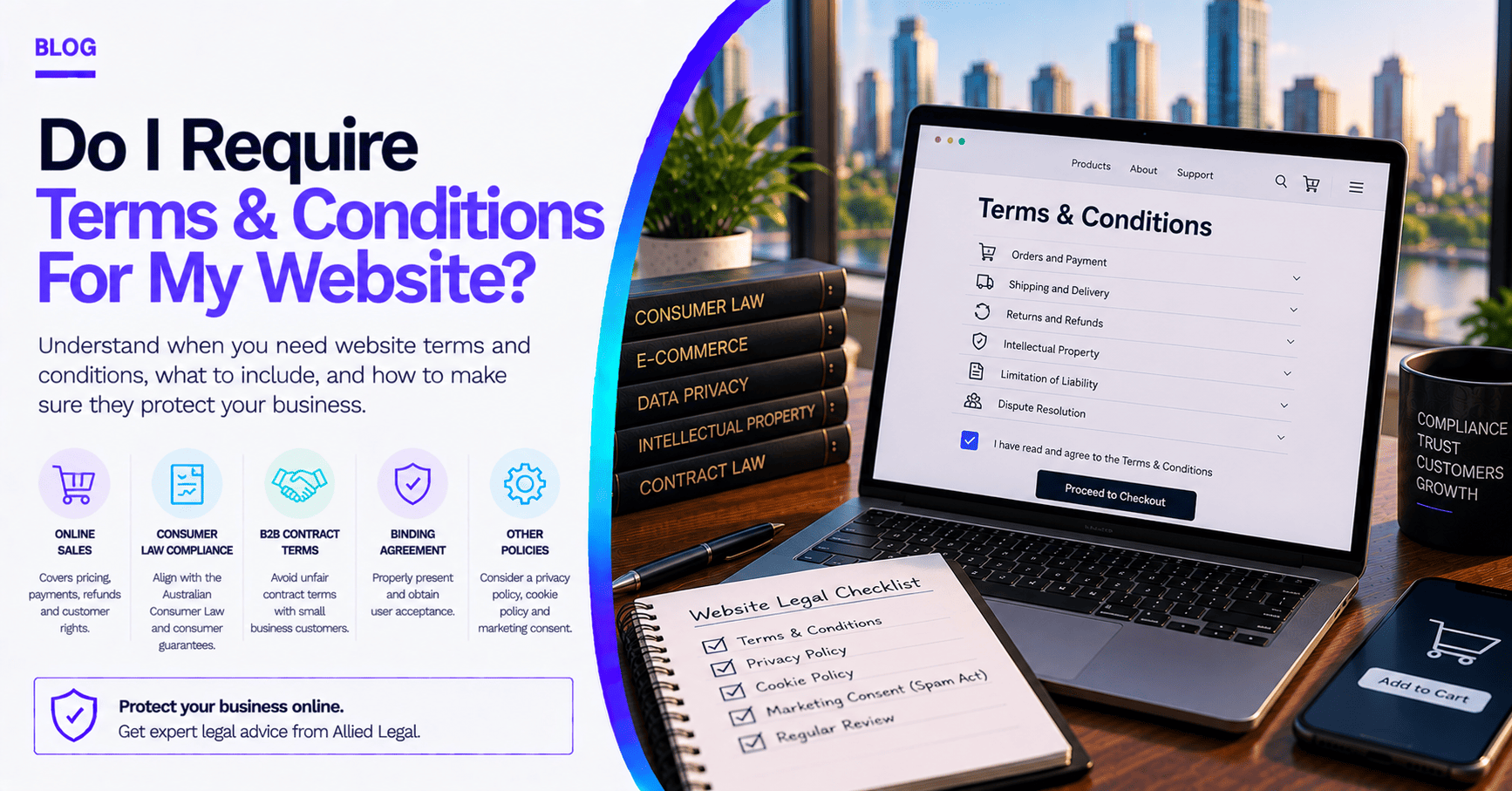
If customers buy goods or services through your website, your e-commerce terms and conditions are effectively your contract with them. They should be simple and clearly drafted, without misleading statements. The right terms depend on your business. This includes whether you deal with other businesses, consumers, or both. At a minimum, address your price, refund policy, and payment terms. You should also cover limitation of liability, quality, dispute resolution, your right to make modifications, and privacy.
One area needs real care. The Australian Consumer Law gives consumers statutory guarantees. Your terms cannot exclude or reduce these. A “no refunds” policy, for example, has no legal effect to the extent it tries to override these guarantees. It can get worse than that. Telling customers they have no such rights can itself be a misleading or false representation under the Australian Consumer Law. The ACCC has previously reviewed online retailer return policies. It found widespread non-compliant language of exactly this kind. Get your refund clause checked against the current consumer guarantee rules, not just copied from another website.
Unfair Terms in Business-to-Business Website Contracts
Some website terms get offered on a take-it-or-leave-it basis to business customers, not just consumers. A separate regime can apply here. Since November 2023, the unfair contract terms regime under the Australian Consumer Law covers standard form contracts with a small business. This applies where that business employs fewer than 100 people, or has turnover under $10 million. There is no longer a contract value cap on this test. Including or relying on an unfair term in a contract like this can now attract a civil penalty. Previously, the term was simply void, with no penalty attached. This matters most for SaaS and other digital products sold to small business customers on standard website terms. Our unfair contract terms service covers how to review your terms against this regime.
Making Your Terms Actually Binding
Having good terms is only half the job. You also need to properly incorporate them into your website. Many sites use a tick box at checkout. The customer confirms they have read, understood, and agree to the terms. This works like a virtual signature. Australian contract law generally requires that terms be properly brought to a customer’s attention. This needs to happen before or at the time a purchase is made, for those terms to actually form part of the contract. A clear, active acceptance step at checkout gives you a much stronger position. This beats simply linking your terms in a website footer. Even if a customer never actually reads your terms, that does not reduce their legal importance. If a transaction is ever challenged, your terms will be central to working out where each party stands.
Terms of Use for Other Websites
Not every website sells something directly. A purely informational or service-marketing website still needs terms of use for its visitors. These are usually more straightforward than e-commerce terms, but they still need to do real work. Make sure your terms of use protect your intellectual property. They should also address the risk of visitors relying on information published on your site, and properly limit your liability.
Other Documents Worth Considering
A website usually needs more than one legal document. Consider a cookie policy alongside your terms. Most businesses use cookies to tailor content and offers to visitors. A privacy policy is separate again. It covers what personal information you collect and how you use it. Our guide on writing a startup’s privacy policy covers what that document should include. Marketing emails or texts need their own consent too. The Spam Act 2003 (Cth) requires this separately, distinct from a customer simply accepting your website terms at checkout.
Keeping Your Terms Up to Date
Website terms are not a set-and-forget document. The law around consumer guarantees and unfair contract terms has changed meaningfully in recent years, and your business model changes too. New products, new markets, or a shift from consumer sales to business customers can all mean your existing terms no longer fit. Review your terms whenever your offering changes significantly, and at minimum every couple of years, so they keep reflecting both your business and the current law.
Frequently Asked Questions
1. Is my business legally required to have website terms and conditions?
Not as a single named document required by law. The Australian Consumer Law still restricts what you can say to customers, and clear terms protect you in ways the default legal position may not. Treat them as essential if you sell goods or services online.
2. Can my terms and conditions include a “no refunds” policy?
No, not fully. Statutory consumer guarantees under the Australian Consumer Law cannot be excluded or reduced. A blanket “no refunds” clause has no legal effect to that extent, and claiming otherwise can itself be a misleading representation.
3. Do unfair contract term rules apply to website terms and conditions?
They can. If your terms are offered on a standard, take-it-or-leave-it basis to a small business customer, such as one with fewer than 100 employees or turnover under $10 million, the unfair contract terms regime can apply. Civil penalties have been available since November 2023.
4. How do I make sure customers are actually bound by my website terms?
Use a clear, active acceptance step, such as a tick box at checkout, rather than only linking your terms in a footer. Courts generally expect terms to be properly brought to a customer’s attention before or at the time of purchase.
5. Do I need separate terms of use if my website does not sell anything?
Yes. Even an informational or marketing website should have terms of use. These protect your intellectual property, limit your liability, and address visitors relying on information published on the site.
6. Do website terms cover email marketing consent too?
No. Accepting your website terms at checkout is not the same as the consent required under the Spam Act 2003 (Cth) for sending marketing emails or texts. Get a separate opt-in for that.
Preparing terms and conditions tailored to your business is not something to rush. Get it wrong, and you risk terms that are out of date. You might also miss key risks, or find they do not hold up when actually tested. Our commercial lawyers regularly draft and review website terms and conditions, terms of use, and the related documents that sit alongside them. If you want the broader case for why every digital business needs these in place, we cover that in our guide on why terms and conditions are crucial for digital startups. Contact us at 03 8691 3111 or email hello@alliedlegal.com.au, and we will help guide you through the process.
This article is provided for general information only and does not constitute legal advice. You should obtain legal advice specific to your circumstances before acting on any information contained in this article.