
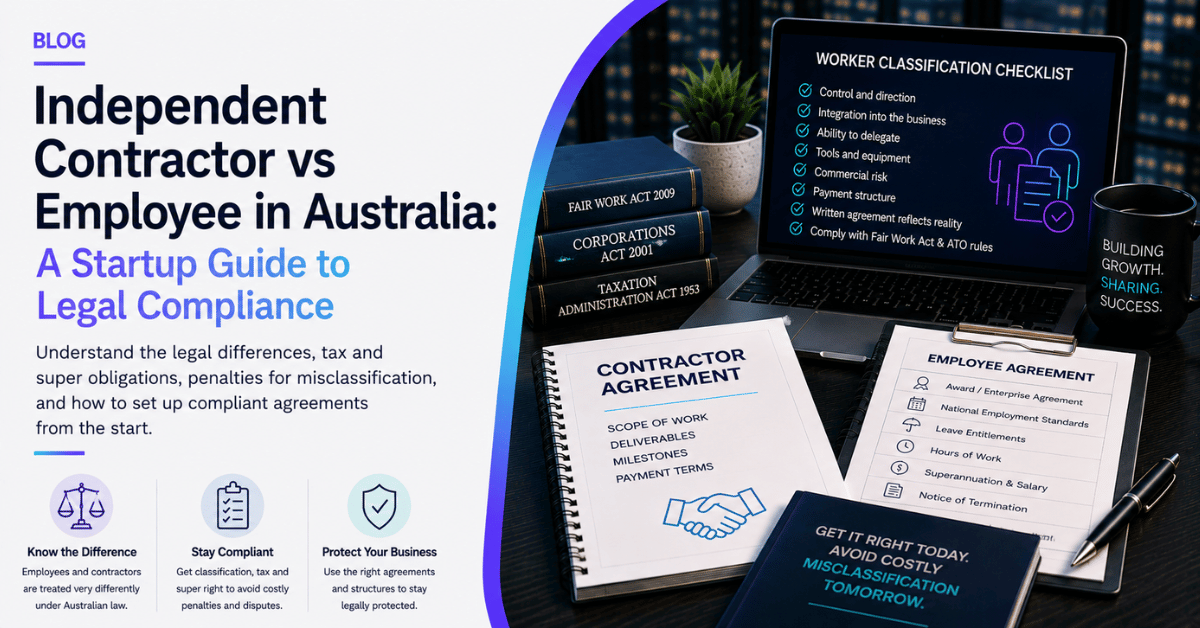
Independent contractors and employees are treated very differently under Australian law, and the difference is not just paperwork. It affects tax, superannuation, insurance, and what happens if the relationship goes wrong.
Many startups get this wrong in the early, fast-moving stages, often without realising it, and the cost of a mistake can run into the hundreds of thousands of dollars.
This guide explains how the independent contractor vs employee test works in Australia, what penalties apply if you misclassify a worker, and how to set up compliant agreements from the start.
Why the Independent Contractor vs Employee Question Matters
Employees are covered by the National Employment Standards, minimum wage laws, paid leave, and unfair dismissal protections. Contractors generally are not. Businesses sometimes engage contractors to reduce these obligations, but Australian regulators actively check whether that classification is genuine.
If a worker is really an employee but is treated as a contractor, this is called sham contracting, and it carries serious financial and legal consequences for the business.
How Australian Law Tests Independent Contractor vs Employee Status
For tax, superannuation and vicarious liability purposes, courts apply the test set out by the High Court in CFMMEU v Personnel Contracting Pty Ltd and ZG Operations v Jamsek in 2022. These decisions confirmed that where a written contract genuinely reflects the relationship, its terms are the primary guide to whether someone is an employee or a contractor.
Factors the courts weigh include:
- Control: does the business direct how, when and where the work is done, or does the worker set their own methods?
- Integration: is the worker part of the business, or running their own business that provides services to it?
- Delegation: can the worker send someone else to do the job, or must they do it personally?
- Tools and equipment: who supplies and pays for them?
- Risk: does the worker bear commercial risk for their own profit and loss?
Since 26 August 2024, a second test applies specifically under the Fair Work Act. Section 15AA of the Act requires the Fair Work Commission to look at the “real substance, practical reality and true nature” of the relationship, not just what the contract says. This whole-of-relationship test sits alongside the High Court’s contract-based test, so a worker’s status can differ depending on which law is being applied. Contractors earning above the indexed high income threshold can choose to opt out of this framework and keep their contractor status.
What Happens If You Get the Classification Wrong
Sham contracting is a breach of the Fair Work Act, and the Fair Work Ombudsman actively investigates it. Current maximum civil penalties are up to $19,800 for an individual, up to $99,000 for a business with fewer than 15 employees, and up to $495,000 for a business with 15 or more employees, per contravention.
Beyond the fine, a misclassified worker can also claim unpaid superannuation, unpaid leave entitlements, and back pay, and the business may face an ATO audit for unpaid PAYG withholding and superannuation guarantee contributions. Our earlier coverage of a recent court ruling on employee vs contractor status shows how quickly a poorly drafted agreement can unravel in court.
Independent Contractor vs Employee: Tax and Super Obligations Compared
The obligations attached to each category are very different.
For employees, the business must withhold PAYG tax from wages, pay superannuation guarantee contributions currently set at 12 percent of ordinary earnings, provide payslips and comply with the relevant Award or enterprise agreement, and cover workers compensation insurance.
For genuine contractors, the business generally does not withhold tax or pay superannuation, unless the contractor is engaged principally for their labour, in which case super guarantee obligations can still apply even without an employment relationship. Contractors are responsible for their own tax, insurance and, once their turnover passes $75,000, GST registration.
Building a Compliant Independent Contractor Agreement
A written agreement should set out the scope of work and deliverables rather than fixed hours, confirm the contractor can subcontract or delegate the work, allow the contractor to work for other clients, require the contractor to hold their own insurance and ABN, and set payment on completion of milestones or invoices rather than a regular salary.
The agreement should reflect how the relationship actually operates day to day. A contract that says “contractor” on the front page will not protect a business if the real working relationship looks like employment.
Employee Agreement Essentials
An employee agreement should reference the applicable Award or enterprise agreement, confirm National Employment Standards entitlements such as leave and notice of termination, set out hours of work and any flexible work arrangements, and specify superannuation, salary and any incentive arrangements.
Common Mistakes Startups Make
- Using a generic contractor template for someone who is functionally an employee
- Letting a contractor’s day-to-day control and integration drift toward employment without updating the agreement
- Assuming a worker’s own ABN settles the question
- Overlooking post-employment restraint clauses that may need to sit alongside the classification
- Forgetting that a worker can be a contractor for tax purposes but assessed as an employee under the Fair Work Act’s whole of relationship test
Frequently Asked Questions
What is the main test for independent contractor vs employee status in Australia?
For tax and superannuation purposes, the High Court’s decisions in Personnel Contracting and Jamsek mean the written contract is the primary guide, provided it genuinely reflects the relationship. Since August 2024, the Fair Work Act also applies a separate “whole of relationship” test for workplace relations matters.
Can a worker be a contractor for tax purposes but an employee under the Fair Work Act?
Yes. The two tests can produce different outcomes for the same worker, because they apply to different areas of law. This is one reason it is worth getting legal advice on classification rather than relying on a template.
What are the penalties for sham contracting in Australia?
Maximum civil penalties currently reach $19,800 for an individual, $99,000 for a small business, and $495,000 for a larger business, per contravention, plus any unpaid entitlements, superannuation and back pay owed to the worker.
Do I need to pay superannuation to independent contractors?
Generally no, unless the contractor is engaged mainly for their labour rather than to produce a result, in which case super guarantee obligations can still apply.
Do independent contractors need to register for GST?
Yes, once their annual turnover reaches $75,000, contractors must register for GST, the same threshold that applies to other businesses.
Getting the classification right from the outset, and reviewing it as the relationship evolves, is far cheaper than fixing a sham contracting claim later.
Allied Legal Employment Law team can review your contractor and employee agreements before you send them out. For broader support as you scale your team, see our Startup Advisory services.
This article is for general information only and isn’t legal advice. Please seek specific advice before acting on anything discussed here.