
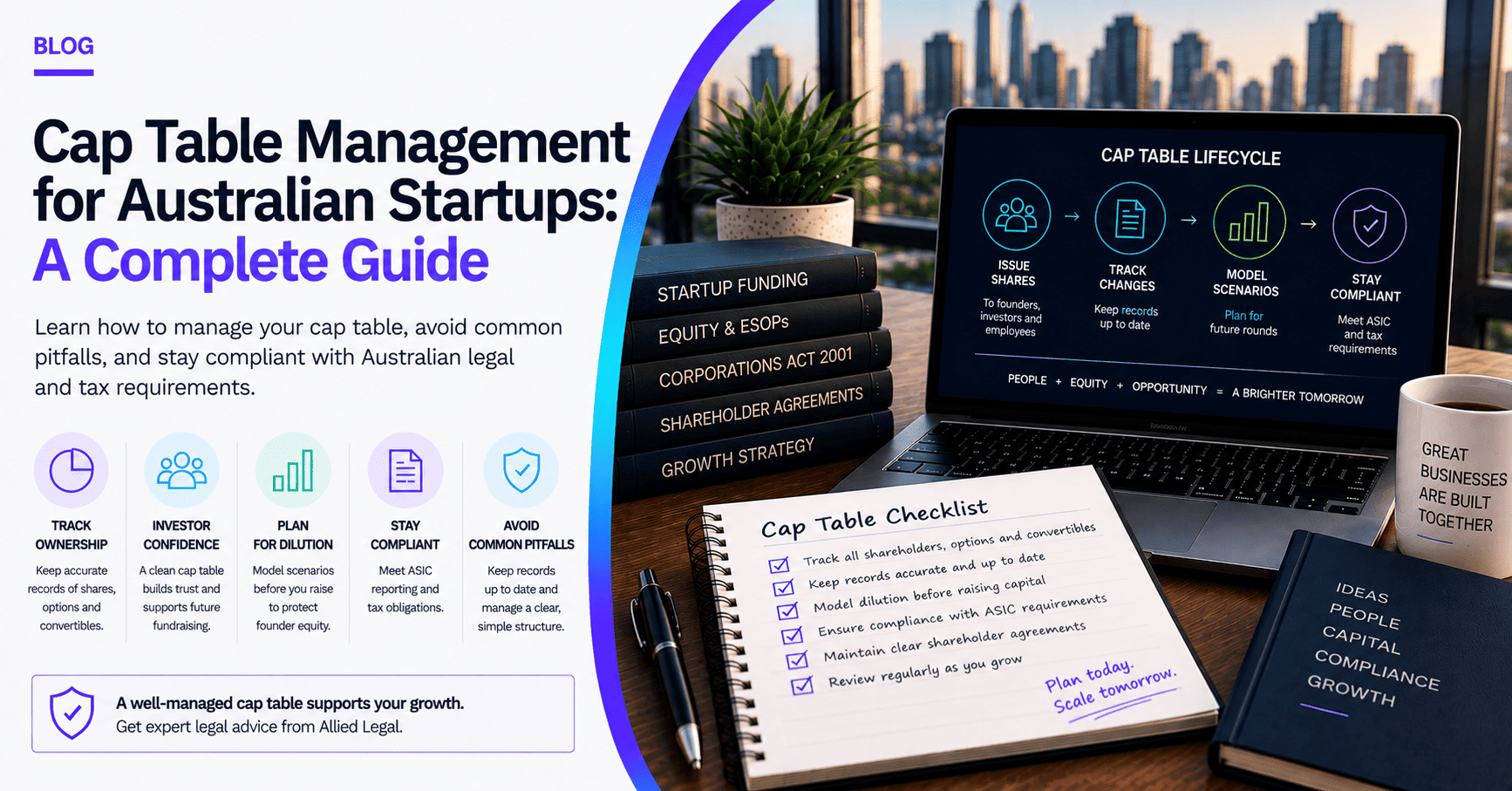
For Australian startups, cap table management is not just administrative housekeeping. A capitalisation table, or cap table, tracks who owns what in your company. A poorly managed one can derail a funding round or dilute founders unfairly. This guide covers how to manage a cap table properly, what investors expect to see, and the legal issues specific to Australia.
Why Cap Table Management Matters
A cap table records equity ownership, options, and convertible securities like SAFE notes. Getting this right builds investor confidence, since clean records signal a well-run company. It also makes future funding rounds and exits far easier to execute. It helps you meet ASIC reporting requirements and tax obligations as your company grows.
Best Practices for Cap Table Management
Start with a simple structure. Move to dedicated cap table software once you have multiple investors, option holders, or SAFE notes to track. Record every transaction as it happens, rather than reconstructing history later.
Model dilution scenarios before you raise. Understanding how a new funding round or a large option pool affects existing shareholders helps you negotiate from an informed position. It also stops the numbers surprising you after the fact.
Keep your cap table transparent with stakeholders. Investors and employees value knowing exactly where they stand. Document equity allocations clearly and communicate changes as they occur.
What Australian Investors Expect
Local investors look closely at your cap table to assess risk. They generally want a clean structure with a manageable number of shareholders. They also want sensible dilution protections, such as pre-emptive rights, and a clear path to an eventual exit. A well-sized option pool, generally in the 10 to 15% range, signals that you are incentivising talent seriously rather than as an afterthought.
Common Pitfalls in Cap Table Management
Overcomplication is a common trap. Too many small investors, including crowdfunding backers, can complicate every future negotiation and decision.
Poor record-keeping causes real problems too. Manual errors and inconsistent records surface during due diligence. This can delay or derail a funding round entirely.
Ignoring dilution is perhaps the most damaging pitfall. A founder can start with 70% ownership and end up with only 20% after several funding rounds. This means losing meaningful strategic control in the process. Modelling dilution early helps you plan for this rather than be caught out by it.
Using an ESOP Effectively
An Employee Share Option Plan (ESOP) aligns employee incentives with the company’s long-term success. Good practice generally means setting aside around 10 to 15% of total equity. Use a vesting schedule of around four years with a one year cliff, and confirm your plan meets the ATO’s requirements. Canva’s own public commentary on its employee share scheme highlights how a well-structured plan can support long-term talent retention as a company scales.
Legal Considerations Specific to Australia
ASIC compliance matters throughout the life of your cap table. You need to report changes in shareholder structure promptly. Any new share issue must comply with ASIC’s regulatory requirements. Private companies must also keep non-employee shareholders capped at 50.
Tax treatment adds another layer. Employee shares issued under an eligible scheme can access tax-deferred treatment under Division 83A of the Income Tax Assessment Act 1997 (Cth), covered in more detail in our ESS Start-Up Concession guide. This concession requires the company to be unlisted and to meet other eligibility conditions. Share sales generally trigger capital gains tax, so structuring an exit properly matters for what founders and investors actually keep.
A well-drafted shareholder agreement prevents many disputes before they start. It should cover voting rights, drag-along and tag-along rights, and exit provisions. Vague or incomplete agreements are a common source of costly, drawn-out disputes later. It is worth getting this right from the outset, rather than relying on a generic template.
Spreadsheets vs Dedicated Cap Table Software
A spreadsheet feels simple and cheap early on, but it becomes risky as your company scales. Manual tracking makes ownership calculations increasingly error-prone. New investors join, options get exercised, and new rounds close, and small mistakes compound quickly. Spreadsheets also lack proper version control. A deleted row or an overwritten entry can quietly erase historical records, with no audit trail to recover them. Inconsistent or outdated numbers can also undermine investor trust. This is most damaging during a raise or exit, exactly when trust matters most.
Dedicated cap table software addresses these gaps. It offers real-time updates, scenario modelling, and stronger compliance and security features than a spreadsheet can provide. The switch is worth making before your cap table gets complicated, not after.
Frequently Asked Questions
1. What is a cap table and why does it matter for Australian startups?
A cap table is a record of who owns equity in your company. This includes shares, options, and convertible securities like SAFE notes. Investors rely on it to assess risk, and errors in it can delay or derail a funding round.
2. When should a startup move from a spreadsheet to dedicated cap table software?
Generally once you have multiple investors, an active option pool, or any convertible instruments like SAFE notes to track. Spreadsheets become error-prone and hard to audit well before most founders expect.
3. How much equity should a startup set aside for an ESOP?
Australian startups typically reserve around 10 to 15% of total equity for an employee share option plan. Vesting over roughly four years, with a one year cliff, is the common structure.
4. Can a private Australian company have unlimited shareholders?
No. A private company must cap its non-employee shareholders at 50. Exceeding this generally requires converting to a public company structure.
5. Are employee shares taxed differently for startups in Australia?
Yes, in some cases. Eligible unlisted companies can offer employee shares under the ESS start-up concession in Division 83A of the Income Tax Assessment Act 1997 (Cth). This can defer or reduce tax for employees, subject to strict eligibility conditions.
6. What should a shareholder agreement cover to avoid cap table disputes?
At minimum, voting rights, drag-along and tag-along rights, and exit provisions. A clear, specific agreement reduces the risk of disputes when a funding round, sale, or exit eventually happens.
Managing your cap table properly protects your ownership and supports future fundraising. It also keeps you compliant with Australian law. At Allied Legal, our startup advisory and fundraising teams help founders across Australia’s startup ecosystem structure their cap tables and prepare for funding rounds. Contact us if you would like guidance on your own cap table.
This article is provided for general information only and does not constitute legal advice. You should obtain legal advice specific to your circumstances before acting on any information contained in this article.