In Australia’s booming startup ecosystem, innovative funding tools are essential for early-stage ventures. One such instrument gaining traction is the SAFE Note (Simple Agreement for Future Equity). But what is a SAFE Note, and why should Aussie founders and investors care? This guide breaks down SAFE Notes in the Australian context, exploring their benefits, risks, and legal nuances.
What is a SAFE Note?
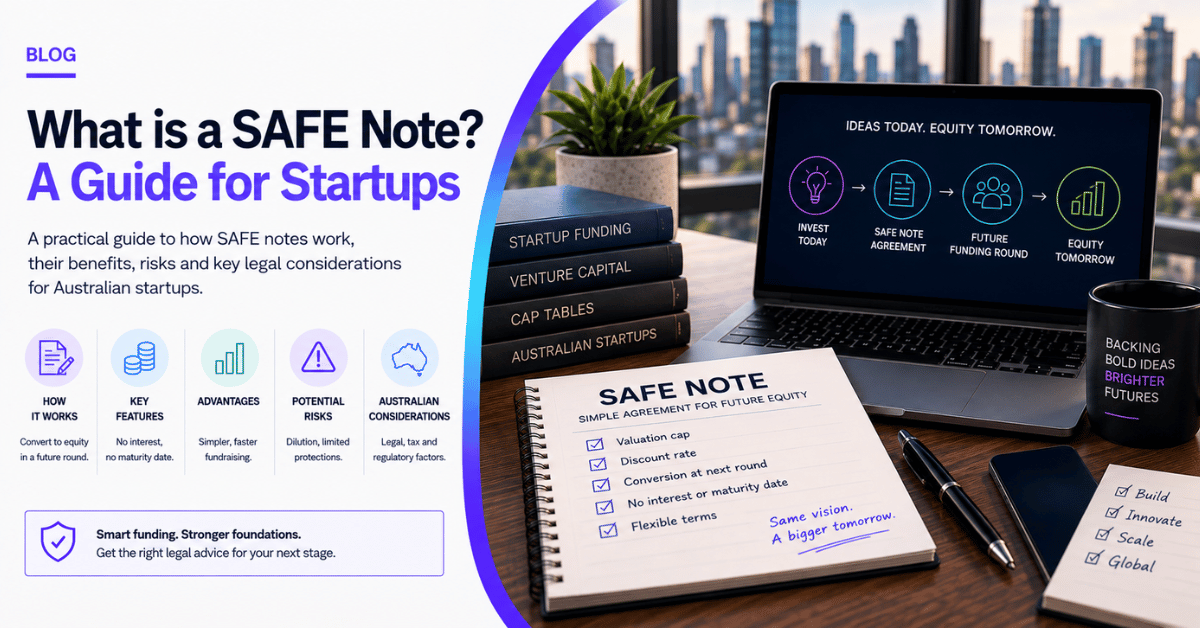
A SAFE Note is a financial agreement between a startup and an investor, allowing the investor to convert their cash investment into equity during a future funding round. Created by Silicon Valley’s Y Combinator in 2013, SAFE Notes simplify early-stage fundraising by deferring valuation discussions until the startup is more mature. Unlike traditional loans or convertible notes, SAFEs don’t accrue interest or have maturity dates, making them founder-friendly.
How Does a SAFE Note Work?
When an investor purchases a SAFE Note, they are essentially betting on the future success of the startup. The key terms of a SAFE Note typically include:
- Valuation Cap: Sets the maximum valuation at which the SAFE Note converts into equity, protecting early investors from excessive dilution in future rounds.
- Discount Rate: Gives investors the right to convert their SAFE at a lower price per share than new investors in a future round.
- Trigger Events: Conversion happens during the startup’s next priced equity round, exit, or IPO, ensuring investors benefit from future growth.
- No Interest or Maturity Date: Unlike convertible notes, SAFE Notes do not have an expiration date or accrue interest, reducing pressure on startups to repay investors.
- Flexibility in Terms: SAFE Notes can be customised with different investor-friendly terms, such as pro-rata rights, giving early investors the option to participate in future funding rounds.
Key Features of SAFE Notes
- No Debt Component: Unlike convertible notes, Simple Agreement for Future Equity aren’t debt, so there’s no repayment obligation or interest.
- Flexible Terms: Negotiable terms like valuation caps and discounts align investor-founder incentives.
- Speed and Simplicity: Fewer legal complexities mean quicker, cheaper execution – ideal for fast-moving startups.
Advantages of SAFE Notes for Startups
- Avoid Early Valuation Battles: Startups can delay valuation debates until they have traction.
- Cost-Effective Fundraising: Minimal legal fees compared to equity rounds.
- Investor Alignment: Attracts backers willing to bet on long-term growth.
Potential Drawbacks
- Dilution Risks: Founders might give away more equity than anticipated if valuations stagnate.
- Limited Investor Protections: SAFEs lack governance rights, which could deter sophisticated investors.
- Regulatory Grey Areas: In Australia, SAFEs aren’t formally regulated, requiring careful legal drafting.
The Australian Context: SAFE Notes Down Under
Australia’s startup scene – home to unicorns like Canva and Atlassian – has embraced SAFE Notes for their flexibility. However, local considerations include:
- Legal Framework: SAFEs are not standalone securities under Australian law. They’re structured as contractual agreements, necessitating expert legal advice to comply with the Corporations Act 2001 and ASIC regulations.
- Tax Implications: Investors may face capital gains tax upon conversion, while startups should consider implications for their cap table.
Market Trends: Australian accelerators (e.g., Startmate) and angel networks increasingly use SAFEs for pre-seed rounds.
A Lawyer’s Tips on SAFE Notes – What Founders Often Overlook
- Customise Your SAFE – SAFEs aren’t standard contracts. Negotiate terms like valuation caps and discounts carefully to avoid over-dilution.
- Watch for Tax Traps – SAFE conversions can create capital gains tax (CGT) liabilities for investors and potential tax issues for founders. Seek expert advice.
- Manage Your Cap Table Wisely – Multiple SAFEs with different terms can complicate equity distribution. Use tracking tools to avoid a messy cap table.
- Avoid “Zombie SAFEs” – Include a sunset clause (e.g., 5–7 years) to prevent SAFEs from lingering indefinitely if no trigger event occurs.
- Prioritise Investor Communication – Regular updates prevent misunderstandings and help maintain strong investor relationships.
- Prepare for Future Funding – VCs may require SAFE conversions before a Series A. Keep all SAFE agreements well-documented for due diligence.
- Formalise Side Agreements – Verbal promises, like advisory roles or board seats, should be in writing to avoid legal disputes.
When Should Startups Use a Simple Agreement for Future Equity?
A Simple Agreement for Future Equity is particularly useful for early-stage startups that need funding but aren’t ready for a priced equity round. They work well when raising capital from angel investors, accelerators, or venture capital firms that are familiar with the instrument.
Startups should consider using SAFE Notes when:
- They want a quick and straightforward fundraising process.
- They anticipate a priced equity round in the near future.
- They want to defer valuation discussions to a later stage.
- They need to attract global investors.
Frequently Asked Questions
1. Is a SAFE Note legally binding in Australia?
Yes. A SAFE Note is a binding contract once both parties sign it. Because it usually grants the investor a future right to shares, it is also likely to be treated as a security under the Corporations Act 2001 (Cth), so the offer needs to be structured under a valid fundraising exemption rather than treated as a simple handshake agreement.
2. Is a SAFE Note the same as a convertible note?
No. Both convert cash into equity at a later date, but a convertible note is technically a debt instrument that accrues interest and has a maturity date, giving the investor a right to repayment if conversion never happens. A SAFE Note carries no interest and no maturity date, so there is no repayment obligation if a triggering event never occurs. See our comparison of SAFEs and convertible notes for a full breakdown.
3. Do SAFE Notes need to be registered with ASIC?
There is no separate SAFE Note register. Instead, the underlying share issue needs to rely on a valid disclosure exemption, most often the small-scale offering exemption or the sophisticated investor exemption, and startups should keep records showing the exemption applied properly.
4. What happens if a startup never raises another funding round?
Most SAFE Notes include a sunset or expiry mechanism, often five to seven years, so the agreement does not remain open indefinitely. Founders and investors should agree upfront on what happens if no priced round, exit, or IPO occurs before that date, whether that means conversion at a fixed valuation, repayment, or expiry.
5. Can a startup issue more than one SAFE Note?
Yes, and it is common for early-stage startups to issue several SAFE Notes to different investors over time. The risk is dilution complexity: each SAFE may carry a different valuation cap or discount, so founders should model the combined conversion impact on the cap table before issuing new SAFEs.
Final Thoughts
SAFE Notes are becoming an increasingly popular funding tool for Australian startups due to their simplicity and flexibility. However, they are not a one-size-fits-all solution. Before issuing or investing in a SAFE Note, both founders and investors should seek professional legal and financial advice to understand the potential risks and implications.
For investors, SAFE Notes present a high-risk, high-reward opportunity to back promising ventures early. As Australia’s innovation economy grows, SAFE Notes could become a staple in the funding toolkit – bridging ideas and growth, one agreement at a time.
At Allied Legal, we specialise in helping startups with early-stage funding, including simple agreements for future equity, convertible notes, and equity rounds. If you’re considering raising capital, get in touch with our team to ensure your agreements are structured for success.
Ready to explore capital raising? Partner with legal advisors to ensure your startup or investment is future-proof.
Related Reading
- Pro Rata Rights in Australian Equity Offerings
- ASIC Fundraising Requirements
- Raising Money from Friends and Family
- Comparing SAFEs and Convertible Notes
Useful Resources
This article is provided for general information only and does not constitute legal advice. You should obtain legal advice specific to your circumstances before acting on any information contained in this article.