
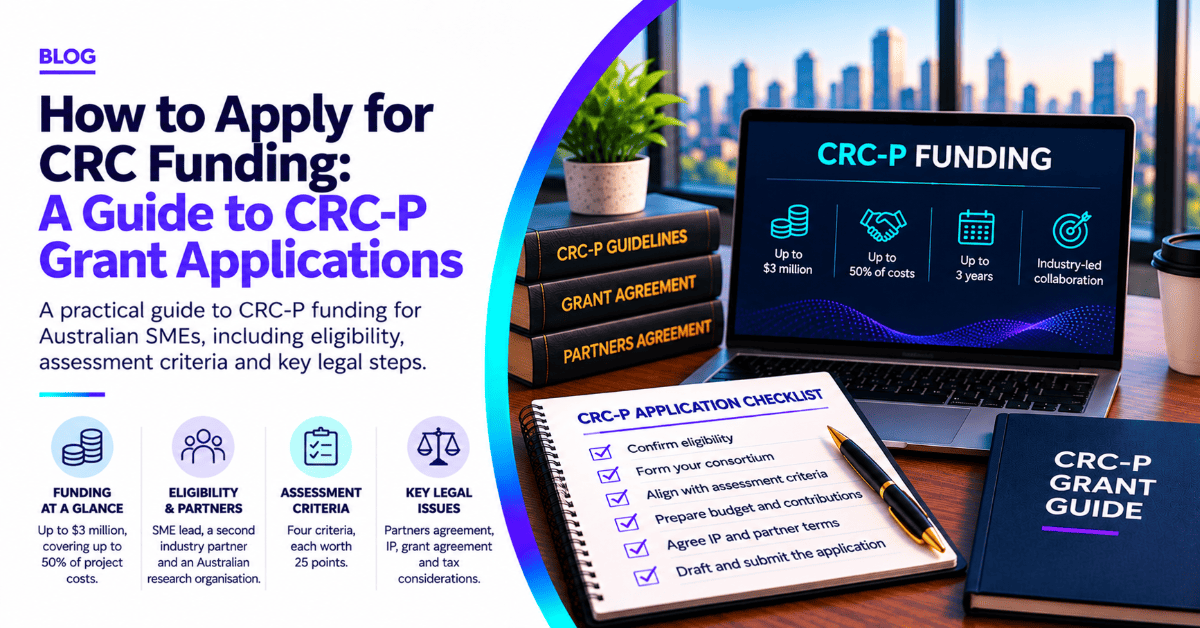
CRC funding in Australia can turn an SME’s research idea into a commercial product. The Cooperative Research Centres Projects (CRC-P) program backs industry-led collaborations with grants of up to $3 million. Competition is strong, and the rules are complex. This guide explains how to apply for CRC funding, how assessors score applications, and the legal issues to settle before you submit.
What Is CRC Funding in Australia?
A CRC-P grant supports short, industry-led research projects. Under the Round 19 guidelines, grants range from $100,000 to $3 million and cover up to 50% of total eligible project expenditure. Projects can run for up to three years and must have at least $200,000 in total eligible value. Only exceptional-merit projects are likely to receive the maximum.
CRC-P is different from the larger Cooperative Research Centres program. The CRC-P targets smaller, shorter projects. Check the official CRC-P grant page for the current status.
Round 19 closed on 12 May 2026. The department has not announced a Round 20, and the Minister decides whether to open future rounds. Rounds have run twice a year recently, so prepare now and register on GrantConnect for alerts.
Who Can Apply for CRC Funding?
The lead applicant must operate as a trading corporation incorporated in Australia, hold an ABN and register for GST. It must also qualify as an SME, which the guidelines define as having fewer than 200 employees. Individuals, sole traders, partnerships, research organisations and government bodies cannot lead an application.
You also need a team. At application, you need the SME lead, a second Australian industry entity of any size, and one Australian research organisation. That organisation is usually a university or medical research institute. All partners must contribute cash, in-kind support or both. According to the program FAQ, international partners can take part if the partners still meet the Australian requirements.
How to Apply for CRC Funding: Step by Step
- Read the grant opportunity guidelines, the sample application form and the sample grant agreement.
- Register on GrantConnect and call the Business Grants Hub on 13 28 46 with questions.
- Build your consortium and agree each partner’s role, contribution and IP position.
- Draft the application in the online portal. The lead SME completes it.
- Prepare your budget using the official CRC Project Application Financial Workbook.
- Submit before the closing date.
Do not start spending until you receive a notification. The guidelines make costs incurred before notification ineligible.
How Assessors Score CRC-P Applications
The Round 19 guidelines use four criteria. Each carries 25 points, so the weighting is equal:
- Project alignment with program objectives. This covers the industry problem and government alignment, research partnerships and SME participation.
- The quality of your project. This covers research and methodology, adopting new technology, and education and training.
- Capacity, capability and resources. This covers management, governance, risk and access to resources.
- Impact of the grant funding. This covers the need for funding, leveraged investment, regional impact and commercial potential.
The largest sub-scores are 10 points each for the industry problem and government alignment, research and methodology, and access to resources. The Cooperative Research Centres Advisory Committee assesses and ranks applications on merit. The Minister makes the final decision. Round 19 priorities included artificial intelligence, the National Reconstruction Fund priority areas and the National Science and Research Priorities.
Budget and Eligible Costs
Cash, cash-staff and in-kind contributions count equally towards the matching share. In-kind support must be realistic and justified. Eligible costs include:
- Salaries, capped at the equivalent of $200,000 a year for a full-time employee.
- A flat 30% on-cost and overhead allowance on eligible salary.
- IP acquisition, licensing and registration.
- Education, training and internships.
- Capital items directly related to the project.
Total travel, both domestic and overseas, generally cannot exceed 10% of eligible project expenditure. Application preparation costs, insurance, financing costs, lobbyist fees and routine operating expenses are ineligible. Check the appendices in the guidelines for the full list.
Legal Issues to Settle Before You Apply
CRC-P is a collaboration, so legal groundwork matters.
Partners agreement. You must sign a partners agreement within 60 days of the grant agreement. It must set out how the partners will manage IP ownership. The department offers an optional partners agreement template. Agree IP, confidentiality and commercialisation terms early, because disputes surface late.
Grant agreement. Under the sample grant agreement, the grantee owns the activity and reporting material. The Commonwealth receives a licence over reporting material only. Payments come quarterly, subject to satisfactory progress, and the Commonwealth holds back 5% until the final payment. It can recover funds for a breach.
Tax. The ATO says most grants are assessable income. GST depends on the terms, and the guidelines say the Commonwealth adds GST to the grant payment. If you also claim the R&D Tax Incentive, the ATO’s clawback rules can apply to grant-funded R&D expenditure. Get tax advice before you finalise your budget.
Our guides to securing grants and university partnerships cover related issues.
Tips to Strengthen Your CRC-P Application
- Use plain language and answer each criterion directly.
- Back your claims with data and evidence.
- Give each partner a clear role with defined deliverables.
- Show your commercial pathway, because commercial potential carries the most points within the impact criterion.
- Include real education and training components, such as internships and placements.
- Balance cash and in-kind support, and show how the grant leverages other investment.
- Start early. Round 19 stayed open for about eight weeks, and research organisations often set earlier internal deadlines.
Frequently Asked Questions
1. Is the CRC-P grant open now?
Round 19 closed on 12 May 2026. The Minister decides when future rounds open, so check the business.gov.au page and GrantConnect for updates.
2. How much CRC funding can I get?
CRC-P grants range from $100,000 to $3 million, up to 50% of eligible project expenditure. Only exceptional-merit projects are likely to receive the maximum.
3. Who can apply for a CRC-P grant?
The lead applicant must operate as a trading corporation incorporated in Australia, hold an ABN, register for GST and employ fewer than 200 people. It needs a second Australian industry partner and an Australian research organisation.
4. Do I need a university partner?
You need an Australian research organisation. Universities qualify, as do certain government research bodies and medical research institutes.
5. Can I claim the R&D Tax Incentive on grant-funded work?
Possibly, but the ATO’s clawback rules can apply to expenditure that a grant funded. Speak to a tax adviser before you plan your claim.
6. Can I start spending before I get the grant?
No. Costs you incur before the notification are ineligible. The Commonwealth is also not liable for spending before you sign the grant agreement.
How Allied Legal Can Help
Allied Legal advises startups and SMEs on grants, including collaboration structures, partners agreements, IP ownership and grant agreement terms. Speak to our team before you lock in your consortium, or contact us on 03 8691 3111 / hello@alliedlegal.com.au.
This article is provided for general information only and does not constitute legal advice. You should obtain legal advice specific to your circumstances before acting on any information contained in this article.