
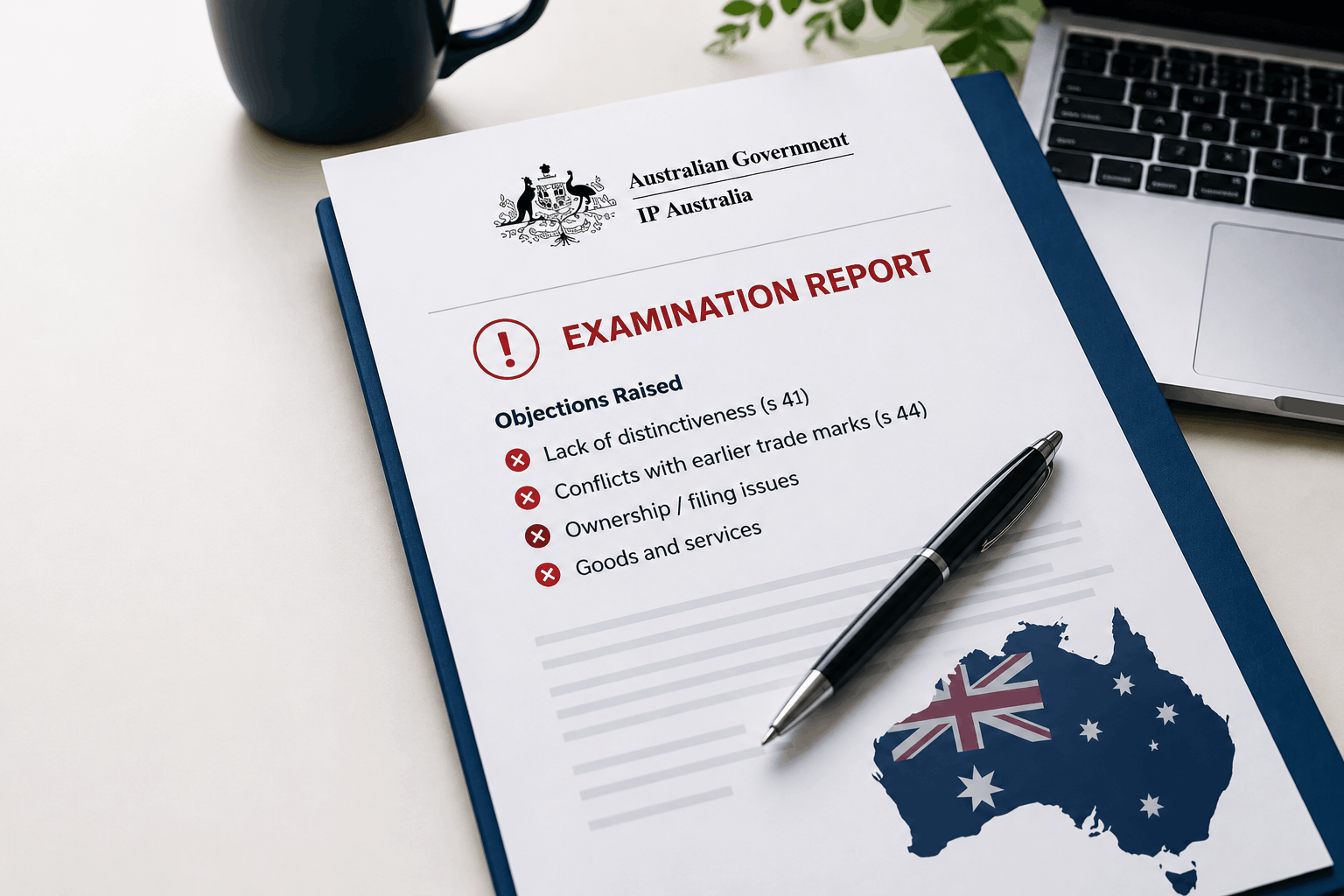
Receiving a trade mark examination report from IP Australia can feel like a major setback, especially after investing time and money into building your brand. But in reality, an adverse report is often just part of the trade mark registration process. The key is understanding how to respond to a trade mark examination report properly and identifying whether the objections can be overcome through legal submissions, amendments, evidence of use, or a more strategic repositioning of the application.
At Allied Legal, we regularly act for startups, founders, ecommerce brands, and scaling companies dealing with examination reports across a broad range of industries. One of the biggest misconceptions we see is applicants assuming an adverse report means the trade mark is dead on arrival. In many cases, that is far from the truth. A well-structured response can often place the application back on track toward registration.
Over time, we have seen recurring themes in the types of objections raised by IP Australia, from descriptiveness and deceptive similarity issues through to ownership concerns and classification problems. Below are some of the key things we have learned about responding to examination reports and the practical steps applicants should consider before reacting too quickly.
What Is a Trade Mark Examination Report?
After a trade mark application is filed, IP Australia will examine it to determine whether it complies with the requirements of the Trade Marks Act 1995 (Cth) (Trade Marks Act).
If the examiner identifies issues, they issue an examination report setting out the objections and what needs to be addressed before the trade mark can proceed to registration.
In practice, examination reports commonly relate to issues such as:
- lack of distinctiveness
- similarity with existing trade marks
- problems with ownership or entitlement
- issues with the classification of goods and services
Applicants generally have 15 months from the date of the first adverse examination report to address and resolve all objections. If the issues are not overcome within this timeframe, the application will lapse.
Common Grounds for Objection
Lack of Distinctiveness
One of the most common objections comes under section 41 of the Trade Marks Act 1995 (Cth), where IP Australia considers the trade mark not sufficiently distinctive.
In simple terms, the examiner is asking: does this actually identify your brand, or is it something other traders should be free to use?
This usually arises where the mark:
- directly describes the goods or services
- uses common industry language
- is too generic or widely used in the market
If that’s the case, the concern is that the trade mark doesn’t clearly distinguish your business from others operating in the same space.
Conflicts with Earlier Trade Marks
Section 44 objections are raised where the applied-for mark is considered substantially identical with, or deceptively similar to, an earlier registered or pending trade mark covering similar goods or services.
In assessing this, IP Australia looks at three core factors:
- how the marks look and sound
- the meaning they convey
- how closely the goods or services overlap
It’s not a side-by-side comparison in isolation. It’s about overall impression and whether consumers could reasonably be confused about the source of the brand.
Ownership and Filing Issues
Some examination reports are less about branding and more about process.
These typically relate to:
- incorrect ownership details
- questions around entitlement to apply
- administrative or filing defects
While these issues are often straightforward to fix, they still need to be addressed properly to keep the application moving forward.
Reviewing the Examination Report Carefully
The first step in responding effectively is not rushing into arguments or amendments, but properly understanding what the report is actually saying.
That means breaking it down and identifying:
- the legal basis for each objection
- whether the issue is substantive (about the mark itself) or procedural (a technical issue)
- what evidence or material would realistically address the examiner’s concerns
- and the key deadlines that apply
From a lawyer’s perspective, this stage is often where the outcome is effectively shaped. A strong response is rarely about volume or complexity, it’s about precision: isolating what the examiner is actually concerned about and responding only to what is legally required, rather than over-addressing or unintentionally narrowing the scope of your own application.
Once you understand those moving parts, you’re in a position to respond strategically rather than reactively.
IP Australia also encourages applicants to contact the examining officer directly if anything in the report is unclear. Their contact details are usually included in the examination report, and in many cases a short discussion can help clarify the scope of the objection before a formal response is prepared.
Options for Responding to an Examination Report
The appropriate response strategy depends on the nature of the objections raised by IP Australia and how strong your trade mark application is in its current form. This is where the real detail of How to Respond to a Trade Mark Examination Report comes into play, because each objection requires a tailored approach rather than a one-size-fits-all reply.
1. Amend the Application
In some cases, objections can be overcome through amendments to the application.
IP Australia permits certain amendments, including:
- Narrowing the specification of goods or services;
- Correcting ownership details; or
- Removing problematic claims.
However, applicants cannot broaden the original scope of the application after filing. For example, an applicant who originally claimed “shoes” cannot later add “hats” merely because they fall within the same class.
Amending specifications is often an effective strategy where a section 44 objection only affects a subset of the nominated goods or services.
2. File Legal Submissions
Where the examiner’s conclusions are contestable, applicants may lodge written submissions explaining why the objections should be withdrawn.
This may involve:
- Distinguishing the cited marks;
- Arguing that the goods or services are not closely related;
- Demonstrating that the mark is inherently distinctive; or
- Addressing legal principles relevant to the examiner’s reasoning.
Effective submissions are usually:
- Clearly structured and presented in a persuasive manner;
- Supported by relevant authority where appropriate; and
- Addressed directly to the legislative provisions identified in the report.
3. Provide Evidence of Use
Evidence of use can be particularly important where objections relate to distinctiveness or conflicting trade marks.
IP Australia allows applicants to provide evidence demonstrating how the trade mark has been used and promoted in Australia.
Persuasive evidence of use should demonstrate continuous use of the trade mark before the earlier mark’s priority date and up to the present, supported by materials such as social media activity, website archives, invoices, marketing and packaging materials, third-party publications, marketing expenditure and revenue evidence.
For section 41 objections, evidence is typically directed toward showing that the mark has acquired factual distinctiveness through use. Generally, the longer a trade mark has been used as a trade mark, the more likely it is capable of distinguishing the applicant’s goods or services.
For section 44 objections, evidence may support arguments relating to:
- Prior continuous use;
- Honest concurrent use; or
- Other circumstances justifying acceptance.
To establish prior use, applicants must show continuous use of the trade mark from before the conflicting mark’s priority date up to the filing date of their application, supported by evidence of the relevant goods and/or services sold under the mark.
Where honest concurrent use is relied upon, relevant evidence may include details of when and why the trade mark was adopted, prior knowledge of similar marks, pre-use searches conducted, the nature and duration of use in Australia, geographic scope of use, examples of commercial use and advertising, evidence of continuous use, absence of consumer confusion, and supporting financial information such as advertising expenditure and turnover.
4. Request Deferment
If conflicting marks are themselves pending or vulnerable to removal, applicants may request deferment of the application.
IP Australia indicates that deferment may be available where:
- The cited mark is pending;
- Non-use removal proceedings are underway;
- The applicant is seeking consent from another trade mark owner; or
- Related proceedings are pending.
Deferment can provide valuable additional time to resolve issues affecting the application.
5. Apply for an Extension of Time
Where additional time is required to gather evidence or finalise submissions, applicants may request an extension of time before the acceptance deadline expires.
Extensions may be particularly important in matters involving:
- Extensive evidence preparation;
- Negotiations with owners of cited marks; or
- Complex legal arguments.
6. Request a Hearing
If objections remain unresolved and the applicant believes the application should nevertheless proceed, the applicant may request a hearing before IP Australia.
At a hearing, applicants may present:
- Written submissions;
- Oral submissions;
- Evidence; or
- A combination of these materials.
The hearing officer will then determine whether the application should be accepted.
Strategic Considerations
Early action matters more than you think
Yes, you technically have up to 15 months to respond to a trade mark examination report from IP Australia, but waiting rarely helps.
In practice, the stronger responses are built early, not rushed at the end. That’s especially true where evidence of use is required, because gathering the right material properly often takes time.
The real advantage comes from assessing the report early and understanding what kind of response is actually needed, rather than treating it as a deadline exercise.
Not every objection should be fought
A key legal and commercial mistake we see is applicants automatically trying to “win” every objection.
A better approach is more strategic:
- How strong is the mark, realistically?
- What are the actual prospects of overcoming the objection?
- What will it cost in time, evidence, and legal spend?
- And is there a better commercial outcome by adjusting the branding slightly?
Sometimes the smartest legal move is not resisting everything, but choosing where to invest effort.
Evidence wins cases, but only if it’s done properly
Where evidence is required, quality matters far more than quantity.
Strong evidence should be:
- accurate and consistent
- clearly structured and easy to follow
- directly relevant to the goods and services applied for
- specifically targeted to the examiner’s concerns
Sloppy or irrelevant material doesn’t just fail to help, it can weaken the overall position.
When legal advice actually changes outcomes
Not every matter needs heavy legal input, but examination reports often sit in a grey zone where experience makes a real difference.
Getting advice from a trade mark lawyer is particularly valuable where:
- there are multiple or complex objections
- significant evidence needs to be prepared and structured
- section 44 conflicts with earlier marks are involved
- or the matter is likely to proceed to a hearing
At that point, it’s no longer just about filing a response. It becomes about strategy, positioning, and how the mark is ultimately framed for acceptance.
What Happens After a Response Is Filed?
Once you’ve submitted your response, the process moves back into the examiner’s hands at IP Australia.
At this point, they will reassess everything you’ve put forward and decide whether the objections have genuinely been addressed.
In reality, there are only a few possible outcomes:
- The application is accepted
This means the examiner is satisfied that the issues have been resolved and your trade mark can move forward. - A further examination report is issued
This happens where the examiner still isn’t convinced, and new or remaining issues need to be dealt with.
And if things still don’t resolve at examination stage, it doesn’t necessarily stop there.
If you believe your position is strong and the application should proceed, you can escalate the matter by requesting a hearing. This is where you or your lawyer can make written or oral submissions to a hearing officer, who then makes a formal determination.
From a practical perspective, this is where preparation really matters. It becomes less about simply responding to objections and more about clearly telling the story of why your trade mark should be accepted.
If the application is ultimately accepted, it then proceeds to advertisement. This opens a formal opposition period where third parties have the opportunity to challenge the registration. If no successful opposition is made during that time, the trade mark then proceeds to registration.
In other words, examination is not the final hurdle, but it is one of the most important stages in shaping whether your brand ultimately secures protection.
Disclaimer: This article is intended for general informational purposes only and does not constitute legal advice. It should not be relied upon as a substitute for obtaining legal advice tailored to your specific circumstances. You should seek advice from a qualified legal practitioner before taking any action based on the information provided.