
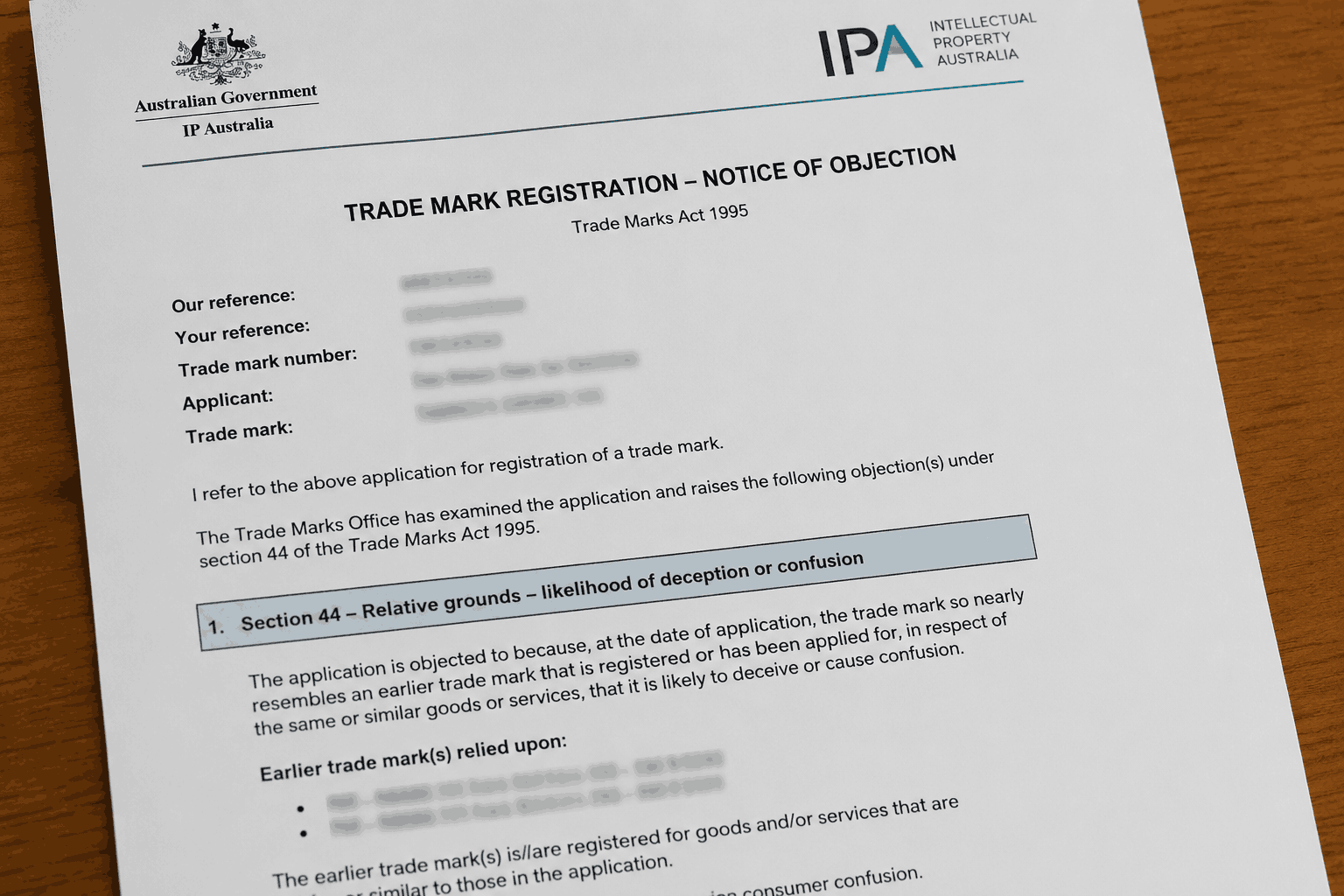
Receiving a rejection notice from IP Australia can feel discouraging, particularly after investing time and money into developing your brand. However, an adverse examination report does not necessarily mean your trade mark application is doomed to fail. In many cases, objections can be resolved with the right legal strategy and supporting evidence.
For Australian businesses and startup founders, understanding the trade mark examination process and knowing how to respond effectively can mean the difference between securing brand protection and starting over.
What Is a Trade Mark Rejection?
When you file a trade mark application in Australia, IP Australia examines the application to determine whether it complies with the requirements of the Trade Marks Act 1995 (Cth) (Trade Marks Act). If the examiner identifies issues preventing acceptance, they issue an examination report (often called an ‘adverse report’).
The report outlines:
- the legal grounds for objection;
- the sections of the legislation relied upon; and
- possible ways to overcome the issues.
Importantly, this is usually not a final refusal. It is an opportunity to respond.
Applicants generally have 15 months from the date of the first adverse report to obtain acceptance of the application.
Common Reasons Trade Mark Applications Are Rejected
1. The Trade Mark Is Not Distinctive Enough
One of the most common objections is that the proposed mark lacks distinctiveness. Australian trade mark law requires a mark to distinguish your goods or services from those of other traders.
Marks are more likely to face objections if they:
- describe the goods or services directly, eg, ‘Vegan Friendly’;
- use laudatory expressions, eg, ‘Perfect Coffee’; or
- contain geographic references, eg. ‘Melbourne Pizza’.
By contrast, invented or highly distinctive brand names are usually easier to register.
2. The Trade Mark Is Too Similar to an Existing Trade Mark
IP Australia may reject an application if it considers the proposed mark substantially identical or deceptively similar to an earlier registered or pending trade mark covering similar goods or services.
The examiner assesses:
- visual similarity;
- phonetic similarity;
- conceptual meaning; and
- whether consumers are likely to be confused.
This issue commonly arises where businesses conduct only limited searches before filing.
3. Problems With Goods and Services Classification
Applications are frequently delayed because the nominated goods and services are:
- too broad;
- incorrectly classified; or
- insufficiently specific.
Startups often attempt to claim overly broad protection in an effort to ‘cover everything’, but this can increase the likelihood of objections.
Not sure which trade mark class applies to your business? You can check the IP Australia classes to see how your goods and services are categorised.
4. Ownership Issues
IP Australia may also object where the applicant is not considered the proper owner of the trade mark. This can occur in situations involving:
- company restructures;
- disputes between founders;
- incorrect entity names; or
- applications filed before a company was incorporated.
Ownership problems can become particularly complex if multiple parties have been using the mark.
What You Should Do After Receiving an Adverse Report
Read the Report Carefully
The first step is to take a structured and considered approach to the examiner’s report. Each objection should be understood in detail, as examination reports often raise multiple issues that require separate and tailored responses.
In our experience advising startups and established businesses, a common mistake is to treat the report as a formality or to respond without fully engaging with the legal basis of the objection. A more effective approach is to step back and assess the report in its entirety, focusing on the underlying issues being raised rather than individual wording or phrasing.
Typically, the report will set out:
- the relevant legal provisions being applied
- the cited conflicting marks (if applicable)
- the examiner’s reasoning and basis for refusal
- the available pathways for response or amendment
Understanding these elements clearly is critical to developing a commercially sensible and legally sound response strategy.
Do Not Ignore the Deadline
Strategies for Overcoming a Trade Mark Rejection
1. Amend the Application
In some cases, relatively minor amendments can resolve the issue.
Examples include:
- narrowing the specification of goods or services;
- removing problematic items; or
- clarifying descriptions.
However, Australian trade mark law restricts amendments that would substantially broaden the original application.
2. Provide Evidence of Use
If the objection relates to lack of distinctiveness, evidence showing established use of the mark may help overcome the rejection.
Evidence may include:
- sales data;
- advertising materials;
- website analytics;
- customer testimonials;
- social media presence;
- invoices; and
- examples of packaging or promotional materials.
The registrar considers the duration, extent, and quality of use, including any use by authorised users or previous owners where relevant. The objective is to demonstrate that consumers already recognise the mark as identifying your business.
For startups, this can sometimes be difficult if the brand is relatively new. In those cases, rebranding or modifying the mark may be commercially more sensible.
By engaging experienced trade mark lawyers, you ensure your legal submissions are thoroughly prepared and persuasive, increasing your prospects of overcoming examiner objections.
3. Argue Against the Examiner’s Findings
Not every objection is correct.
A carefully prepared legal submission may persuade the examiner that:
- the marks are sufficiently different;
- the goods or services are not closely related;
- the mark is inherently distinctive; or
- the likelihood of consumer confusion is low.
This is often where experienced trade mark lawyers add substantial value.
4. Obtain Consent from the Earlier Trade Mark Owner
Where the objection involves a conflicting earlier mark, it may be possible to obtain a letter of consent from the owner of the earlier registration.
Consent arrangements are more likely where:
- the businesses operate in different markets;
- there is limited risk of confusion; or
- coexistence has already occurred without issue.
However, consent is not automatic, and commercial and legal negotiations may be required.
5. Request Deferment
IP Australia may allow deferment of the application in certain circumstances, including where:
- the conflicting mark is itself pending;
- non-use removal action is being considered;
- negotiations are underway; or
- court proceedings exist.
This can provide valuable time to resolve related issues strategically.
6. File Non-use Application
Any person may apply to remove a registered trade mark from the register for non-use under the Trade Marks Act. The application may seek removal of the mark in whole or in part for specified goods or services.
To oppose removal, the registered owner must show genuine commercial use of the trade mark in Australia, either directly or through authorised use by licensees or related entities. If use is shown only for some goods or services, the registrar may remove the mark for the remainder.
Non-use proceedings are often used to remove blocking marks cited against later trade mark applications or to challenge dormant registrations in infringement disputes.
When Refiling May Be the Better Option
Sometimes the commercially sensible approach is to adopt a revised brand and file a fresh application.
This may be appropriate where:
- the mark is highly descriptive;
- strong earlier rights exist;
- evidence of use is weak; or
- ongoing disputes would become expensive.
For startups in particular, early-stage rebranding is often less costly than prolonged legal battles or future infringement risks.
Can You Appeal a Rejection?
Yes. If an examiner maintains an adverse position and the objection cannot be resolved through correspondence, applicants may request a hearing before IP Australia.
From our experience advising startups and scaling businesses, hearings are typically only pursued where the trade mark is strategically important to the brand or where there is a clear and defensible legal position. At this stage, the matter becomes formal legal argument, and the quality of evidence, submissions, and strategic framing can materially influence the outcome.
However, we regularly see businesses underestimate the time, cost, and evidentiary burden involved in hearings. For most early-stage companies, it is critical to weigh the commercial value of the mark against the effort required to defend it.
How We Typically Advise Clients Responding to Adverse Reports
In practice, most trade mark objections we see from IP Australia can be resolved without escalating to a hearing. The strongest outcomes generally come from early, strategic decision-making rather than reactive responses.
Based on our work with startups and established businesses, key risk-reduction strategies include:
- undertaking comprehensive clearance searches before filing, not after an objection arises
- selecting distinctive, brandable names rather than descriptive or industry-led terms
- carefully defining goods and services to avoid unnecessary overlap with existing registrations
- responding to examiner objections with targeted legal submissions supported by evidence where available
- engaging legal advice early to assess registrability risk and refine filing strategy before lodgement
A common issue we encounter is that businesses treat trade mark filing as a procedural step in brand rollout. In reality, it is a strategic legal exercise that benefits significantly from upfront planning.
Final Thoughts
Trade mark objections in Australia are common in the startup and scale-up ecosystem, particularly where businesses are selecting descriptive or industry-aligned names. In our experience, most adverse reports can be overcome with the right combination of legal framing, evidence, and strategic amendments.
Where objections cannot be overcome, options typically include negotiation with existing rights holders, limitation of goods and services, submission of evidence of use, or progression to a hearing. The appropriate approach depends heavily on the strength of the mark and the commercial importance of the brand.
We regularly work with founders to assess whether it is more commercially sensible to persist with an application or pivot early to a stronger, more defensible brand. This decision is rarely purely legal; it is a balance between legal prospects, brand investment, and long-term growth strategy.
This content is for general informational purposes only and does not constitute legal advice.