Most people assume delaying tax is always a good thing. That makes sense. Nobody wants to pay tax on shares or options they can’t even sell yet.
But here’s the catch: ESOP tax deferral doesn’t get rid of the tax. It just pushes it back to a later date.
If your company grows a lot before that later date, an employee could end up with a much bigger tax bill than if they’d paid earlier.
So the real question isn’t “can we delay the tax?” It’s “will delaying the tax actually help our employees?”
What is ESOP tax deferral?
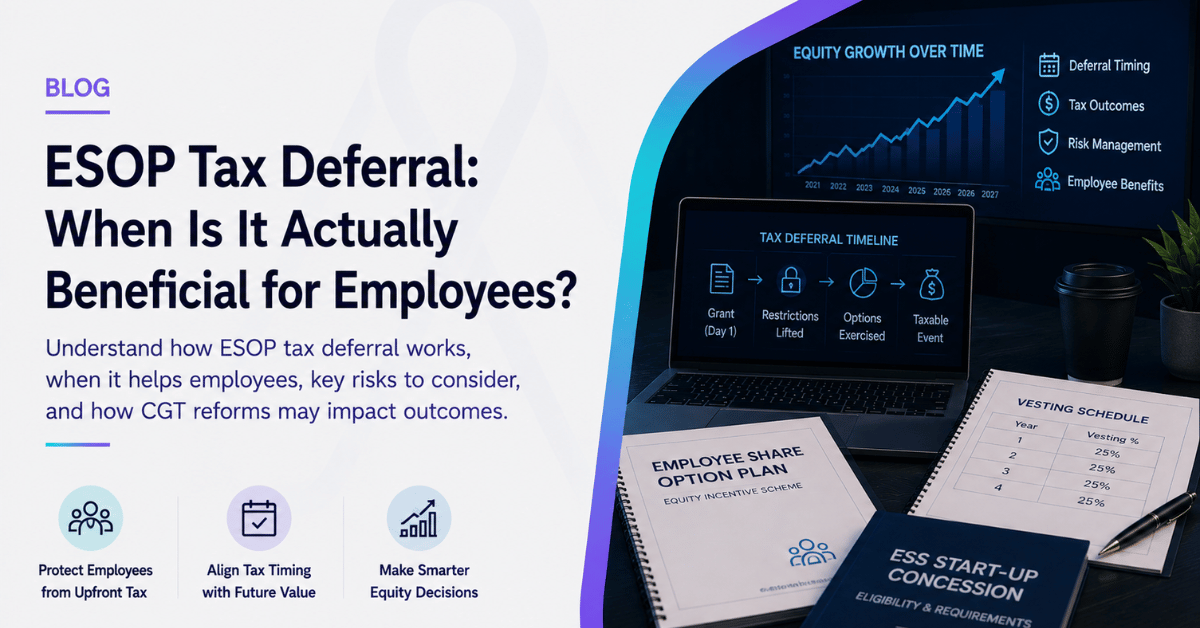
ESOP tax deferral is a rule that lets an employee wait to pay tax on their shares or options, instead of paying it straight away. They pay later, at a point called the “taxing point.”
At a Glance
| Deferral is usually good when… | Deferral may not be so good when… |
|---|---|
| Employees can’t afford to pay tax now | Options are worth very little at the start |
| The shares or options are already worth a lot | The company is about to grow a lot |
| There’s a real chance of losing the shares | There’s no cash yet to pay the tax bill |
| The tax date lines up with a sale or listing | The employee’s tax rate might jump later |
How ESOP Tax Deferral Works
Let’s start with the rules. Under a law called Division 83A, if an employee buys shares or options at a discount, that discount can count as taxable income.
Normally, tax is due straight away – the moment the employee gets the shares or options. This is called the “upfront” rule.
Under a tax-deferred plan, that tax date gets pushed back instead. For options, this might happen when:
- there’s no real risk of losing the options any more,
- any selling restrictions are lifted,
- the employee turns the option into shares, and those shares are free to sell, or
- the law’s maximum time limit for delaying is reached.
Here’s the important bit: tax is worked out using the value at that later date, not the value on the day the employee first got the options.
When Is ESOP Tax Deferral Usually Better?
Employees Can’t Pay Tax Upfront
This is the easiest case. Imagine an employee gets shares in a private company. Those shares are worth something on paper, but there’s nowhere to sell them yet.
If they’re taxed straight away, they’d have to find the money some other way – maybe from their wages or savings.
Deferring the tax means employees don’t need to find cash before they’ve actually received any money from their shares.
The Options or Shares Are Already Worth a Lot
Sometimes options or shares are valuable from day one. This can happen when:
- the price to buy the shares later (called the exercise price) is set low,
- the option is already “in the money” – worth more than it costs,
- shares are handed out at a big discount, or
- the employee gets a large amount of shares or options.
If the upfront tax bill would be big, deferring it usually helps.
The Employee Might Never Get the Shares
Sometimes there’s a real chance an employee won’t keep their shares at all. This can happen because of vesting conditions – for example:
- a set amount of time they need to stay with the company,
- performance targets they need to hit,
- minimum work requirements, or
- rules about what happens if they leave.
If there’s a genuine chance of losing the shares, taxing the employee upfront doesn’t feel fair. But the risk has to be real, not just something written into the paperwork for show.
The Tax Date Lines Up With a Sale
Deferral works best when the later tax date happens close to a real event – like the company being sold, listed on the stock exchange, bought back, or the options being cashed out.
That way, the employee pays tax at the same time they actually get money in their pocket.
When ESOP Tax Deferral May Not Be Better
Options Are Worth Very Little at the Start
If options are granted at or above the current share price, they might have a low taxable value straight away.
They could still be worth something, called “time value,” so don’t assume it’s zero. But if the value is small, paying tax now might actually be the smarter move, before things grow.
The Company Is About to Grow a Lot
This is the big one. If a company expects a major jump in value soon, deferring tax could mean the employee pays tax later on a much bigger number, taxed as ordinary income at a higher rate.
This might happen around events like:
- a new funding round
- landing a major contract
- getting regulatory approval
- launching a big product
- preparing to list on the stock exchange
- being bought by another company
There’s No Cash to Pay the Tax
Here’s a tricky problem: the tax date and the cash date don’t always match up.
An employee might owe tax the moment restrictions lift, or the moment they exercise their option, even though there’s still no way to sell the shares.
This is called “dry tax risk.” The employee owes money but hasn’t actually received any cash to pay it with.
Their Tax Rate Might Be Higher Later
If an employee is likely to earn more by the time the deferred tax date arrives, they might land in a higher tax bracket.
This is especially worth checking for senior employees, or anyone expecting a pay rise.
How CGT Reforms Affect ESOP Tax Deferral
The basic tax deferral rules under Division 83A aren’t changing. Companies still need to check the deferred tax date, and whether the employee can actually afford the tax at that point.
However, changes to capital gains tax (CGT) might change how attractive upfront tax looks, compared to waiting.
If future growth qualifies for a good CGT deal, such as a small business concession or the proposed Innovative Business CGT Concession, paying tax upfront might work out better than it first seems. If those concessions don’t apply, upfront tax becomes less appealing again.
For most everyday employees, rather than founders or major shareholders, the proposed Innovative Business CGT Concession is likely to matter more than the small business concessions. That’s because the small business concessions usually require someone to actively run the business and hold a decent chunk of it – which doesn’t describe most employees with a handful of shares or options.
Tax reform note: none of this is locked in yet. The final outcome depends on the finished rules, the employee’s situation, how long they hold the shares, and whether the company counts as an innovative start-up or small business.
A Practical Decision Framework
Before choosing a structure, companies should work out the numbers for both options.
Compare the tax due if employees pay upfront, against the tax likely due at the expected later date.
Think about: how much the options are worth now, how much the company might grow, employees’ likely tax rates, whether there’ll be cash available to pay tax when it’s due, vesting rules, selling restrictions, what happens if someone leaves, when an exit is likely, and how CGT changes might affect the numbers. Our startup advisory team can help you run this modelling before you lock in a structure.
Allied Legal’s Perspective
At Allied Legal, we don’t treat tax deferral as the automatic best choice. It’s a tool – useful in the right situation, less useful in others.
It usually helps when the real problem is employees having no cash to pay tax on shares they can’t sell yet.
It can be less helpful when the shares start out cheap and big growth is expected soon after.
The CGT changes don’t flip this advice on its head. They just make it more important to run the numbers properly, especially if a company is counting on future capital gains treatment as part of its plan. If you haven’t already worked out whether the ESS start-up concession applies to your company, that’s usually the first question to answer before comparing deferral against upfront tax.
Frequently Asked Questions
1. What is ESOP tax deferral?
It’s a rule that lets employees wait to pay tax on their shares or options, instead of paying straight away.
2. Is tax deferral always better than paying tax upfront?
No. It’s usually better when employees can’t sell their shares yet. But if the company grows a lot before the tax is due, the employee could end up with a bigger bill later.
3. What is “dry tax risk”?
It’s when an employee owes tax but has no way to sell shares to pay for it, because there’s still no buyer.
4. Do the CGT changes affect ESOP tax deferral?
Not directly. The Division 83A rules stay the same. But the CGT changes might make paying tax upfront look more appealing, depending on which concessions apply.
5. How should a company choose between upfront tax and deferral?
By comparing the numbers. Work out the tax due now, versus the tax likely due later, and think about growth, cash flow and each employee’s situation.
Key Takeaway: Is ESOP Tax Deferral Right for Your Company?
Tax deferral usually helps when it protects employees from paying tax on shares they can’t sell, or might not even keep.
It can be less helpful when it simply delays tax until after the company’s value has already jumped.
The answer isn’t a guess. It comes from running the numbers.
In the next article in this series, we’ll look at upfront taxation, capital gains tax, and the recent CGT reforms in more detail.
Related reading: Employee Share Option Plans: A Simple Guide · The ESS Start-Up Concession Explained · What Is Vesting and Why It Matters for Startups
This article is for general information only and isn’t legal advice. Please seek specific advice before acting on anything discussed here.