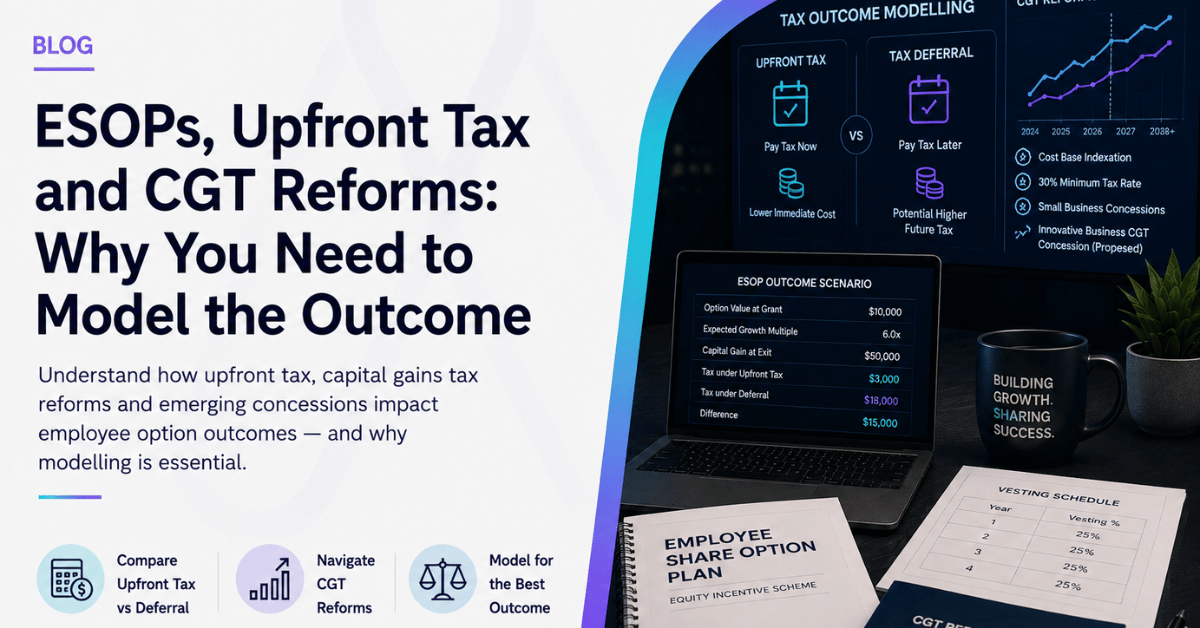
Sometimes, paying tax upfront on an ESOP is actually the smart move. This usually happens when the options aren’t worth much at the start, but the company is about to grow fast.
But here’s the twist: Australia’s capital gains tax (CGT) rules are changing. So the old maths doesn’t always hold up any more.
The answer isn’t “always defer” or “always pay upfront.” The answer is to run the numbers – for this specific company, this specific tax rule, and any tax break that might apply.
Why Upfront Tax Can Be a Good Idea
When an employee pays tax upfront, it’s based on the option’s value on the day they got it.
If the option is granted at or above the current share price, that value might be quite low. It’s probably not zero, though – so don’t assume that.
Here’s the potential win: if the employee pays a small amount of tax now, any growth after that point may be dealt with under CGT rules instead – which can sometimes work out cheaper.
Why the Value of the Option Matters
Getting the option’s value right is the most important step.
Even an option granted at market value can still be worth something. This is called “time value” – a bit like how a lottery ticket has some value even before the draw, just because it could win.
Because of this, companies shouldn’t claim an option is worth nothing unless they have solid, defensible proof.
When Might Upfront Tax Be Worth Considering?
Upfront tax tends to work best when:
- the option’s value at grant is low, and that can be proven
- the exercise price is at or above the current market value
- the company expects strong growth after the grant
- employees can actually afford to pay the tax now
- there’s a realistic chance of good growth later
- the plan doesn’t use fake or overly strict forfeiture rules just to look better on paper
- the company wants to avoid a bigger tax bill under deferral later on
The Big CGT Changes From 1 July 2027
The Australian Government is changing the CGT rules.
Right now, individuals get a 50% discount on capital gains. From 1 July 2027, that discount is being replaced with two things instead: cost base indexation (adjusting for inflation over time) and a minimum 30% tax rate on gains.
These new rules apply to gains that build up from 1 July 2027 onwards, once the gain is actually realised (usually when the shares are sold).
Because of this, ESOP planning now needs to think carefully about timing – when options are granted, when they vest, when they’re exercised, and when they’re eventually sold.
Small Business Tax Breaks
The Government is keeping the four existing small business CGT concessions. It’s also raising the turnover limit for one of them – the 50% active asset reduction – from $2 million to $10 million, starting 1 July 2027.
This sounds helpful for ESOPs, but don’t get too excited yet. These concessions are usually aimed at founders and big shareholders who actively run the business – not employees holding a small number of options.
So companies shouldn’t tell employees “we’re a small business, so you’ll get the tax break.” Each person needs to be checked against the actual rules first.
The New Innovative Business Tax Break
The Government is also considering a brand-new tax break: the Innovative Business CGT Concession. It’s not law yet – it’s still being discussed.
If it goes ahead, it would give early investors, founders and ESOP participants a choice between:
- a 50% discount on gains, with no minimum tax rate, or
- the new cost base indexation method, with the 30% minimum tax rate
To qualify, the shares would generally need to:
- be new shares in an unlisted, independent company
- be issued while the company’s turnover is under $50 million
- be issued while the company is generally under 10 years old
- come from an active, genuinely innovative business
- be held for at least 5 years
- stay within a lifetime cap on how much gain can get the concession
There are also proposed transition rules for some shares issued before 1 July 2027.
Tax reform note: this concession isn’t confirmed yet. It’s still being consulted on, and the details could change. Treat it as a possibility to plan around – not a guarantee.
Why These Changes Matter for ESOPs
Here’s the original appeal of upfront tax: pay a little tax now, on a low option value, and let any future growth be taxed under CGT instead.
But if the CGT discount is being replaced with indexation and a 30% minimum tax rate, that benefit might shrink for some employees.
It’s not all bad news, though. If a small business concession or the new Innovative Business CGT Concession applies, the capital gains outcome can still be a good one. If neither applies, upfront tax becomes less of a clear win – especially for fast-growing companies where most of the gain happens quickly, from a low starting value.
This doesn’t mean deferral automatically wins instead. It just means: don’t guess. Model it properly under the rules that actually apply.
What Companies Should Model
Before setting up an ESOP, work through:
- the grant date
- the share’s market value at grant
- the option’s exercise price
- the option’s value at grant
- expected vesting dates
- expected exercise dates
- expected sale dates
- whether employees can afford tax upfront
- each employee’s likely tax rate
- the expected capital gain
- the cost base and any indexation
- the effect of the 30% minimum tax rate
- whether small business CGT concessions could apply
- whether the Innovative Business CGT Concession could apply
- any transition rules that might apply
- the risk that these tax rules could change again
Allied Legal’s Perspective
At Allied Legal, our message across this whole series has been the same: model it, don’t assume it.
Don’t pick tax deferral just because it avoids tax today. And don’t pick upfront tax just because future growth might land in the CGT system. The right choice depends on the employee’s likely take-home outcome, the company’s path to a sale or listing, when growth is expected, and whether any CGT concession genuinely applies. Our employee incentive schemes team can help you run this modelling properly before anything is issued.
Frequently Asked Questions
1. What is ESOP tax modelling?
It’s the process of comparing tax outcomes for different ESOP structures – like paying tax upfront versus deferring it – before deciding which one to use.
2. Why might upfront tax be better than deferral for some ESOPs?
If the options are worth very little when granted, and the company expects to grow a lot afterwards, paying a small amount of tax now can end up cheaper than paying more tax later.
3. What changes from 1 July 2027?
The current 50% CGT discount is being replaced with a new system: cost base indexation, plus a minimum 30% tax rate on capital gains.
4. Will small business tax concessions help my employees?
Maybe, but usually only for founders and larger shareholders, not most employees. The rules generally require actively running the business and owning a decent share of it.
5. What is the Innovative Business CGT Concession?
It’s a proposed new tax break for early investors, founders and employees in qualifying innovative start-ups. It isn’t law yet, so it shouldn’t be relied on until it’s finalised.
Key Takeaway
Upfront tax can work well when employees are taxed on a low option value before big growth happens.
But the CGT reforms from 1 July 2027 may reduce that advantage for some employees.
The small business concessions and the proposed Innovative Business CGT Concession might help – but they shouldn’t be assumed. The real answer is to model the outcome properly before issuing any ESOP interests. Our startup advisory service can help startups and scaleups work through this before their next raise or hire.
Related reading: Employee Share Option Plans: A Simple Guide · The ESS Start-Up Concession Explained · ESOP Tax Deferral: When Is It Actually Beneficial?
This article is for general information only and isn’t legal advice. Please seek specific advice before acting on anything discussed here.