
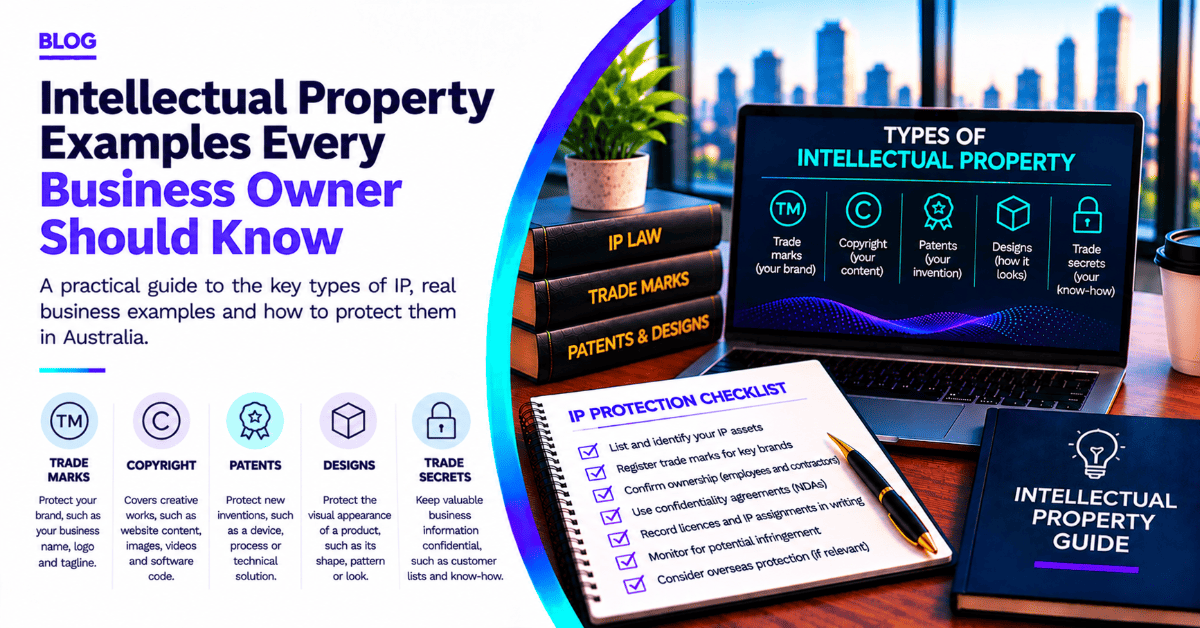
Most businesses own more intellectual property than they realise. Your logo, your website copy, your customer database and even your internal processes can all count as IP. Yet many owners never identify these assets, let alone protect them. As a result, they often discover a gap only when a competitor copies them or a buyer asks for proof of ownership.
This guide gives practical intellectual property examples for Australian businesses, explains how the law protects each type and shows how to keep them safe.
What Is Intellectual Property?
Intellectual property is the legal protection given to creations of the mind. It lets you stop others from copying or using your ideas, brand and creative work without permission. Some IP rights arise automatically, while others need registration.
In Australia, IP Australia manages the registered rights: trade marks, patents, designs and plant breeder’s rights. For a broader introduction, see our guide to what intellectual property means.
Why Identifying Your IP Matters
First, IP is often a large part of what a business is worth. Investors and buyers will want to see what you own and whether you can prove it. In addition, unprotected IP is hard to enforce. If someone copies your brand or product, your options depend on the rights you hold and the records you keep. Finally, knowing your IP helps you avoid infringing someone else’s rights by accident.
Trade Marks
A trade mark identifies your goods or services and sets them apart from competitors. Examples include:
- your business or product name
- your logo
- a slogan or tagline
- a distinctive colour, shape or sound linked to your brand
A registered trade mark lasts for 10 years from the filing date, and you can renew it indefinitely. Unregistered brands may have some protection under the law of passing off and the Australian Consumer Law, but these claims are harder and more costly to prove than infringement of a registered mark. Importantly, registering a business name or company name does not give you ownership of the name as a brand. Our article on trade marks vs business names explains why.
Copyright
By contrast, copyright protects the way people express ideas, not the ideas themselves. In a business, common examples include:
- website text, blog posts and marketing material
- photos, videos and graphics
- training manuals and internal documents
- software source code
- music and audio
In Australia, copyright protection is automatic. You do not need to register it. However, you do need to prove that you own it. This matters when staff or contractors created the work. As a general rule, an employer owns copyright in work an employee creates in the course of employment, but a contractor keeps copyright unless a written agreement assigns it. Creators also hold moral rights, which cannot be assigned, so agreements should include an appropriate moral rights consent. Our guide on copyright vs trade marks compares the two.
Patents
A patent protects a new invention, such as a device, a substance, a method or a process. For example, a business might patent a new manufacturing technique, a medical device or a new type of machinery.
In general, an invention must be a patentable subject matter (a “manner of manufacture”), be new, involve an inventive step and be useful to qualify. A standard patent can last up to 20 years, and up to 25 years for some pharmaceutical products. Australia’s innovation patent has been phased out and is no longer available for new filings. Publicly disclosing your invention before you file can seriously jeopardise your rights. Australia offers a limited 12-month grace period, but many other countries do not, so speak to an adviser before any disclosure. If you work in tech, our article on patenting technology covers the common questions.
Designs
Meanwhile, a registered design protects the visual appearance of a product, such as its shape, pattern or ornamentation. Examples include the shape of a chair, the pattern on a fabric or the look of a bottle.
In other words, a design right protects how a product looks, not how it works. In Australia, registration lasts for an initial 5 years from the filing date and can be renewed once, for a maximum of 10 years. As with patents, file before you publicly disclose the design. A limited 12-month grace period now applies, but you should not rely on it.
Confidential Information and Trade Secrets
Some of a business’s most valuable IP never appears on any register. Examples include:
- customer and supplier lists
- recipes and formulas
- pricing strategies
- business methods and know-how
- unreleased product plans
However, these assets stay protected only while they stay secret. The law protects them through contract and the equitable action for breach of confidence, not through registration. As a result, contracts do much of the work. A well-drafted confidentiality agreement and strong confidentiality clauses in employment contracts help keep them safe.
Software and Digital Assets
Software is a common source of confusion. In most cases, however, copyright protects the source code. A patent may protect software only in limited situations, where it delivers a genuine technical improvement.
Beyond software, other digital assets also matter. Domain names, social media handles, databases and apps can all hold significant value, even though not every one counts as IP in the strict legal sense.
Other Types of IP
There are also some more specialised rights. For example, plant breeder’s rights protect new plant varieties, while circuit layout rights protect the layout of integrated circuits. These matter mainly in agriculture and electronics.
How to Protect Your Business IP
Knowing what you own is the first step. After that, a few practical habits go a long way:
- List your IP assets and note who created each one.
- Register trade marks for your key brands, starting with your business name and logo.
- Make sure employment and contractor agreements assign IP to the business.
- Use confidentiality agreements before sharing sensitive information.
- Record licences and IP assignments in writing.
- Monitor the market for anyone copying your brand or products.
Also, remember that Australian registrations only protect you in Australia. According to business.gov.au, you need to consider registering overseas if you trade in other countries.
Frequently Asked Questions
1. What are the main types of intellectual property?
The main types are trade marks, copyright, patents, designs and confidential information. Plant breeder’s rights and circuit layout rights are also forms of IP, but they apply to more specialised industries.
2. What is an example of intellectual property in a small business?
A café’s name and logo (trademarks), its menu design and website photos (copyright) and its signature recipes (confidential information, as long as they are kept secret) are all examples of intellectual property.
3. Do I need to register copyright in Australia?
No. Copyright protection is automatic in Australia, so you do not need to register it. However, you should keep records showing who created the work and when.
4. Who owns IP created by a contractor?
Generally, the contractor owns it unless a written agreement assigns it to your business. This is a common trap, so always include an IP assignment clause in contractor agreements, together with a moral rights consent. Ideally, sign these before the work starts.
How Allied Legal Can Help
Our intellectual property lawyers help businesses identify, protect and commercialise their IP. We handle trade mark registration, draft IP assignments, licences and confidentiality agreements, and act in IP disputes when someone copies your work.
To discuss protecting your business IP, call us on 03 8691 3111 or email hello@alliedlegal.com.au.
This article is provided for general information only and does not constitute legal advice. You should obtain legal advice specific to your circumstances before acting on any information contained in this article.