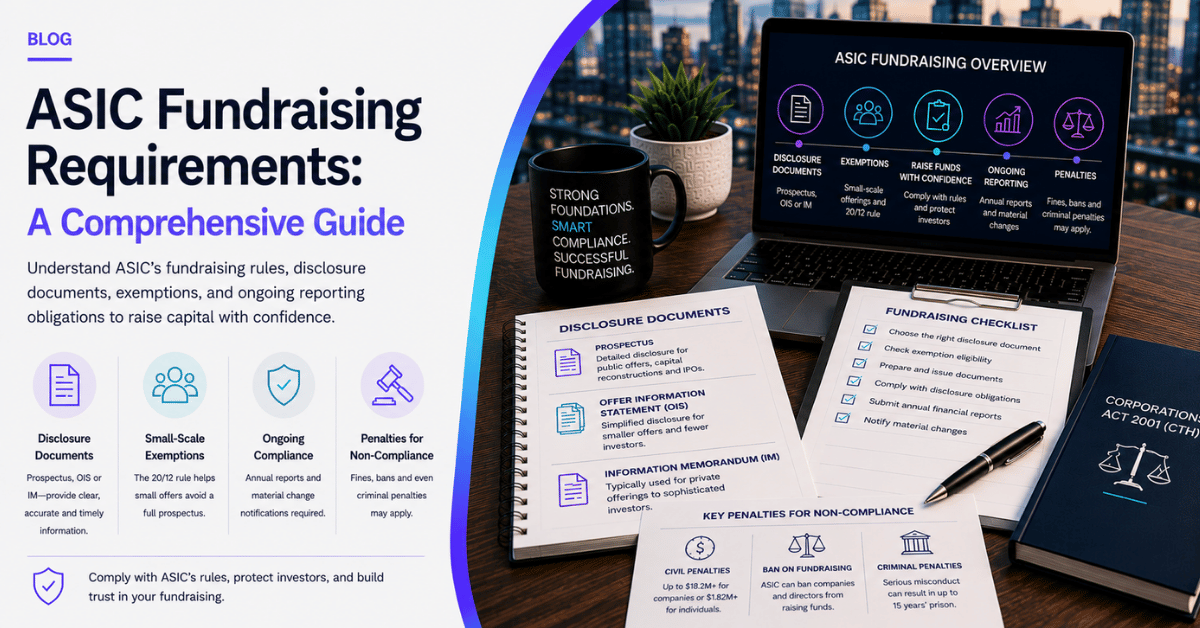
When raising funds in Australia, businesses need to comply with ASIC’s fundraising requirements. These rules exist to keep the market transparent, protect investors, and build trust in how companies raise capital. This guide explains the key disclosure documents ASIC requires. It also covers exemptions for small-scale offerings and the reporting obligations that continue after the raise.
If you have not yet set up your company, our guide to incorporating a company in Australia covers that groundwork first.
Key Disclosure Documents: Prospectus, OIS and IM
The purpose of any fundraising disclosure document is the same: give potential investors clear, accurate and timely information about the opportunity.
A prospectus is the most detailed option, issued when a company offers securities to the public. It typically covers the company overview, audited financial statements, how the raised capital will be used, and the risks involved. A prospectus is generally required for public offers, capital reconstructions, and IPOs.
An Offer Information Statement, or OIS, is a lighter alternative for smaller offers or companies not seeking a large pool of public investors. It still covers the offer terms, business risks and financial position, just in less depth than a full prospectus.
An Information Memorandum, or IM, is not always a strict regulatory requirement, but it is commonly used in private fundraising rounds aimed at sophisticated investors. It usually sets out the business plan, financial performance and specific offer terms.
Whichever document applies, ASIC expects each one to contain clear information about the business, address the relevant risks, include financial forecasts where applicable, and set out the investment terms, including pricing and investor rights.
Exemptions for Small-Scale Offerings
Not every capital raise needs a full prospectus. ASIC’s small-scale offering exemption, often called the 20/12 rule, means a business raising funds from fewer than 20 investors, or offering less than $2 million in total in a 12 month period, generally does not need to issue a prospectus. An OIS may be enough instead.
To rely on this exemption, three conditions generally need to apply.
- Fewer than 20 investors are involved in the offer.
- The total amount raised is under $2 million.
- The offer itself is not complex or high risk.
Even under this exemption, investors still need clear information about the offer, the company’s financial position, and the risks involved. The exemption reduces paperwork, not the duty to be upfront.
Applying for ASIC Relief or a Waiver
If a business does not automatically qualify for an exemption but believes its offering should still attract relief, it can apply to ASIC directly.
- Check eligibility first, confirming the offering genuinely fits the small-scale exemption or another relief category.
- Prepare the application, including details of the business, the offer itself, and the reasons a waiver is being sought.
- Submit to ASIC and wait for a decision before proceeding with the raise.
Post-Fundraising Reporting Obligations
Compliance does not end once the raise closes. Businesses still need to submit annual financial reports, including audited statements, to keep investors informed of the company’s financial health.
Any material change also needs prompt disclosure to investors and ASIC. This includes changes to business strategy or operations, new or materially changed contracts, and acquisitions, mergers or management changes that could affect the company’s future performance. Timely updates like these are central to ASIC’s continuous disclosure requirements, particularly for public companies.
Penalties for Non-Compliance
Failing to meet ASIC’s fundraising and reporting requirements carries real consequences, from fines and legal action through to a ban on fundraising activity and lasting reputational damage.
Under the Corporations Act, current maximum civil penalties for companies are the greatest of 50,000 penalty units, currently 18.2 million dollars, three times the benefit obtained and detriment avoided, or 10 percent of annual turnover, capped at 2.5 million penalty units, currently 910 million dollars.
For individuals, the maximum is the greater of 5,000 penalty units, currently 1.82 million dollars, or three times the benefit obtained and detriment avoided.
For the most serious misconduct, including breaches of directors’ duties, false or misleading disclosure, and dishonest conduct, criminal penalties can apply, with maximum prison terms of 15 years.
Which Document Should You Use?
The right disclosure document usually comes down to the size and audience of the raise. A public offer aimed at retail investors almost always needs a full prospectus. A smaller, private round aimed at sophisticated investors is more likely to run on an Information Memorandum. A modest raise that falls within the 20-investor or $2 million thresholds may only require an OIS. In some cases, no formal disclosure document is needed. Choosing the wrong pathway can create problems later. It may even require the paperwork to be redone during the raise. For that reason, it is worth confirming the correct approach before approaching investors.
Frequently Asked Questions
1. What is the 20/12 rule for ASIC fundraising exemptions?
It refers to the small-scale offering exemption, which generally allows a business to raise funds without a full prospectus if it has fewer than 20 investors and raises less than 2 million dollars in total within a 12-month period.
2. Do I always need a prospectus to raise capital in Australia?
No. A prospectus is generally required for public offers, capital reconstructions and IPOs, but smaller or private offerings can often rely on an Offer Information Statement, an Information Memorandum, or a small-scale offering exemption instead.
3. What happens if a business does not meet ASIC’s reporting obligations after fundraising?
Non-compliance can lead to fines, legal action, a ban on further fundraising, and reputational damage that makes future capital raises harder to complete.
4. What are the maximum penalties for breaching ASIC’s fundraising requirements?
For companies, the maximum civil penalty is the greatest of 50,000 penalty units, currently 18.2 million dollars, three times the benefit gained, or 10 per cent of annual turnover up to 910 million dollars. For individuals, it is the greater of 5,000 penalty units, currently 1.82 million dollars, or three times the benefit gained.
5. Can a business apply to ASIC for relief from fundraising requirements?
Yes. A business can apply directly to ASIC for a waiver or relief if it believes its offering should qualify, by confirming its eligibility and submitting an application explaining why the relief is appropriate.
At Allied Legal, we recognise the complexities involved in fundraising and the importance of compliance with ASIC’s requirements. Our team of experienced commercial lawyers is here to guide you through every step, from preparing key disclosure documents to ensuring ongoing compliance. Whether you’re raising capital for a startup or scaling your business, we offer tailored legal support to help you secure investment with confidence. Contact us today to find out how we can assist with your fundraising journey.
Related Reading:
- Incorporating a Company in Australia: Key Requirements and Legal Considerations
- Startup Capital Raising with SAFE Notes
- Convertible Notes in Startup Fundraising
Useful Resources: