
The civil justice system in Australia gives individuals, businesses and organisations a structured way to resolve disputes. Whether you are pursuing compensation, enforcing a contract, or defending against a claim, understanding how it works is critical to protecting your rights and avoiding costly mistakes.
This guide breaks down the court structure, the key stages of a civil case, and the state-specific rules that affect how litigation actually plays out.
Australia’s Court Structure: Federal and State Jurisdictions
Australia has a federal system, so both the Commonwealth and each state or territory run their own court hierarchy.
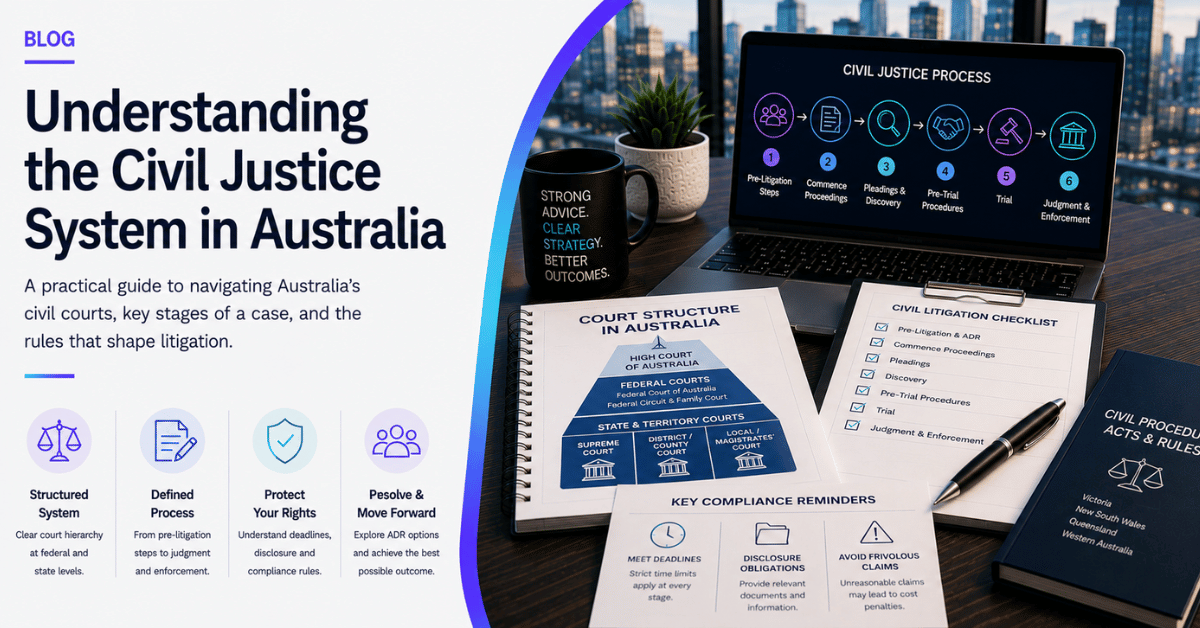
- Federal courts: the Federal Court of Australia and the Federal Circuit and Family Court of Australia.
- State and territory courts: a three tier system in each state, made up of the Supreme Court, the District or County Court, and the Local or Magistrates’ Court.
Civil matters span a wide range of areas, including contract and commercial disputes, torts, equity, defamation and consumer law. Procedural rules vary slightly between courts, but the core stages of litigation stay broadly consistent.
How a Civil Case Moves Through the System
Most civil matters follow the same general path, regardless of which court hears them.
- Pre-litigation steps: parties are encouraged to try negotiation, mediation or other alternative dispute resolution first. Many courts require this before a claim can even be filed.
- Starting proceedings: the plaintiff files an originating process, such as a statement of claim, and the defendant is served with strict deadlines to respond.
- Pleadings: the statement of claim sets out the allegations and relief sought, the defence responds to each allegation, and a counterclaim can be filed if the defendant has claims of their own.
- Discovery: both sides exchange relevant documents. Courts can limit excessive requests to control cost and delay, and tools such as interrogatories and subpoenas help gather evidence.
- Pre-trial procedures: case management hearings check compliance with timelines, and judges may order mediation or expert reports to narrow the issues in dispute.
- Trial: evidence is presented, witnesses are examined, and legal arguments are made. Most Australian civil trials are decided by a judge alone, though some jurisdictions, including New South Wales, still allow a jury for certain matters such as defamation.
- Judgment and enforcement: a successful plaintiff can enforce a judgment through property seizure, garnishee orders, or insolvency proceedings.
State-Specific Rules in the Civil Justice System
Every state and territory applies its own procedural rules on top of this general framework.
- Victoria: governed by the Civil Procedure Act 2010 (Vic) and the Supreme Court Rules.
- New South Wales: follows the Uniform Civil Procedure Rules 2005 (NSW).
- Queensland: uses the Uniform Civil Procedure Rules 1999 (Qld).
Whichever state applies, three compliance points matter most: meeting court-mandated filing deadlines, satisfying disclosure obligations during discovery, and avoiding frivolous or vexatious claims, which can lead to cost penalties.
Why Pleadings and Discovery Matter So Much
Pleadings set the boundaries of a dispute. A poorly drafted statement of claim or defence can weaken your position, or even be struck out by the court. In Aon Risk Services Australia Ltd v Australian National University, the High Court made clear that a party is not automatically entitled to amend a pleading and add a new claim just because they are willing to cover the resulting costs.
Discovery raises a similar balance. It gives both parties access to relevant evidence, but excessive requests slow everything down. In Victoria, for example, a party must justify a discovery request by showing the documents are genuinely relevant to the case. Missing a court deadline anywhere in this process can lead to adverse cost orders, dismissal of a claim or defence, or loss of the right to appeal.
Challenges in the Civil Justice System
Litigation is rarely simple, and four challenges come up again and again.
- High costs: court filing fees, lawyers and experts all add up.
- Complexity: procedural and evidence rules require careful navigation.
- Delays: court backlogs can stretch out resolution well beyond what parties expect.
- No guarantee: even a strong case carries no certainty of a favourable judgment.
How to Navigate the Civil Justice System Effectively
A few practical steps make a real difference to how a case unfolds.
- Get legal advice early, so a lawyer can assess the merits of your case and recommend the right dispute resolution option.
- Prepare thoroughly, organising documents, witness statements and evidence well before they are needed.
- Stay on top of deadlines, with a lawyer’s help tracking court submissions and hearing dates.
- Consider settlement, since many cases resolve before trial through mediation or offers of compromise.
Recent Reforms to the Civil Justice System
Australia’s civil justice system keeps evolving to improve access and efficiency, including online filing systems and virtual hearings, fast-track processes for smaller claims, and stronger case management, with mandatory ADR and judges actively intervening to cut unnecessary delays.
Frequently Asked Questions
1. What is the civil justice system in Australia?
It is the structured court process used to resolve disputes between individuals, businesses or organisations, covering everything from contract and commercial disputes to torts, equity and consumer law claims.
2. What is the difference between federal and state courts in Australia?
Federal courts, such as the Federal Court of Australia, handle matters under Commonwealth law. Each state and territory also runs its own three tier system of Supreme, District or County, and Local or Magistrates’ Courts for matters under state law.
3. Do civil cases in Australia go before a jury?
Most civil trials are decided by a judge alone. Some jurisdictions, including New South Wales, still allow a jury for specific matters such as defamation.
4. What happens if I miss a court deadline in a civil case?
Missing a deadline can lead to an adverse cost order, dismissal of a claim or defence, or loss of the right to appeal, so tracking court timelines closely is essential.
5. Do most civil disputes in Australia go to trial?
No. Many cases resolve before trial through negotiation, mediation or offers of compromise, and courts actively encourage this through mandatory alternative dispute resolution requirements.
How Allied Legal Can Help
At Allied Legal, our experienced litigation team specialises in guiding clients through the civil justice system. We assist with everything from drafting pleadings to conducting cost-benefit analyses and risk assessments, as well as managing stakeholders and litigation projects. Our goal is to ensure your case is presented effectively while complying with all procedural requirements.
Related Reading:
- Settling Your Dispute: Offers of Compromise, Without Prejudice and Without Prejudice Save as to Costs Offers
- Preventing Contract Disputes
Useful Resources:
- High Court of Australia: Aon Risk Services Australia Ltd v Australian National University
- Civil Procedure Act 2010 (Vic)
- Uniform Civil Procedure Rules 2005 (NSW)
- Uniform Civil Procedure Rules 1999 (Qld)
This article is provided for general information only and does not constitute legal advice. You should obtain legal advice specific to your circumstances before acting on any information contained in this article.