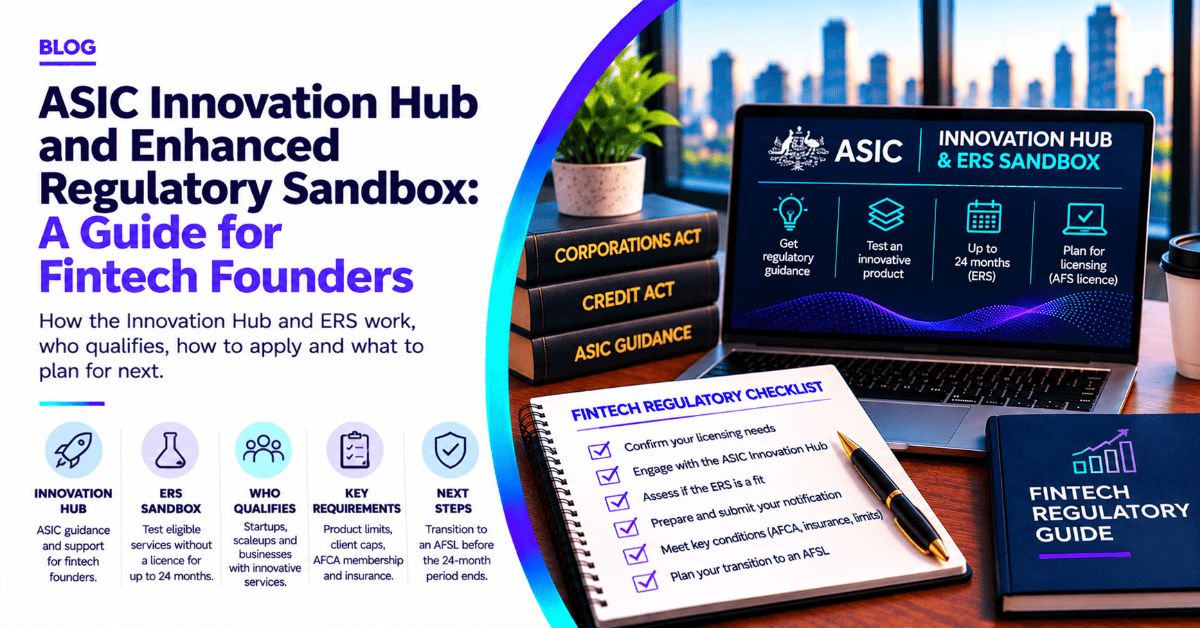
Fintech founders face licensing questions early. The ASIC Innovation Hub offers informal help with those questions, and the Enhanced Regulatory Sandbox (ERS) lets eligible businesses test a product without a licence for up to 24 months. This guide explains who qualifies for each, how to apply and what to plan for next.
What Is the ASIC Innovation Hub?
The Innovation Hub has helped innovative fintech and regtech businesses navigate the regulatory framework since 2015, according to ASIC’s media release of 21 May 2026. ASIC reviewed the Hub and relaunched it, and the review concluded in March 2026. The Hub gives informal assistance on potential regulatory obligations and the licensing process. ASIC also uses it to administer the ERS and to run an external Digital Finance Advisory Panel.
ASIC does not give legal advice, financial assistance or endorsement through the Hub. It also will not refer you to a licensee that might appoint you as an authorised representative.
Who Can Use the Innovation Hub?
ASIC’s informal assistance page sets the fintech criteria. Your business can be a startup, scaleup or established business. It must be developing innovative fintech products or services that could lead to better outcomes for investors, consumers and markets. It must also meet one of three conditions:
- The business needs an Australian financial services (AFS) licence or a credit licence from ASIC.
- Alternatively, it is in the process of getting one of those licences.
- Or it has held either licence for less than 12 months.
ASIC treats products and services as innovative if they are new or significantly different from what the market offers today. It gives preference to innovative business models. Regtech businesses follow a separate stream with its own criteria.
What Support Does the Hub Provide?
If ASIC accepts your request, you can expect help in these areas:
- Guidance on your obligations under the financial services framework.
- Help understanding how ASIC administers the framework, such as how to get an AFS licence.
- Advice on regulatory issues when you set up.
- Referrals to other ASIC teams or international agencies.
- A named ASIC contact, with guidance and meetings with senior staff, before you hold a licence and during your first licensed year.
The 12-month limit is an eligibility cut-off. The Hub does not run a fixed 12-month programme.
How Do You Apply for Innovation Hub Assistance?
Submit the Innovation Hub assistance request form, which has separate fintech and regtech versions. ASIC aims to assess requests within about one week. You can send questions to innovationhub@asic.gov.au. Give ASIC a clear description of your product, your licensing status and what makes the business innovative. A startup lawyer can help you frame the request.
Innovation Hub or Sandbox: Which Fits Your Business?
Most fintechs start with the Hub. It gives guidance but does not exempt you from licensing. The ERS suits a business that wants to test with real customers before it holds a licence, and ASIC asks you to contact the Hub first.
Both routes depend on a clear description of your product. Start by mapping your services against the licensing rules. Section 911A(1) of the Corporations Act says a person who carries on a financial services business in Australia must hold an AFS licence, subject to exemptions. The National Consumer Credit Protection Act 2009 (Cth) prohibits credit activities without a credit licence.
What Is the Enhanced Regulatory Sandbox?
ASIC describes the ERS as a limited licensing exemption for eligible fintechs to test innovative business models. It lets a business test certain financial services or credit activities without first holding an AFS licence or Australian credit licence. The testing period lasts up to 24 months.
The ERS rests on the 2020 FinTech Sandbox regulations made under the Corporations Act and the National Consumer Credit Protection Act. It supersedes the earlier sandbox, and ASIC withdrew Regulatory Guide 257 on 25 August 2020. ASIC’s INFO 248 sets out the detail.
The ERS is not automatic. You lodge a notification with ASIC, which has 30 calendar days to assess it. If ASIC does not respond, the exemption starts on day 31. ASIC asks you to email your notification to ersnotifications@asic.gov.au and to contact the Innovation Hub first for informal guidance.
Who Qualifies for the ERS?
ASIC’s criteria in INFO 248 include:
- You must not already hold a licence or authorisation for the same activity, and no related person can hold one.
- ASIC will not approve you to test the same service twice.
- Market and clearing operators cannot use the ERS.
- The net public benefit test asks you to show the benefit of the exemption outweighs the likely detriment.
- The innovation test asks you to show the service is new or a new adaptation of an existing one.
Product limits also apply. Wholesale clients can receive most financial products, except derivatives and margin lending. Retail clients can receive a narrower list, including deposit and non-cash payment facilities, insurance, simple managed investment scheme interests and listed securities. Credit contracts must run for no more than four years, with a limit above $2,000 and below $25,000. Check INFO 248 for the full list.
What Conditions Apply During the Sandbox?
The ERS carries real limits and duties:
- A $5 million aggregate exposure limit applies across your services and clients.
- A $10,000 retail client limit applies to certain products.
- Clients must know you are unlicensed and operating under the exemption.
- Australian Financial Complaints Authority (AFCA) membership and an internal dispute resolution process are mandatory.
- Compensation arrangements also apply, generally professional indemnity insurance of at least $1 million.
- Licensee-style duties apply, including Statements of Advice, client money rules and responsible lending.
ASIC says you cannot extend, pause or reset the exemption. It can also cancel the exemption, for example if you breach a condition or fail the fitness and propriety standard.
What Happens After 24 Months?
You must either stop the activity or apply for a licence. ASIC recommends applying six to nine months before the exemption ends. You must also make sure existing clients suffer no detriment or loss of service, and you must report to ASIC within two months after the exemption ends. Our guide to the AFSL for fintech startups explains the licence application. If you run a digital advice model, read our guide to robo advisors in Australia.
Frequently Asked Questions
1. What is the ASIC Innovation Hub?
It is ASIC’s service for innovative fintech and regtech businesses. It gives informal assistance on regulatory obligations and licensing, and it administers the Enhanced Regulatory Sandbox. ASIC reviewed and relaunched the Hub in 2026.
2. Who is eligible for the Innovation Hub?
A fintech must be developing innovative products or services. It must also need an AFS or credit licence, be in the process of getting one, or have held one for less than 12 months. Regtech businesses have separate criteria.
3. How long can I test in the Enhanced Regulatory Sandbox?
Up to 24 months. ASIC says you cannot extend, pause or reset the exemption. After that period, you must stop the activity or apply for a licence.
4. Do I need a licence after the sandbox?
Yes, if you want to keep providing the service. ASIC recommends applying six to nine months before the exemption ends so you avoid a gap.
5. Does the Innovation Hub give legal advice?
No. ASIC does not give legal advice, financial assistance or endorsement through the Hub. A lawyer can help you prepare your request and plan your licensing path.
6. What limits apply in the Enhanced Regulatory Sandbox?
ASIC sets a $5 million aggregate exposure limit and a $10,000 retail client limit for certain products. You must also meet disclosure, dispute resolution and compensation duties.
How Allied Legal Can Help
Allied Legal helps fintech founders prepare Innovation Hub requests, ERS notifications and licence applications. We can also advise on the wider issues a fintech faces, from privacy to intellectual property. Funding matters too, so see our guide to national startup grants. Learn more about our fintech lawyers, or contact us on 03 8691 3111 / hello@alliedlegal.com.au.
This article is provided for general information only and does not constitute legal advice. You should obtain legal advice specific to your circumstances before acting on any information contained in this article.