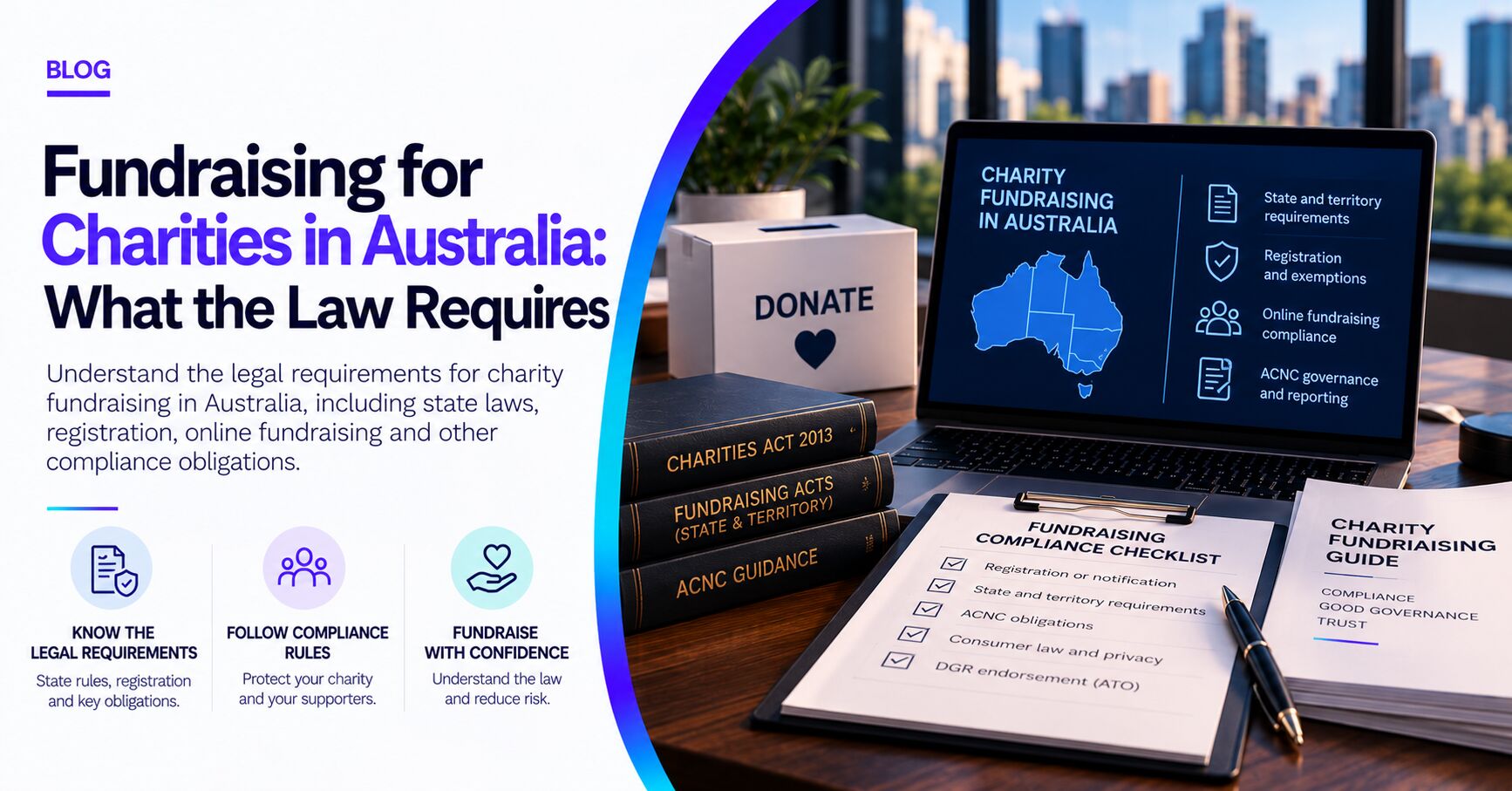
Australian law regulates fundraising for charities and not-for-profits. If you raise money without following the rules, you risk penalties and lasting reputational damage. The rules also vary by state and territory, and several changed in 2025 and 2026. This guide explains the main legal requirements, with a closer look at Victoria. It also covers online fundraising and the other laws that apply.
Charity or Not-for-Profit: Why the Difference Matters
A not-for-profit does not distribute its profits to members or owners for private gain. It uses them to further its purposes. A charity goes further. Under the Charities Act 2013 (Cth), a charity must be not-for-profit and have only charitable purposes that benefit the public. The ACNC explains the legal meaning of charity on its website. Every charity is a not-for-profit, but not every not-for-profit is a charity.
The distinction matters for fundraising. Many state regimes now treat ACNC-registered charities differently from other fundraisers, and often more lightly. Our guide to setting up a charity covers the registration steps.
Who Regulates Fundraising for Charities?
No single national law governs charity fundraising. Each state and territory regulates it under its own legislation. The ACNC does not regulate fundraising itself, as its Fundraising Hub explains. It does expect your board to oversee fundraising as part of its duties under the ACNC Governance Standards.
Governments are now aligning their rules. The Commonwealth, states and territories agreed on 16 National Fundraising Principles in 2023. Several jurisdictions have written the Principles into law. Many have also let ACNC-registered charities notify the state regulator instead of applying for a licence. The result is less duplication, but the detail still differs by state.
Fundraising Laws by State and Territory
New South Wales, Queensland and the ACT
New South Wales regulates charity fundraising under the Charitable Fundraising Act 1991 (NSW). Since 1 April 2026, ACNC-registered charities no longer apply or renew. They tell the ACNC they will fundraise in NSW and receive a deemed authority. Queensland uses the Collections Act 1966 (Qld). Since 1 May 2023, ACNC-registered charities notify the Office of Fair Trading instead of registering. The ACT applies the Charitable Collections Act 2003 (ACT). Registered charities do not need to apply for or renew an ACT licence.
Western Australia, South Australia, Tasmania and the Northern Territory
Western Australia relies on the Charitable Collections Act 1946 (WA). Parliament passed amendments in November 2025 that deem ACNC-registered charities licensed once they notify the Commissioner. Check the commencement date before you rely on them. South Australia’s Collections for Charitable Purposes Act 1939 (SA) requires ACNC-registered charities to notify Consumer and Business Services first. Tasmania’s Collections for Charities Act 2001 (Tas) is also changing. Parliament passed amendments in September 2026 that adopt ACNC cross-border recognition and a mandatory code. The ACNC states that the Northern Territory has no general charitable fundraising law. Gaming and raffles have their own rules.
These rules change often. Always check your regulator’s current requirements before you launch an appeal.
Fundraising Rules in Victoria
In Victoria, Consumer Affairs Victoria (CAV) regulates fundraising under the Fundraising Act 1998 (Vic) and the Fundraising Regulations 2019 (Vic). The 2019 Regulations replaced the 2009 Regulations, and the latest amendments took effect on 3 July 2024.
Anyone who fundraises in Victoria must register unless an exemption applies. ACNC-registered charities take an easier path. They notify CAV through myCAV, and CAV treats them as registered. They still keep records and follow the National Fundraising Principles, as the CAV charities page explains.
Other organisations register as a fundraiser through myCAV. Registration is free and lasts three years. You should apply at least 28 days before you start. CAV says it will respond within 21 days, so wait for confirmation before you fundraise. The application asks for a criminal record and personal insolvency declaration, and written consent from each beneficiary. An interstate incorporated association also needs a Responsible Person Consent form and a Victorian principal place of business.
If CAV refuses registration, you can apply to VCAT for review. You generally have 28 days from the decision.
Victorian Exemptions and Ongoing Duties
Some fundraising is exempt from registration. Exempt activities include memorial gifts, patriotic funds, and sponsorships from commercial organisations that may legally donate. Small volunteer-only groups that raise under $20,000 gross a year are also exempt, as are schools, universities and public hospitals. Even exempt fundraisers must display collector ID where it applies and keep collection tins secure.
Other fundraisers have ongoing duties. They keep primary accounts and prepare summary accounts within three months of the fundraising ending. They also lodge an annual statement through myCAV within six months of year end. Penalties apply if you miss these duties.
Online and Interstate Fundraising
Online campaigns cross borders by default. The ACNC’s crowdfunding guide warns that a national campaign may need registration in each state and territory. It also warns that taking money from residents of a state where you have not registered may breach local law. That guide dates from 2017, and newer reforms rely on ACNC notification. Check each regulator’s current position, and keep clear records of how you describe your cause to donors.
Other Laws That Apply to Charity Fundraising
The Australian Consumer Law applies when fundraising happens in trade or commerce. That is more likely when you sell goods or services or use a for-profit professional fundraiser. It is also more likely when you fundraise continuously and repeatedly. The ACCC says charities should avoid misleading or unconscionable conduct even where the law may not apply. Its guide to the Australian Consumer Law for charities explains the detail. Our consumer law team can review your appeals and marketing.
Privacy rules matter too. The Privacy Act covers a not-for-profit with annual turnover over $3 million. It also covers some smaller organisations, as the OAIC explains. Registered charities can call numbers on the Do Not Call Register to ask for donations. Our data and privacy lawyers can review how you collect and use donor data.
Tax is the final piece. ACNC registration is the first step towards charity tax concessions. To offer tax-deductible donations, your charity also needs deductible gift recipient (DGR) endorsement from the ATO. Our guide to DGR endorsement explains the process, and the ATO publishes its DGR application instructions.
Frequently Asked Questions
1. Do charities need a licence to fundraise in Australia?
It depends on the state or territory. Each has its own law, and many now let ACNC-registered charities notify the regulator instead of applying. Check the rules in every state where you fundraise.
2. What is the difference between a charity and a not-for-profit?
A not-for-profit uses its profits to further its purposes rather than for private gain. A charity must also have only charitable purposes that benefit the public. Every charity is a not-for-profit, but not every not-for-profit is a charity.
3. Do ACNC-registered charities have to register with CAV?
No. They notify CAV through myCAV, and CAV treats them as registered. They still keep records and follow the National Fundraising Principles.
4. How long does fundraiser registration last in Victoria?
Registration lasts three years and is free. Apply at least 28 days before you start fundraising.
5. What fundraising is exempt in Victoria?
Exempt activities include memorial gifts, patriotic funds and sponsorships from commercial organisations that may legally donate. Small volunteer-only groups that raise under $20,000 a year are also exempt.
6. Can a charity fundraise online across states?
Yes, but online campaigns can trigger rules in each state where donors live. Check each regulator’s current position before you launch a national campaign.
7. Do I need DGR status to fundraise?
No. DGR endorsement is separate from fundraising law. It lets donors claim a tax deduction for gifts to your charity.
Our not-for-profit lawyers advise charities and not-for-profits on fundraising compliance in Victoria and across Australia. We check whether you need to register or notify, and we review your appeals and your agreements with professional fundraisers. We also help with charity and not-for-profit registration so your structure is right from the start. If you are raising capital for a business instead, see our fundraising page and our guide to ASIC fundraising requirements. Call us on 03 8691 3111 or email hello@alliedlegal.com.au to discuss your fundraising compliance.
This article is provided for general information only and does not constitute legal advice. You should obtain legal advice specific to your circumstances before acting on any information contained in this article.