
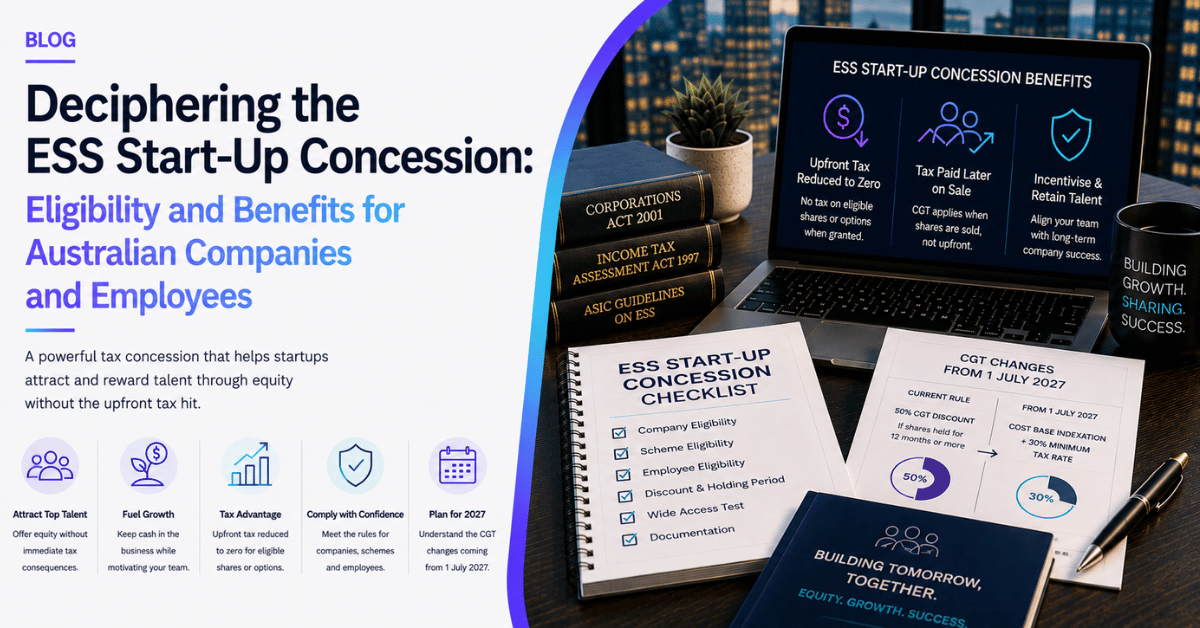
The Employee Share Scheme (ESS) start-up concession is a tax rule for new companies. It has been part of Australian law since July 2015.
Here is what it does in plain terms. It lets eligible companies give shares or options to their team without a big tax bill upfront. This is one big reason startups use employee share schemes to attract good people.
This guide explains who qualifies, step by step. It also explains a change coming in 2027 that every startup offering equity should know about.
How the ESS Start-Up Concession Works
Normally, when someone gets shares at a discount, they pay tax on that discount straight away. That can be a real problem if the shares are not easy to sell yet.
The start-up concession removes this problem. It brings the upfront tax down to zero for qualifying shares. The employee only pays tax later, when they actually sell.
When they do sell, Capital Gains Tax rules kick in instead. Right now, sellers can get a 50 percent discount on that tax if they held the shares for at least 12 months. This only applies to shares granted after 30 June 2015.
Here is the update to know. From 1 July 2027, new CGT rules change how this works. The 50 percent discount is replaced with cost base indexation and a 30 percent minimum tax rate. This applies to gains made after that date. So anyone planning to sell after mid-2027 should check how the new rules affect them, rather than assuming the old 50 percent discount still applies.
Does Your Company Qualify?
Not every company can offer this concession. The company itself must tick every box below.
- Turnover: the company, plus any related companies, must earn less than $50 million a year.
- Not listed: the company cannot be listed on a stock exchange.
- Age: the company must be less than 10 years old.
- Main business: the company cannot mainly buy, sell or hold shares and investments for others.
- Australian: the company must be an Australian tax resident.
If even one of these does not apply, the concession is not available.
Does Your Scheme Qualify?
The scheme itself also needs to meet some rules.
- Type of shares: they must be ordinary shares, or options and rights to get ordinary shares.
- Holding period: the employee must hold the shares for at least three years, or until they leave the company, whichever comes first.
- Exercise price: for options, the price to buy the shares must be at least their market value on the day they were granted.
- Discount limit: for shares, the discount cannot be more than 15 percent below market value.
- Wide access: if the company is more than three years old, at least 75 percent of its long-serving Australian employees must be offered a chance to join a scheme.
Does the Employee Qualify?
Individual employees or contractors need to meet two simple rules.
- They must work for the company, or a related company, as an employee or a contractor.
- They cannot own more than 10 percent of the company’s shares or voting rights, counting past and current grants together.
Why This Matters
For startups, this concession is a real tool. It helps you offer equity without a big cash cost, and without giving your team a surprise tax bill.
For employees, it means real ownership in a company’s growth, without paying tax before the shares are worth anything in cash.
But eligibility depends on turnover, age, listing status and how the scheme is built. So it pays to get the scheme checked before you grant any shares, not after. If just one rule is missed, every employee in the scheme can lose the concession.
What If Your Company Does Not Qualify?
Growing companies sometimes outgrow the turnover or age limits. That does not mean all options disappear.
Standard ESS tax deferral rules can still help. They let employees delay their tax, often until they can sell the shares or the company lists on the market. This works differently to the start-up concession, but it solves a similar problem. It is worth checking which rule actually applies to your scheme, rather than assuming either one does.
Quick Recap: Three Things to Check First
Before you offer any shares under this concession, run through three quick checks.
- Check your company’s turnover, age and listing status against the rules above.
- Check your scheme’s share type, holding period and discount all fit the limits.
- Check every eligible employee actually gets offered a chance to join, not just a few.
Getting these three things right from the start saves a lot of trouble later.
Frequently Asked Questions
1. What is the ESS start-up concession?
It is a tax rule that lets eligible new companies bring the upfront tax on employee shares down to zero. Employees pay tax later, when they sell, instead of when they first get the shares.
2. Which companies can use the ESS start-up concession?
To qualify, the company must generate less than $50 million in annual revenue, remain unlisted, be less than 10 years old, avoid operating primarily as an investment vehicle, and qualify as an Australian tax resident. The company must satisfy all of these requirements.
3. Will the 2027 tax changes affect the ESS start-up concession?
The concession itself still works the same way. The way tax applies when shareholders sell their shares is also changing. From 1 July 2027, the Government will replace the current 50% CGT discount with a cost base indexation system and a 30% minimum tax rate on gains that accrue after that date.
4. Can a contractor join an ESS start-up scheme, not just an employee?
Yes. Contractors can participate in the scheme if they provide services to the company or a related company, provided the scheme satisfies all other eligibility requirements.
5. What happens if a company misses one of the eligibility rules?
The concession does not apply, even if the company satisfies every other requirement. Instead, the employee share scheme interests fall under the standard ESS tax rules, which generally require participants to pay tax upfront.
Related Reading:
- Is Your Start-Up Considering an Employee Share Scheme?
- Changes to Employee Share Scheme Tax Laws: What You Need to Know
Useful Resources:
Contact Allied Legal to review your ESS eligibility: (03) 8691 3111 or hello@alliedlegal.com.au.
This article is provided for general information only and does not constitute legal advice. You should obtain legal advice specific to your circumstances before acting on any information contained in this article.