
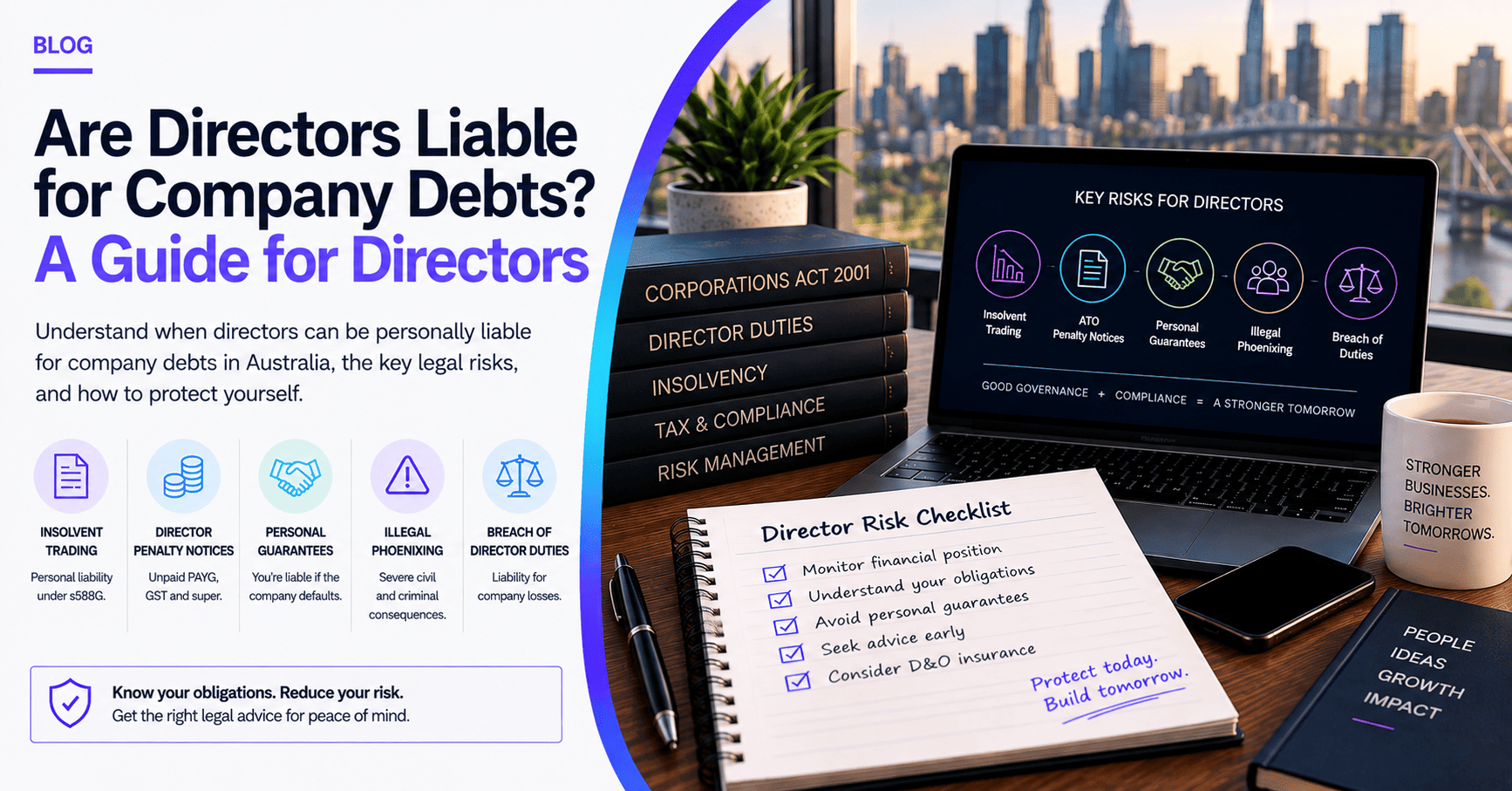
Many directors want a direct answer to one question: can they become personally liable for company debts? In some situations, yes. This guide sets out exactly when that risk arises under Australian law, and how you can reduce it.
What Is the Corporate Veil?
A company is a separate legal entity. It can own property, sign contracts, and incur debts in its own name. This separation, often called the corporate veil, generally shields directors and shareholders from personal responsibility for the company’s debts.
Australian courts respect this separation strongly. They rarely pierce the corporate veil, and they only step in when someone has clearly misused the company structure. Most director liability in Australia comes from specific statutes, not from a court disregarding the company altogether.
When Are Directors Liable for Company Debts?
Several distinct legal rules can expose a director to personal liability. Each one applies in a different situation, so it helps to understand them individually.
Insolvent Trading
Under section 588G of the Corporations Act 2001 (Cth), a director must prevent the company from incurring debts while insolvent. This also applies where a new debt would itself make the company insolvent. If a director allows this to happen, ASIC can pursue the director personally for the resulting debts. This is the single biggest source of personal liability for Australian directors.
Director Penalty Notices
The ATO can issue a Director Penalty Notice for unpaid PAYG withholding, GST, and superannuation guarantee amounts. Once issued, a director becomes personally liable for that debt unless they act quickly. This can mean placing the company into administration or liquidation within 21 days. Many directors do not realise this liability exists until a notice arrives.
Personal Guarantees
Banks, landlords, and suppliers often ask directors to personally guarantee a company loan or lease. If the company defaults, the guarantee makes the director directly responsible for that debt. This applies regardless of what happens to the company itself. This is a contractual liability, not a veil-piercing one, and a director can avoid it simply by declining to sign.
Illegal Phoenixing
Phoenixing involves transferring a failing company’s assets to a new company to avoid paying creditors, then continuing the same business. The Treasury Laws Amendment (Combating Illegal Phoenixing) Act 2020 introduced creditor-defeating disposition rules. These let a liquidator or ASIC unwind the transfers and pursue the directors involved, both civilly and criminally.
Breach of Director Duties
Directors owe statutory duties under sections 180 to 184 of the Corporations Act. These include a duty of care and diligence and a duty to act in good faith. A serious breach, particularly one involving dishonesty, can expose a director to personal liability for the company’s losses.
Can Courts Still Pierce the Corporate Veil?
Yes, but rarely, and usually alongside one of the statutory grounds above rather than instead of them. Courts have pierced the veil in a few narrow situations. One is where a company operated as a facade for fraud. Another is where a director used the company purely as a personal alter ego. A parent company can also become liable under section 588V of the Corporations Act. This applies if it controlled an insolvent subsidiary closely enough to be treated as responsible for that subsidiary’s debts. These situations remain the exception, not the rule.
Safe Harbour: A Way to Reduce the Risk
Directors worried about insolvent trading liability do not have to simply wait and hope. The safe harbour provisions in the Corporations Act protect a director from insolvent trading liability. This applies while they develop a genuine turnaround plan and meet the conditions the Act sets out. Getting professional advice early is central to relying on this protection.
How Directors Can Protect Themselves
A few practical steps lower the risk considerably. Keep financial records current and review the company’s cash position regularly. Take out director and officer (D&O) insurance, which covers many claims arising from decisions made in good faith. Ask for a deed of indemnity, which can cover certain liabilities incurred while acting reasonably as a director. Seek advice the moment insolvency looks possible, rather than after a creditor has already acted.
None of these steps protect a director who acts fraudulently or dishonestly. They exist to manage genuine business risk, not to excuse misconduct.
Limited liability protects directors in the ordinary course of business. It was never meant to cover insolvent trading, unpaid tax debts, personal guarantees, or dishonest conduct. Understanding exactly where that protection ends is the best way to avoid personal exposure.
Frequently Asked Questions
1. Are directors personally liable for company debts in Australia?
Generally, no. A company’s debts belong to the company, not its directors. Directors become personally liable only in specific situations. These include insolvent trading, a Director Penalty Notice for unpaid PAYG or superannuation, a personal guarantee, and illegal phoenixing.
2. What is insolvent trading and when does it make a director personally liable?
Insolvent trading happens when a director lets the company take on debt it cannot pay while existing debts are overdue. Under section 588G of the Corporations Act, this can make the director personally liable for that debt.
3. Can a director be liable for unpaid superannuation or tax?
Yes. The ATO can issue a Director Penalty Notice for unpaid PAYG withholding, GST, and superannuation guarantee amounts. This makes the director personally responsible for the debt unless they take specific action within 21 days of the notice.
4. Does resigning as a director remove personal liability?
No. Resignation does not erase past conduct. ASIC or the ATO can still pursue a former director for insolvent trading or breaches of duty. This includes unpaid tax debts from their time in the role.
5. What is safe harbour and how does it protect directors?
Safe harbour protects a director from insolvent trading liability while they develop and carry out a genuine restructuring plan. To rely on it, a director must meet the conditions set out in the Corporations Act. These include keeping proper records and taking appropriate advice early.
If you want to understand your specific risk as a director, Allied Legal can help. Our team advises directors across Australia on their duties and how to manage this exposure.
Contact Allied Legal today at 03 8691 3111 or email hello@alliedlegal.com.au to talk through your situation.
This article is provided for general information only and does not constitute legal advice. You should obtain legal advice specific to your circumstances before acting on any information contained in this article.



Commercial Law
Key Commercial Law Issues Founders Need to Know


COMMERCIAL LAW