
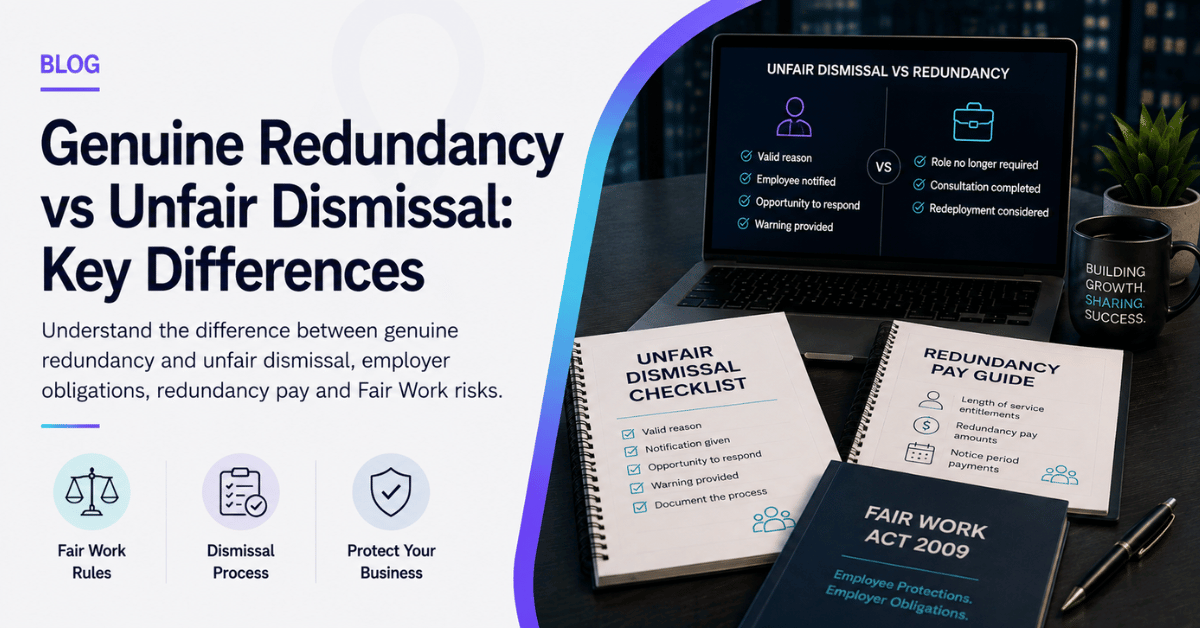
Australia has some of the strongest employee protection laws in the world. That’s good for workers, but it can also be a real risk for employers if a dismissal isn’t handled properly.
Allied Legal’s commercial lawyers regularly advise on exactly this issue.
This article explains unfair dismissal under the Fair Work Act 2009, and when a dismissal counts as a genuine redundancy instead. Worth knowing upfront: the Fair Work Commission, which generally handles these claims, tends to lean employee-friendly. Because claims are low-cost and easy to lodge, many dismissed employees will “have a crack” even where the employer has done everything by the book. So getting the process right matters.
When Can an Employee Claim Unfair Dismissal?
An employee can bring an unfair dismissal claim if two things are true.
First, they’ve worked for the employer for at least 6 months (for larger companies) or 12 months (for small businesses).
Second, at least one of the following applies:
- they’re covered by a modern award
- they’re covered by an enterprise agreement, or
- they earn less than the high income threshold, which is currently $190,100 (effective from 1 July 2026, and adjusted annually)
Working out whether someone is under the threshold isn’t always straightforward. Generally, only fixed and guaranteed earnings count, superannuation doesn’t count at all. Bonuses are the tricky part: discretionary, incentive-based or commission-based bonuses usually don’t count, since they can’t be predicted in advance. A guaranteed bonus, like a fixed quarterly payment, generally does count.
What Counts as “Harsh, Unjust or Unreasonable”?
To win an unfair dismissal claim, an employee needs to show the dismissal was harsh, unjust or unreasonable.
The Fair Work Act sets out a process employers can follow to keep a dismissal fair, sometimes called “managing someone out.” It generally means:
- there’s a valid reason for the dismissal, tied to the person’s conduct or capacity
- the employee is told what that reason is, for example, that their performance is below standard
- the employee gets a genuine chance to respond and explain
- the employee can bring a support person to any discussion about the dismissal
- the employee is clearly warned that they could be dismissed if they don’t improve, and given a fair chance to fix the problem
That warning needs to be explicit. Vague hints aren’t enough, the Fair Work Commission generally looks for something as direct as “if you do not improve your performance, you will be dismissed.”
What Happens If a Dismissal Is Found Unfair?
If an employer doesn’t follow this process, the employee may have a valid unfair dismissal claim.
Compensation is capped at whichever is lower: 26 weeks of the employee’s pay, or half the high income threshold. As of 1 July 2026, that cap sits at $95,050. This can be a significant cost for a business, so it’s worth taking real care before dismissing anyone in a way that could be seen as harsh, unjust or unreasonable.
What Is a Genuine Redundancy?
If someone is genuinely made redundant, it isn’t unfair dismissal, and they can’t bring an unfair dismissal claim over it.
A redundancy is “genuine” when:
- the role genuinely isn’t needed any more, because of changes to how the business operates
- if an award or enterprise agreement applies, the employer met its consultation obligations, and
- it wouldn’t have been reasonable to redeploy the employee elsewhere in the business, or a related entity
Whether it counts as genuine comes down to the actual circumstances. For example, if the role gets filled by someone else shortly after the dismissal, the Fair Work Commission is unlikely to see it as genuine. Employers need to be able to show the role truly wasn’t needed, and that this is why the employee was let go.
Redundancy Pay: How Much Is Owed?
Employees made genuinely redundant are entitled to redundancy pay, based on how long they’ve worked for the employer:
| Length of continuous service | Redundancy pay |
|---|---|
| At least 1 year, less than 2 years | 4 weeks |
| At least 2 years, less than 3 years | 6 weeks |
| At least 3 years, less than 4 years | 7 weeks |
| At least 4 years, less than 5 years | 8 weeks |
| At least 5 years, less than 6 years | 10 weeks |
| At least 6 years, less than 7 years | 11 weeks |
| At least 7 years, less than 8 years | 13 weeks |
| At least 8 years, less than 9 years | 14 weeks |
| At least 9 years, less than 10 years | 16 weeks |
| At least 10 years | 12 weeks (this drops because long service leave entitlements apply instead) |
On top of this, the employee is also entitled to be paid out their notice period. So redundancies can add up to a real cost for a business. You can check the Fair Work Ombudsman’s redundancy pay guidance for a calculator and further detail.
Key Takeaway
Getting a dismissal wrong, whether by mishandling the process or misjudging a redundancy, can expose a business to a real financial and legal risk. Understanding the difference between unfair dismissal and genuine redundancy, and following the right process either way, is the best protection.
Frequently Asked Questions
1. How long do I need to work somewhere before I can claim unfair dismissal?
At least 6 months for a larger employer, or 12 months for a small business.
2. What is the current high income threshold for unfair dismissal claims?
$190,100, effective from 1 July 2026. It’s adjusted annually, so it’s worth checking the current figure before relying on it.
3. What’s the maximum compensation for an unfair dismissal claim?
The lesser of 26 weeks’ pay or half the high income threshold, currently $95,050.
4. What makes a redundancy “genuine” rather than unfair dismissal?
The role genuinely isn’t needed any more due to business changes, any consultation obligations were met, and redeployment elsewhere in the business wasn’t reasonably possible.
5. How much redundancy pay is an employee entitled to?
It depends on length of service, ranging from 4 weeks after 1 year up to 16 weeks after 9 years, before dropping to 12 weeks at 10+ years due to long service leave entitlements.
Need Help? Contact Us
Navigating Fair Work laws can be difficult. Our team at Allied Legal can help, we have a wealth of experience acting for both employers and employees.
Call us on (03) 8691 3111 or email hello@alliedlegal.com.au.
Related reading: High Income Threshold and Unfair Dismissal: What Is a Non-Monetary Benefit?
This article is for general information only and doesn’t constitute legal advice. You should obtain advice specific to your circumstances before acting on anything discussed here.

Employment Articles
ESS Disclosure Requirements – A Roadmap (Part 3 – Loan Plans, Contribution Plans, Plans Involving ESOP Trusts)
Employment Articles
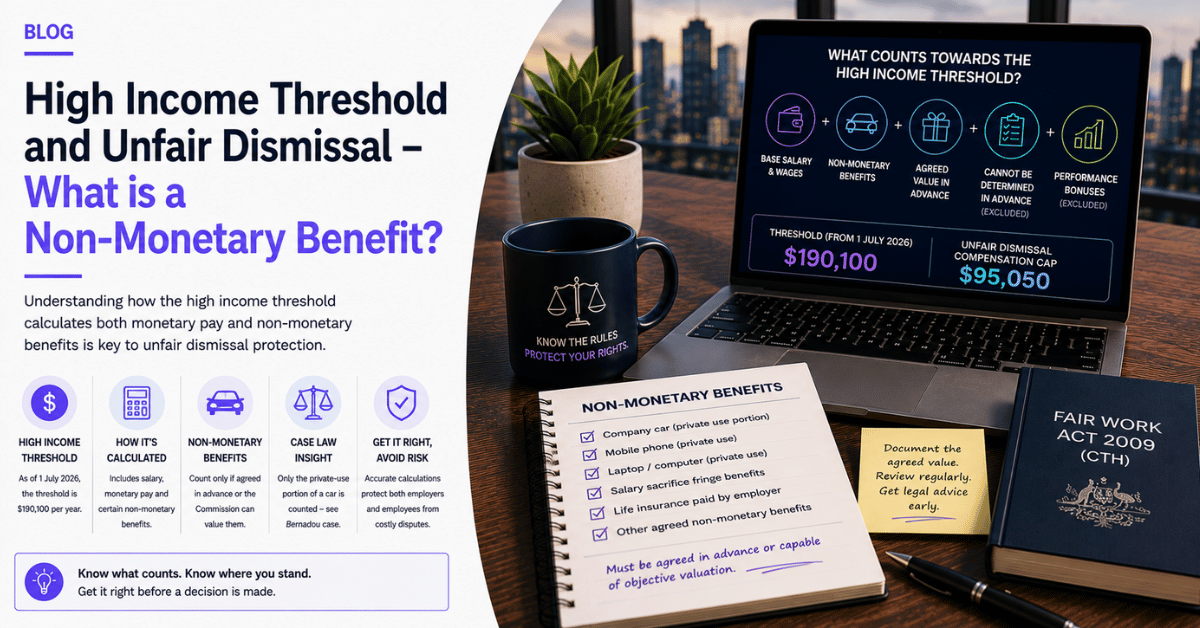
High Income Threshold and Unfair Dismissal – What is a Non-Monetary Benefit?
Employment Articles
ESS Disclosure Requirements – A Roadmap (Part 2 – General Disclosure Requirements)

Employment Articles
In the Balance: Employee or Contractor – Recent Court Ruling in Australia Reinforces Contract Importance
Employment Articles