
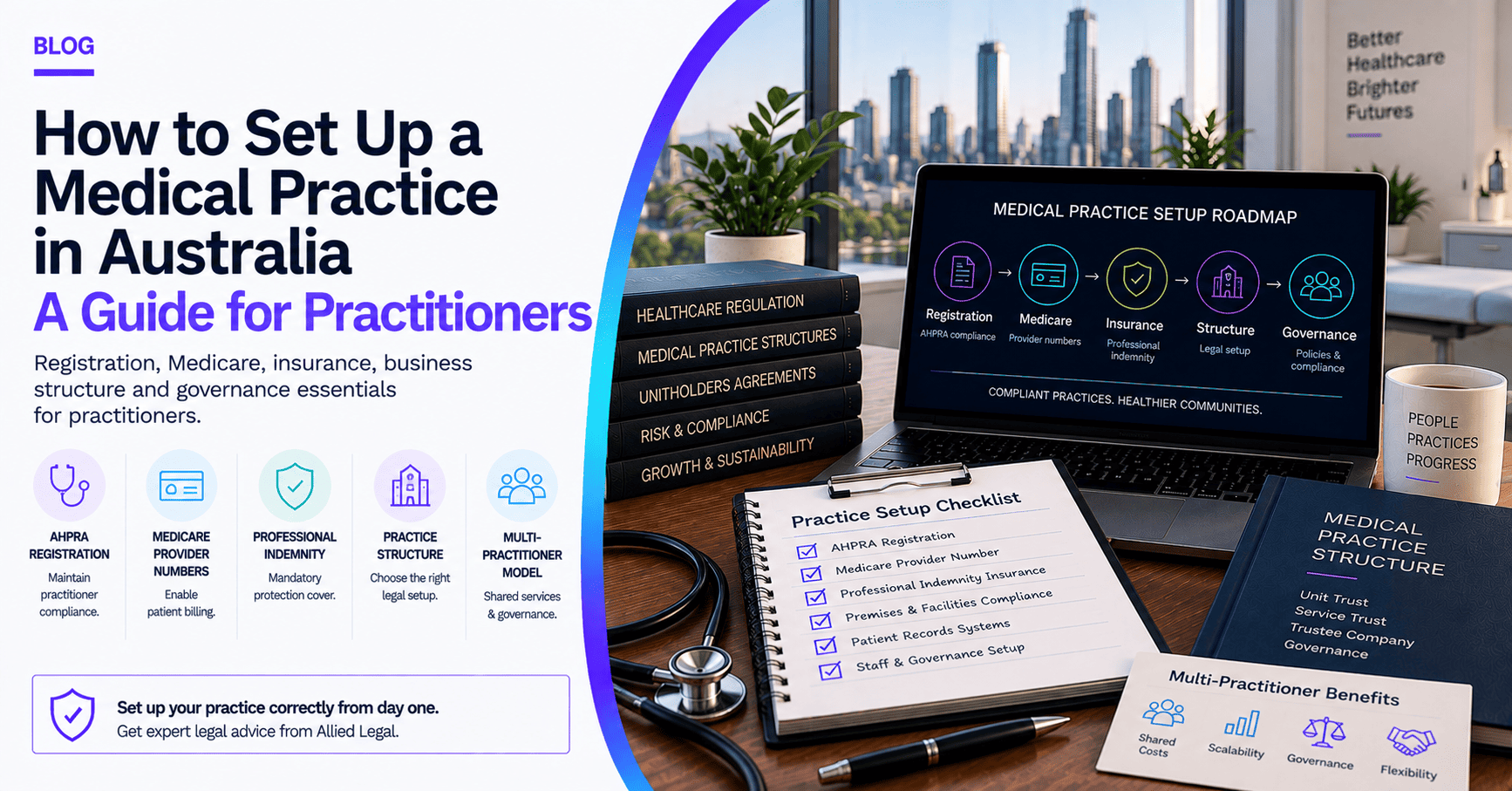
Setting up a medical practice in Australia involves more than finding premises and seeing patients. Registration, insurance, and business structure all need to be right from the start. Getting the structure wrong early can be expensive to unwind later. This guide covers how to set up a medical practice. It then looks specifically at structuring a multi-practitioner practice, an area Allied Legal advises on regularly.
Steps to Set Up a Medical Practice in Australia
Every practising doctor needs current registration with the Medical Board of Australia through AHPRA. This needs to stay current for the life of the practice, not just at setup. You also need a Medicare provider number for each practitioner who will bill Medicare. You apply for this through Services Australia using a PRODA account.
Professional indemnity insurance is not optional. Registered practitioners must hold adequate cover under section 129 of the Health Practitioner Regulation National Law. A practice needs to confirm this cover is in place before a doctor sees their first patient.
Beyond registration and insurance, you need compliant premises, appropriate staffing, and systems that protect patient health records. Some specialties also need specific facility accreditation, such as day procedure centre licensing for certain procedural practices. Check your state health department’s requirements early, rather than after you sign a lease.
Choosing a Business Structure for a Multi-Practitioner Practice
Allied Legal is increasingly advising on multi-practitioner medical practices. Medical professionals can see real benefits in combining forces. Sharing overheads such as practice management, insurance, accounting, and tax creates genuine economies of scale. It also lets practitioners share knowledge and support each other as partners should.
When practitioners partner up, the right structure matters. It lets each doctor focus on patients. Administrative and managerial tasks then sit with the structure itself, rather than any one practitioner.
We generally find that a unit trust structure suits the needs of specialist practices like a medical clinic. In this structure, a trust holds the service business, and a company acts as trustee. Each doctor’s holding entity, usually the trustee of a family trust, generally holds units in the trust. Each doctor personally holds shares in the trustee company.
Once each financial year’s accounts are finalised, each unitholder can generally draw their proportion of the service business profits. Many unitholders agreements also allow gradual draws against expected profits throughout the year, rather than waiting until year end.
What the Unitholders Agreement Should Cover
A well-drafted unitholders agreement should address:
- An agreed approach to buy-in and buy-out of the trust.
- Qualification requirements for participating doctors and new entrants.
- General governance, including a board to manage the service entity’s daily running.
- Voting requirements for key business decisions.
- How the practice shares expenses.
- A restraint of trade if a practitioner leaves, provided it is reasonable in scope, area, and duration.
- How the trust makes distributions to unitholders.
Advantages of the Service Trust Structure
This structure lets practitioners maintain a shared service entity together. It removes shared managerial duties, while each practitioner still runs their own practice separately. Unitholders can generally join or leave with more flexibility than a traditional partnership allows, subject to the unitholders agreement. It can also accommodate real practice issues, such as a doctor needing leave due to illness or disability, without leaving their patients unsupported. Tax treatment then depends on who holds the units. A corporate unitholder pays tax at the corporate rate. A family trust unitholder can generally access the tax advantages that a family trust offers.
A Caution on ATO Scrutiny
Service trust arrangements attract real ATO attention. This structure needs proper implementation, not simple adoption because it is common. The fees the trust charges practitioners need to be commercial and reasonable, reflecting genuine services actually provided. A written service agreement should document all of this clearly. Recent ATO activity has specifically revisited service trust fee arrangements. Getting the documentation and pricing right at setup, and reviewing it periodically, matters as much as choosing the structure itself.
Frequently Asked Questions
1. What do I need to set up a medical practice in Australia?
At minimum, you need current AHPRA registration and a Medicare provider number for each billing practitioner. You also need professional indemnity insurance, compliant premises, and a business structure that suits how you and any other practitioners want to operate.
2. Do I need professional indemnity insurance to set up a medical practice?
Yes. Registered practitioners must hold adequate professional indemnity insurance under the Health Practitioner Regulation National Law. A practice should confirm this cover is in place before any doctor sees a patient.
3. Why do multi-practitioner medical practices often use a unit trust structure?
A unit trust, with a company acting as trustee, lets each practitioner share overheads and administrative tasks. Each practitioner still runs their own practice separately, and the structure generally offers more flexible entry and exit terms than a traditional partnership.
4. Is a unit trust structure right for every medical practice?
No. The right structure depends on the number of practitioners, how they want to share costs and control, and their individual tax positions. A solo practitioner or a small partnership may not need this level of structure at all.
5. What should a unitholders agreement cover?
It should cover buy-in and buy-out terms, qualification requirements for new entrants, governance arrangements, voting rights, and expense sharing. It should also set out restraint of trade terms and how the trust makes distributions.
6. Does the ATO scrutinise service trust arrangements used by medical practices?
Yes. The ATO looks closely at whether service fees charged to practitioners are commercial and reasonable, and whether the arrangement is properly documented. Getting this right at setup reduces the risk of a later dispute with the ATO.
A unit trust structure is not right for every practice. The correct structure depends on the number of practitioners, how they want to share costs and control, and their individual tax positions. Allied Legal can help you assess your options and put the right agreements in place from the start.
Contact Allied Legal at info@alliedlegal.com.au if you have questions or need help setting up your medical practice.
This article is provided for general information only and does not constitute legal advice. You should obtain legal advice specific to your circumstances before acting on any information contained in this article.