Setting up a company in Australia gives your business a separate legal identity, limited liability, and a structure investors recognise. Company incorporation Australia wide follows one national framework, regardless of which state you trade in. This guide walks through the requirements for incorporating a company in Australia. It covers everything from choosing a structure to staying compliant after registration.
If timing is your main question rather than process, our guide on when to incorporate your startup covers that separately.
Why Incorporate a Company in Australia?
Incorporation gives owners limited liability, so personal assets generally stay protected from business debts. It also adds credibility with investors, lenders, and customers, and makes it easier to raise capital and scale. Company profits can also attract a lower tax rate than individual income in some circumstances. Eligible base rate entities pay 25% tax, rather than the standard 30% company rate. Every company must meet the requirements set by the Australian Securities and Investments Commission (ASIC). These requirements sit in the Corporations Act 2001 (Cth).
Choosing the Right Business Structure
Before incorporating a company in Australia, decide which structure fits your plans. Australia recognises two main company types.
A proprietary company (Pty Ltd) suits most small and medium businesses. It cannot raise funds from the public, and it caps non-employee shareholders at 50. It also carries fewer reporting obligations than a public company.
A public company (Ltd) suits businesses planning to raise capital from investors or list on the Australian Securities Exchange (ASX). It needs at least three directors, with at least two ordinarily residing in Australia. It also faces stricter obligations, including annual general meetings and financial reporting.
Minimum Requirements for Incorporation
To incorporate a company, you need to satisfy three core requirements.
Directors: a proprietary company needs at least one director who ordinarily resides in Australia. A public company needs at least three directors, with at least two residing in Australia. Every director must hold a Director Identification Number before appointment, under the Modernising Business Registers program.
Shareholders: every company needs at least one shareholder, and there is no residency requirement for shareholders.
Registered office: your company needs a physical address in Australia for formal document service. This address must stay accessible during ordinary business hours. Many companies use a registered agent’s address for this purpose.
Company Governance: Constitution or Replaceable Rules
Every company needs a governance framework, either a written constitution or the replaceable rules set out in the Corporations Act. The replaceable rules act as a default rulebook, covering matters like directors’ meetings, shareholder rights, and dividends. They work well for many simple companies. If you want to change any of these default rules, your company needs its own constitution instead. Common examples include adding share transfer restrictions or special voting rights.
How ASIC Regulates Company Incorporation
ASIC administers company incorporation Australia wide under the Corporations Act. To register, a company needs an Australian Company Number (ACN). ASIC issues this automatically on registration. Most trading companies also need an Australian Business Number (ABN). Proprietary companies still need at least one Australian resident director. Public companies need at least two, consistent with the requirements above.
Choosing and Registering a Company Name
Your company name cannot mislead the public or suggest an association it does not have. It must also be distinguishable from existing registered names. Certain words, including “bank,” “trust,” “university,” and “Royal,” need specific regulatory approval before use.
ASIC lets you check name availability through its business registration portal before you apply. If your preferred name is available, you can reserve it for up to two months while you finalise incorporation. If you plan to trade under a name different from your registered company name, register that business name separately.
Director Eligibility Rules
Anyone appointed as a director must be at least 18 years old. A person cannot serve as a director while bankrupt. The same applies if a court or ASIC has disqualified them from managing corporations. ASIC actively enforces these restrictions and can disqualify directors who breach their duties.
Steps to Incorporate a Company in Australia
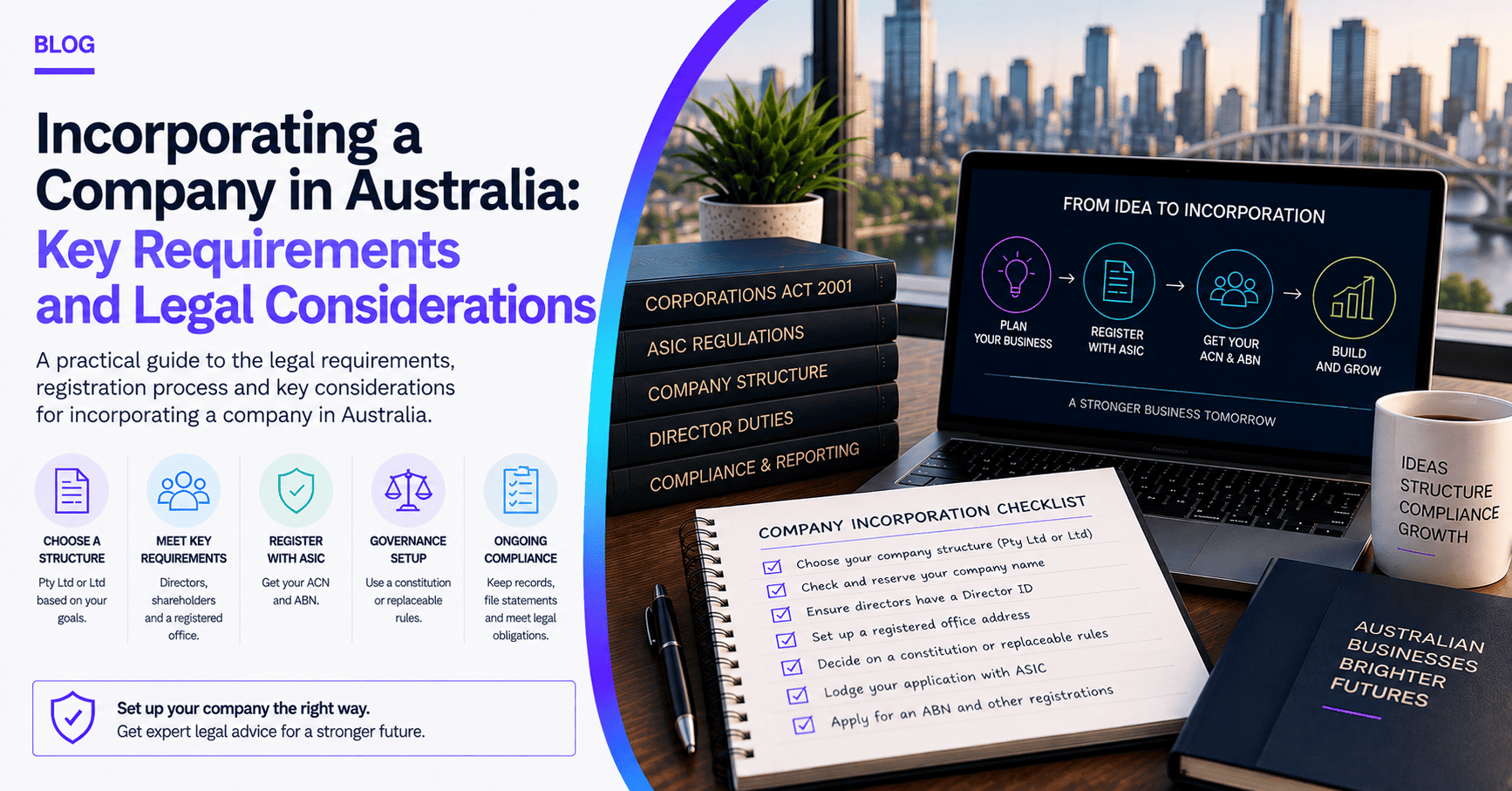
The registration process generally follows the same sequence:
- Choose your company structure, either proprietary or public.
- Check your preferred company name is available, and reserve it if needed.
- Confirm each proposed director holds a Director Identification Number.
- Decide whether the company will operate under a constitution or the replaceable rules.
- Identify your shareholders and confirm the shares each will hold.
- Set up a registered office and a principal place of business.
- Lodge your application with ASIC and pay the registration fee.
- Apply for an ABN and any other registrations your business needs once ASIC issues your ACN.
Costs and Timeframes
ASIC charges a standard fee to register a new company. This fee changes periodically, so check the current fee schedule on ASIC’s website for the exact amount. Public company registration costs more and depends on the company’s structure and capital. Once your application and payment are complete, ASIC often processes registration within one to three business days. Sometimes it happens the same day, through ASIC’s online lodgement system.
Registering a Foreign Company in Australia
A foreign company must register with ASIC before it carries on business in Australia, not afterwards. It must also appoint a local agent who takes responsibility for the company’s compliance with the Corporations Act. It must also comply with Australia’s Anti-Money Laundering and Counter-Terrorism Financing laws, including reporting certain transactions to AUSTRAC. Requirements can differ from other countries. The United States handles incorporation at the state level, with separate rules for LLCs and corporations. Singapore, like Australia, requires at least one local director.
Staying Compliant After Incorporation
Once incorporated, your company takes on ongoing obligations. It must keep proper financial records for seven years and prepare financial reports that meet Australian accounting standards. Public companies must hold annual general meetings. Your company must also notify ASIC within 28 days of changes to directors, addresses, or share structures. It must confirm its details with ASIC annually and pay the applicable review fee. The registered office must stay open to the public during ordinary business hours throughout the life of the company.
Shareholder Agreements and the Cap Table
Incorporation gives you a company, but it does not protect the relationships between its owners on its own. A shareholder agreement sets out how the company makes decisions and issues new shares. It also covers what happens if a shareholder wants to exit, and how to resolve disputes. Keeping an accurate cap table from day one also helps later. It makes fundraising, share transfers, and employee share schemes far easier to manage.
Getting Legal Advice
Incorporating a company in Australia involves genuine legal complexity. Getting the structure wrong early can be expensive to fix later. A commercial lawyer can help you choose the right structure and meet ASIC’s requirements. They can also draft shareholder agreements and governance documents, and manage the tax and legal risks of running a company.
Frequently Asked Questions
1. What is company incorporation in Australia?
Company incorporation is the legal process of registering a business as a separate legal entity with ASIC. This happens under the Corporations Act 2001 (Cth). Once incorporated, the company can own property, enter contracts, and incur debts in its own name, separately from its owners.
2. How much does it cost to set up a company in Australia?
ASIC publishes a standard registration fee for a proprietary company on its current fee schedule. You may also pay professional fees if you use a lawyer or registered agent. Public company registration costs more, since it depends on the company’s structure and capital.
3. How long does it take to incorporate a company in Australia?
Once your application and payment are complete, ASIC typically processes registration within one to three business days. Sometimes this happens the same day, through its online system. Delays usually come from name availability issues or incomplete director information rather than ASIC’s processing time itself.
4. Do I need an Australian resident director to incorporate a company?
Yes. A proprietary company needs at least one director who ordinarily resides in Australia. A public company needs at least three directors, with at least two ordinarily residing in Australia. Every director also needs a Director Identification Number before appointment.
5. Can a foreign company operate in Australia without registering?
No. A foreign company must register with ASIC before it carries on business in Australia, not after. It must also appoint a local agent responsible for its compliance with the Corporations Act.
6. What is the difference between a proprietary company and a public company?
A proprietary company (Pty Ltd) cannot raise funds from the public, and it caps non-employee shareholders at 50. It also faces fewer reporting obligations. A public company (Ltd) can raise capital from investors and list on the ASX. It must meet stricter requirements though, including more directors and annual general meetings.
7. Does my company need its own constitution?
Not necessarily. Many companies rely on the replaceable rules in the Corporations Act instead of a custom constitution. You only need a constitution if you want to change or add to those default governance rules. A common example is restricting how shareholders can transfer their shares.
8. Is an ACN the same as an ABN?
No. ASIC issues an ACN (Australian Company Number) automatically when it registers your company. The ACN identifies the company itself. An ABN (Australian Business Number) is a separate registration you generally need if the company will trade. Businesses use it for tax and invoicing purposes.
For expert assistance with incorporating a company in Australia, contact Allied Legal today. We offer guidance through every stage of the process, from structure selection through to ongoing compliance.
This article is provided for general information only and does not constitute legal advice. You should obtain legal advice specific to your circumstances before acting on any information contained in this article.