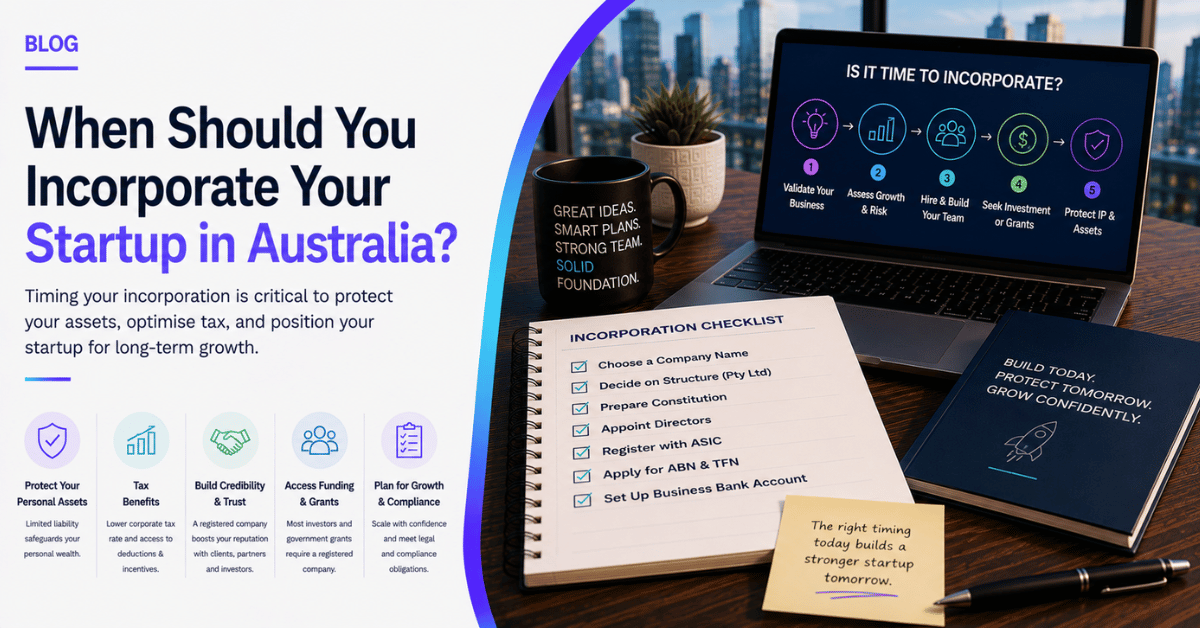
Starting a business in Australia is an exciting venture, but timing your company’s incorporation is critical to safeguarding your assets, optimising tax efficiency, and positioning your startup for growth. While many founders rush to register their business, others delay incorporation until it’s too late.
This guide unpacks the legal, financial, and strategic factors to determine when to incorporate your startup in Australia, aligned with local laws and best practices.
Why Incorporation Matters for Australian Startups
Incorporating your startup as a registered company under the Corporations Act 2001 (Cth) offers key advantages:
Limited Liability Protection
One of the biggest advantages of incorporation is limited liability, which protects your personal assets from business debts and legal claims. If your startup faces financial difficulties or lawsuits, your home, savings, and personal belongings remain safeguarded, as long as you comply with corporate governance requirements. This is especially crucial for founders in industries with higher legal or financial risks, such as fintech, healthcare, or SaaS platforms handling sensitive customer data.
Tax Benefits
Incorporating your business can offer significant tax advantages. Companies in Australia pay a base rate of 25% corporate tax rate (for businesses with aggregated turnover under $50 million) or 30% for other companies, which is often lower than individual marginal tax rates that can reach up to 45% plus Medicare levy. Additionally, incorporated businesses may qualify for tax deductions on expenses like R&D, equipment purchases, and employee salaries. Startups engaged in innovation can also access tax incentives such as the R&D Tax Incentive, which provides refunds or tax offsets for eligible research and development activities.
Credibility and Professionalism
A registered company enhances your startup’s credibility in the eyes of investors, customers, and business partners. Many B2B clients and corporate partners prefer to work with Pty Ltd companies rather than sole traders or partnerships, as incorporation signals a commitment to long-term business operations. A formal company structure also makes it easier to establish contracts, open corporate bank accounts, and build a strong brand reputation.
Access to Funding and Grants
Most venture capitalists, angel investors, and government grants require startups to be incorporated before providing funding. Investors view a registered company as a legally structured entity with clear ownership and governance, reducing risk. Many Australian startup grants, including the Entrepreneurs’ Programme and Accelerating Commercialisation Grant, mandate incorporation as part of the eligibility criteria. Additionally, incorporation allows founders to issue shares, which is essential for raising capital through equity investment rounds.
Compliance and Administrative Considerations
While incorporation provides these benefits, it also comes with compliance obligations. Companies must register with ASIC (Australian Securities and Investments Commission), maintain financial records, submit annual reports, and meet taxation requirements with the ATO (Australian Taxation Office). The added administration can increase costs and complexity, which is why it’s important to assess the right timing for incorporation based on your business stage, risk exposure, and funding needs.
Key Factors to Determine When to Incorporate
1. Business Validation Stage
Before incorporating, validate your business idea. If you’re still testing prototypes or conducting market research, operating as a sole trader or partnership (with an ABN) may be more cost-effective. Once you’ve secured early customers or commitments, incorporation becomes strategic to limit liability and formalise operations.
Australian Example: A Sydney-based SaaS startup waited to incorporate until securing its first enterprise client, avoiding unnecessary ASIC fees during the proof-of-concept phase.
2. Scaling Plans and Risk Exposure
If your startup involves significant financial risk (e.g., hiring employees, leasing equipment, or handling client data), incorporation is advisable. Under Australian law, unincorporated businesses expose founders to unlimited liability for lawsuits or debts.
3. Hiring Employees or Contractors
Once you hire staff, incorporation simplifies payroll management, superannuation contributions (currently 11.5%), and compliance with the Fair Work Act 2009. Companies must obtain workers’ compensation insurance and can issue employee share schemes (ESS), which may qualify for tax concessions under Division 83A of the Income Tax Assessment Act 1997.
4. Seeking Investment or Grants
Most Australian investors (e.g., venture capital firms, angel networks) require startups to be incorporated before funding. Similarly, government grants like the Entrepreneurs’ Programme or R&D Tax Incentive mandate a registered company structure.
Pro Tip: Incorporate at least 3–6 months before pitching to investors to demonstrate stability and compliance.
5. Intellectual Property (IP) and Asset Protection
If your startup owns valuable IP (e.g., patents, trademarks), holding these assets under a company structure prevents personal liability in IP disputes. The Corporations Act also allows for easier transfer of ownership during equity sales.
Once you’ve decided to incorporate, it’s important to follow the correct legal steps to ensure compliance with Australian regulations. Incorporation establishes your business as a separate legal entity, providing liability protection and facilitating access to funding. Below is a step-by-step guide to incorporating a company in Australia.
The Incorporation Process in Australia
Once you’ve decided to incorporate, follow these steps under Australian law:
1. Choose a Business Structure
The first step is selecting the right business structure. Most startups opt for a Proprietary Limited Company (Pty Ltd) due to its flexibility, limited liability protection, and ability to raise investment through share issuance. Other structures, such as sole trader, partnership, or trust, may be suitable in specific cases, but they lack the same level of legal separation and scalability.
2. Register with ASIC
To formally incorporate, you must register your company with the Australian Securities and Investments Commission (ASIC). This process involves:
- Reserving a company name – A $50 fee applies if you wish to secure a name before registration. Ensure the name is unique and compliant with ASIC’s guidelines.
- Appointing at least one Australian resident director – Every company must have at least one director who resides in Australia.
- Providing a registered office address – This must be a physical Australian address (not a PO Box).
- Paying the incorporation fee – The ASIC registration fee is $595 (as of 2025).
Once registered, you will receive an Australian Company Number (ACN), which serves as your company’s unique identifier.
3. Obtain Industry-Specific Licences and Permits
Certain industries require additional licences or permits to operate legally. For example:
- Hospitality and food businesses may need food handling permits.
- Financial services providers must comply with Australian Financial Services Licence (AFSL) requirements.
- Import/export businesses may need customs registrations.
Check with business.gov.au to determine which licences apply to your startup.
4. Set Up Governance and Internal Agreements
Proper corporate governance ensures smooth business operations and prevents future disputes. At this stage, founders should:
- Draft a Shareholders’ Agreement – This outlines the rights, responsibilities, and equity distribution among founders and investors. A well-structured agreement helps prevent conflicts over decision-making, ownership, and exit strategies.
- Adopt a Company Constitution – While not legally required, a constitution can provide additional governance rules beyond ASIC’s default replaceable rules.
5. Register for Taxes and Compliance Obligations
Once incorporated, you must register your company for tax purposes with the Australian Taxation Office (ATO):
- Apply for an Australian Business Number (ABN) – Essential for tax and business transactions.
- Register for Goods and Services Tax (GST) – Required if your annual turnover exceeds $85,000 (as of 2025).
- Set up Pay-As-You-Go (PAYG) withholding – Necessary if you intend to hire employees or pay directors’ salaries.
Additionally, some startups may qualify for tax incentives such as the R&D Tax Incentive, which provides refunds or offsets for eligible research activities.
6. Estimated Costs of Incorporation
Incorporation involves several costs beyond ASIC fees, including legal, tax, and accounting expenses. On average, you should budget:
- $1,000–$3,000 for incorporation, covering ASIC fees, legal agreements, and accounting setup.
- Annual ASIC compliance fees of $310+ to maintain registration (as of 2025).
- Additional costs for legal consultations, tax registration, and industry-specific licences.
Common Mistakes to Avoid
When to Delay Incorporation
Hold off if:
- You’re bootstrapping with minimal risk (e.g., freelance consulting).
- Testing multiple ideas simultaneously (use sole trader structures for each).
- Waiting for grant application deadlines (incorporate closer to submission dates).
FAQs About Incorporation in Australia
1. Can a non-resident incorporate a company in Australia?
Yes, but you must appoint at least one director who resides in Australia.
2. How long does incorporation take?
ASIC typically processes registrations within 1–2 business days.
3. What’s the difference between a Pty Ltd and a public company?
Proprietary companies cannot raise capital from the public, making them ideal for startups.
Key Takeaways
Incorporating your startup in Australia is a pivotal decision that impacts liability, tax outcomes, and growth potential. By aligning incorporation with your validation stage, risk exposure, and funding goals, you’ll avoid costly missteps.
Always consult an Australian business lawyer or accountant to ensure compliance with ASIC regulations and tax planning.
This article is provided for general information only and does not constitute legal advice. You should obtain legal advice specific to your circumstances before acting on any information contained in this article.