

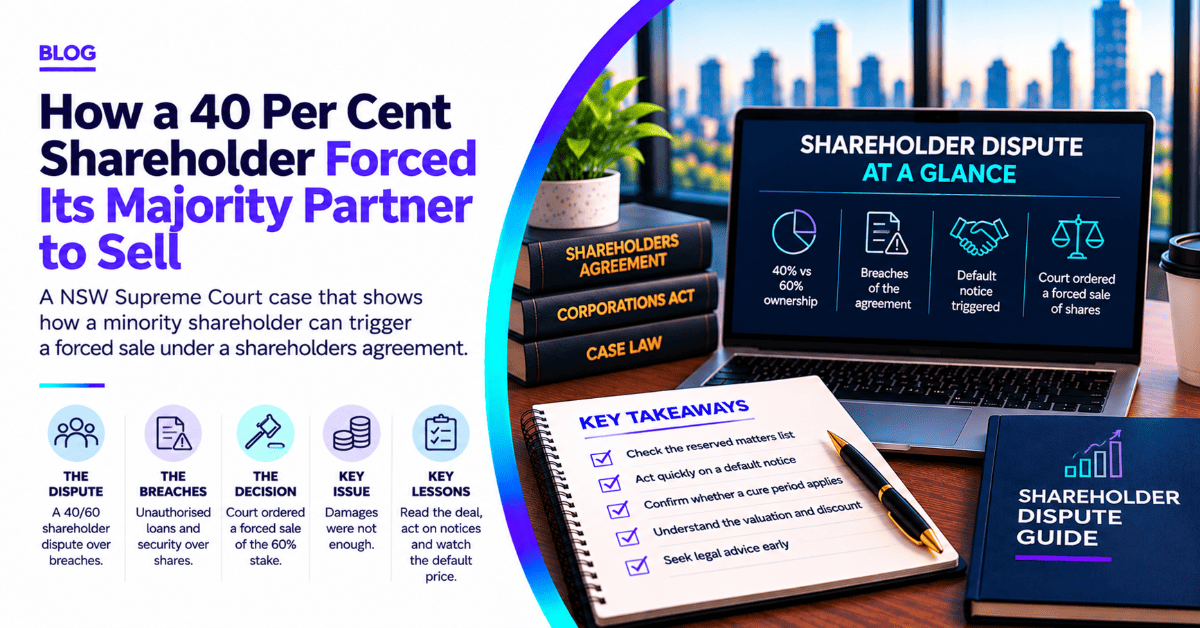
Most people assume that if you hold 60 per cent of a company, you run it. In Sibley Investments Pty Ltd v Oldfields Advance Scaffold Pty Ltd [2026] NSWSC 1021, the Supreme Court of New South Wales held that a 40 per cent shareholder was entitled to compel the 60 per cent shareholder to sell its entire stake under their shareholders agreement. Judgment was given on 26 August 2026.
Adelaide Scaffold Solutions Pty Ltd was a substantial business, turning over about $11 million a year with around 55 to 60 employees. Oldfields Advance Scaffold held 60 per cent and Sibley Investments held 40 per cent.
What went wrong
The shareholders agreement listed “Major Matters” that needed approval from holders of at least 75 per cent of the votes. Loans or advances over $50,000 were one of them. On those decisions, Oldfields needed Sibley.
It didn’t ask. From August 2020, money went from the company to other companies in the Oldfields group, and by February 2025 about $1.96 million was owing. Separately, in 2022 Oldfields had given security over all its assets, which caught its shares in the company. The agreement prohibited that too.
Oldfields admitted both breaches at trial. Its fight was about the consequence, which sat in clause 10. Once a default notice was served, the defaulting shareholder was deemed to have offered all its shares to the other shareholders at 90 per cent of fair market value.
The PPSR search
Sibley found the security because it was preparing to buy Oldfields out. On 27 March 2025 its solicitors searched the Personal Property Securities Register. The search revealed security over Oldfields’ shares that may not have been apparent from the company’s ordinary records. The next day Sibley served two default notices, one for the loans and one for the security.
The two defaults worked differently. The loan default allowed ten days to fix the breach. Oldfields accepted the notice was valid but didn’t repay in time, and the Court held that Sibley did not need to serve a second notice once the ten days had passed.
The security default had no cure period at all. Under clause 10(a)(i) it was an immediate default, and Sibley’s notice invoked the deemed offer and accepted it, subject to completion conditions.
On 16 May 2025 the secured party signed a deed poll releasing the shares. By then, Sibley had already exercised its contractual rights. The Court held that releasing the security did not undo those rights.
Oldfields also argued that the agreement had come to an end because of other proceedings involving the company. The Court rejected that, and said that even if the agreement had ended, rights arising from the earlier defaults would have survived.
Why money wasn’t enough
Oldfields said damages would do. The Court ordered specific performance instead, which meant Oldfields had to hand over the shares.
Shares in a private company can’t simply be bought elsewhere, so courts ordinarily enforce contracts over them directly. These shares also carried control. Sibley would go from 40 to 100 per cent, and the valuation formula in the agreement didn’t reflect the value of that control, so damages calculated under it would have left Sibley short.
The price was later fixed under the formula in Sibley Investments Pty Ltd v Oldfields Advance Scaffold Pty Ltd (No 2) [2026] NSWSC 1181, on 29 September 2026. It is a New South Wales decision, but nothing in the reasoning is peculiar to that state. The same contract and equitable principles apply in Victoria.
What you should take from it
For majority holders, the first step is to read the reserved matters list again. Loans between related companies and security over shares are easy to put in place without anyone opening the shareholders agreement. Between them, they cost Oldfields its controlling stake.
Received a default notice? Repaying the money or releasing the security may not end it. Work out first whether the agreement has already given the other side a right. Here it had, before the security was released.
The same care applies on the other side. Before a notice goes out, the default clause needs a close read, because the breach you rely on and whether it carries a cure period can decide whether the notice works.
And when the agreement is first negotiated, look hard at the default price. A 10 per cent discount sounds modest until it is applied to a controlling stake.
Allied Legal acts on shareholders agreements and shareholder disputes. If a default notice is about to go out, or has just arrived, we can review the agreement and tell you where you stand before anyone takes the next step.
This article is general information only and does not constitute legal advice. You should obtain advice specific to your circumstances before acting.






Customer Success: Fuel For Your Startup