
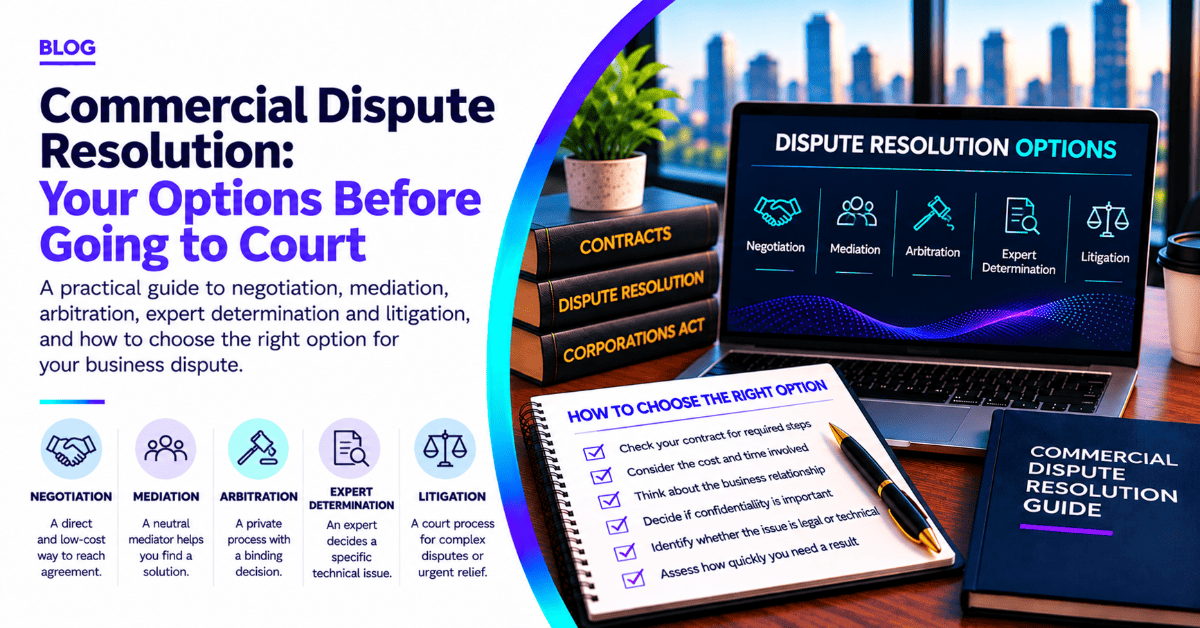
Disputes are a normal part of doing business. A supplier misses deadlines, a customer refuses to pay or a partner walks away from a deal. When that happens, court is rarely the only option, and it is often not the best one. Commercial dispute resolution covers the full range of ways to settle a business disagreement, from a simple conversation to a binding decision.
This guide explains each option, when it works best and what it is likely to cost, so you can choose the right path for your dispute.
Why Your Choice of Process Matters
The process you choose affects how long the dispute takes, how much it costs and who controls the outcome. It also affects whether the dispute stays private and whether you can keep working with the other side afterwards.
Before you decide, check your contract. Many commercial contracts include a dispute resolution clause that sets out the steps you must follow, such as negotiation followed by mediation or arbitration. If you skip those steps, a court may pause your case until you complete them.
Negotiation
Negotiation is the simplest and cheapest form of commercial dispute resolution. The parties, or their lawyers, talk directly and try to reach an agreement.
Negotiation works best when both sides want to preserve the relationship and the issues are fairly clear. A well-drafted letter of demand often opens the conversation. You can also make without prejudice offers, which let you put forward a compromise without the other side using it against you in court.
Mediation
Mediation brings in a neutral third party, the mediator, to help the parties reach their own agreement. The mediator does not decide who is right. Instead, they guide the discussion, test each side’s position and help find common ground.
Mediation is confidential, flexible and usually completed in a day. As a result, it is one of the most popular forms of alternative dispute resolution in Australia. Courts also encourage it. The Federal Court, for example, can order parties to attend mediation even when they do not agree to it.
If the parties settle, they sign a written agreement that can be legally binding. If they do not, they can still move on to another process.
Arbitration
Arbitration is a private alternative to court. The parties appoint an arbitrator, often an expert in the relevant industry, who hears evidence and makes a binding decision called an award.
Arbitration usually only happens if your contract requires it or both parties agree to it. Its main advantages are privacy, expert decision-makers and limited rights of appeal, which can make the outcome more final. It is also common in international contracts, since awards are easier to enforce overseas than many court judgments. Organisations such as ACICA administer arbitrations in Australia.
However, arbitration is not always cheap. You pay the arbitrator’s fees and venue costs, and a complex arbitration can cost as much as litigation.
Expert Determination
Expert determination suits disputes that turn on a technical question rather than a legal one. For example, it works well for disagreements about a valuation, a set of accounts or whether building work meets a specification.
The parties appoint an independent expert to decide the issue. The process is usually faster and cheaper than arbitration or court. Whether the decision binds the parties depends on the contract, so check the wording carefully. Similarly, confirm who will act as the expert, how you will share the costs and what information each side can put forward. Clear rules at the start help avoid a second dispute about the process itself.
Litigation
Litigation means taking the dispute to court. A judge hears the evidence and makes a binding decision that the court can enforce.
Litigation makes sense when the other side will not engage, when you need an urgent order such as an injunction, or when an important legal principle is at stake. It also gives you access to court powers, such as compelling the other side to produce documents.
On the other hand, litigation is public, slow and expensive. The losing party usually pays part of the winner’s legal costs, but rarely all of them. Before you start, our corporate and commercial litigation team can help you weigh the likely costs against what you stand to recover.
Choosing the Right Commercial Dispute Resolution Option
There is no single best process. Instead, consider these questions:
- What does your contract say about dispute resolution?
- How much money is at stake compared with the likely costs?
- Do you want to keep doing business with the other party?
- Does the dispute need to stay confidential?
- Is the core issue legal, technical or commercial?
- How quickly do you need an outcome?
In practice, many disputes move through several stages. A business might negotiate first, then mediate, and only start court proceedings if those steps fail. Small businesses may also be able to get low-cost help through the Australian Small Business and Family Enterprise Ombudsman.
How Allied Legal Can Help
Our dispute resolution lawyers help businesses choose the right process and see it through. We negotiate on your behalf, prepare you for mediation, run arbitrations and expert determinations, and represent you in court when needed. If you want to reduce the risk of future disputes, we can also review your contracts and dispute resolution clauses.
To discuss your dispute, call us on 03 8691 3111 or email hello@alliedlegal.com.au.
Frequently Asked Questions
1. What is commercial dispute resolution?
Commercial dispute resolution covers the ways businesses settle disagreements with customers, suppliers, partners and others. It includes negotiation, mediation, arbitration, expert determination and litigation.
2. Is mediation legally binding?
The mediation process itself is not binding, and either party can walk away. However, if the parties reach agreement and sign a settlement deed, that agreement is usually legally binding.
3. What is the difference between arbitration and mediation?
In mediation, a neutral person helps the parties reach their own agreement. In arbitration, the arbitrator hears both sides and makes a binding decision.
4. Do I have to try mediation before going to court?
Not always, but you will usually need to take steps to resolve the dispute first. Your contract may require mediation, and in the Federal Court an applicant must generally file a genuine steps statement under the Civil Dispute Resolution Act 2011 (Cth) setting out what they did to try to resolve the dispute. In some cases, a court can order the parties to mediate.