A breach of contract can hit a business hard. It disrupts operations and cash flow at the same time. If your business is facing one, a breach of contract lawyer can guide you through the process. They protect your position and work toward the best outcome available. This guide explains how a commercial lawyer actually handles a breach of contract matter under Australian law. It covers the steps involved, and how a business can reduce the risk of future breaches.
Understanding Breach of Contract
A breach of contract happens when one party fails to meet its obligations under a legally binding agreement. Australian contract law combines common law principles with statutory provisions. Together they create a fairly comprehensive framework. Whether a breach is minor or material, it can still lead to disputes, damages, and legal proceedings.
The Legal Framework Behind Contract Disputes
Common law forms the foundation of Australian contract law, adapted from English law to modern commercial practice. It sets out how a contract forms. This includes offer, acceptance, consideration, an intention to create legal relations, and certainty of terms. It also distinguishes between express and implied terms, and between conditions and warranties. It covers the remedies available once a breach occurs too.
Statute law adds further protection on top of this. The Australian Consumer Law sits in Schedule 2 of the Competition and Consumer Act 2010 (Cth). It protects against unfair contract terms, misleading or deceptive conduct, and unconscionable behaviour. State and territory Fair Trading Acts mirror parts of the ACL. Specific statutes, such as the Contracts Review Act 1980 (NSW), let courts set aside unjust contracts. The Electronic Transactions Act, at both federal and state level, confirms that contracts formed electronically are legally valid. The Corporations Act 2001 (Cth) governs contracts involving companies, including questions of director authority and corporate capacity.
Equity fills gaps that common law and statute leave open. A court can grant relief for unconscionable conduct where one party exploits another’s vulnerability. Promissory estoppel can enforce a non-contractual promise where someone has relied on it to their detriment. Australia is also a signatory to the United Nations Convention on Contracts for the International Sale of Goods. This standardises rules for international commercial contracts.
Types of Breach of Contract
A material breach is a significant violation that strikes at the core of the agreement. It often leads to termination and a damages claim. A minor breach does not substantially affect the contract overall. The non-breaching party may seek specific performance or partial damages instead. An anticipatory breach happens when one party makes clear, before the due date, that it will not perform. This can be through a direct statement or conduct that makes performance impossible. An actual breach is a clear failure to perform on time or shortly after.
Common causes include a failure to deliver goods or services on time. Non-payment or delayed payment is another. Breach of confidentiality obligations and breach of warranties made when the contract was formed round out the usual list.
The Role of a Commercial Lawyer in Breach of Contract Cases
A commercial lawyer manages the legal complexity of a breach. This keeps your business protected and compliant with Australian law throughout.
Step 1: Assessing the Breach
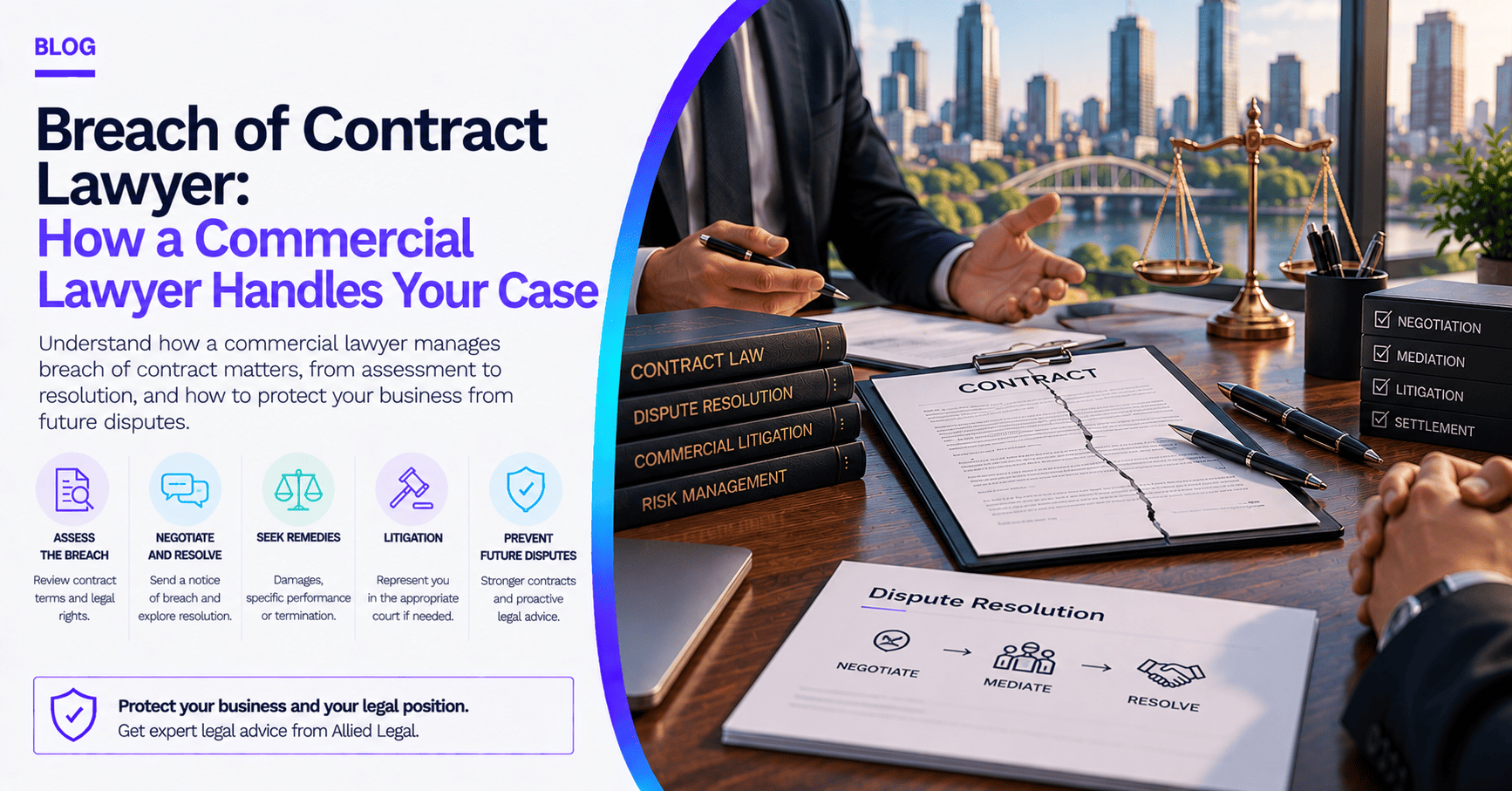
The lawyer first reviews the contract terms. They work out whether the breach is material or minor. They check whether the non-breaching party has met its own obligations. They also check whether the breach supports a claim for damages, termination, or another remedy. A few key questions come up early. Has there been a genuine failure to perform? How serious is the breach? What remedies does the contract itself provide? Does a notice provision require formal notification before action can be taken?
Step 2: Communicating with the Breaching Party
Before formal legal action, a commercial lawyer typically tries to resolve the matter through negotiation or informal communication first. This often starts with a notice of breach. It sets out the specifics and seeks a demand for performance, rectification, or compensation. For a minor issue, the lawyer may recommend mediation or another dispute resolution process. This is usually faster and cheaper than litigation. It also helps preserve the business relationship where ongoing collaboration matters.
Step 3: Seeking Damages or Other Remedies
If negotiation fails, a commercial lawyer may advise pursuing formal legal action. Compensatory damages are the most common remedy. They aim to put the non-breaching party in the position it would have been in if the contract had been performed properly. Consequential damages cover losses beyond the direct breach, such as lost profits or business opportunities. Specific performance is a court order requiring the breaching party to actually perform the contract. Courts generally use this where damages would not be adequate, such as for unique goods. Rescission cancels the contract where the breach is serious enough to undermine the whole agreement. This releases both parties from further obligations. Rectification lets a court correct the wording of a contract where it does not reflect what the parties actually agreed, typically because of a drafting mistake.
Step 4: Litigation
If resolution attempts fail, a commercial lawyer files a claim in the appropriate court. Which court depends on the claim’s value and nature. Smaller claims generally go to a Local or Magistrates Court. Mid-range claims go to a District or County Court. Higher-value or more complex claims go to a Supreme Court, which has unlimited jurisdiction by value. The Federal Court of Australia hears matters arising under federal law, including some corporate and consumer law claims. The lawyer gathers evidence, including communications, documents, and expert testimony. For significant financial claims, they will often work with accountants to assess the loss accurately. Where a company is involved, directors have a duty to act in the company’s best interests. A director who contributes to a breach can face personal exposure for breaching that duty.
Legal Costs and Timeframes
Litigation can be costly and slow. Fees vary with the complexity of the case, court costs, and how long proceedings run. Most commercial lawyers give a cost estimate upfront. They may also offer fixed fees or other alternative arrangements.
Step 5: Defending a Breach of Contract Claim
Sometimes your business is the one accused of breaching a contract. A commercial lawyer can challenge the contract’s validity. They can argue the breach was justified, or work to reduce any damages claimed. Two genuine defences are worth knowing. Frustration is a common law doctrine. It can discharge a contract where a later, unforeseen event makes performance radically different from what was agreed, through no fault of either party. Force majeure is not a general legal defence. It only applies if the contract itself contains a force majeure clause covering the specific event.
Protecting Your Business From Future Breaches
Prevention beats a cure here. A commercial lawyer can draft contracts that are specific and enforceable from the outset. This reduces the room for later disputes over ambiguous terms. Regular contract reviews and a proper contract management system catch compliance issues before they turn into a breach. Ongoing legal advice on your commercial agreements also helps you spot risk before it escalates.
Frequently Asked Questions
1. What is the first thing a breach of contract lawyer does?
They assess whether the breach is material or minor by reviewing the contract terms and the conduct of both parties. This determines what remedies are realistically available.
2. Do I have to go to court over a breach of contract?
Not necessarily. Most commercial lawyers try negotiation or mediation first. It is usually faster, cheaper, and better for preserving a business relationship than litigation.
3. What compensation can I claim for a breach of contract?
Common remedies include compensatory damages and consequential damages for flow-on losses. Specific performance, rescission, and rectification are also available depending on the case.
4. Is force majeure always a valid defence to a breach of contract claim?
No. Force majeure only applies if the contract contains a force majeure clause covering the specific event. Without one, a party would need to rely on the separate common law doctrine of frustration instead.
5. Which court hears a breach of contract case in Australia?
It depends on the claim’s value and complexity. Smaller claims go to a Local or Magistrates Court, mid-range claims go to a District or County Court, and larger claims go to a Supreme Court or the Federal Court.
6. Can a company director be personally liable for a breach of contract?
A director is not automatically liable. One who contributes to a breach can face personal exposure if it also involves a breach of their duty to act in the company’s best interests.
A breach of contract can put real pressure on a business, but the right legal support makes the process far more manageable. Our team at Allied Legal assesses the strength of your position. We handle negotiation and dispute resolution where possible, and represent you through litigation if it becomes necessary. We also help draft contracts upfront to reduce your exposure to a breach in the first place. Contact us at 03 8691 3111 or email hello@alliedlegal.com.au if you are dealing with a breach of contract or want to protect your business against one.
This article is provided for general information only and does not constitute legal advice. You should obtain legal advice specific to your circumstances before acting on any information contained in this article.