
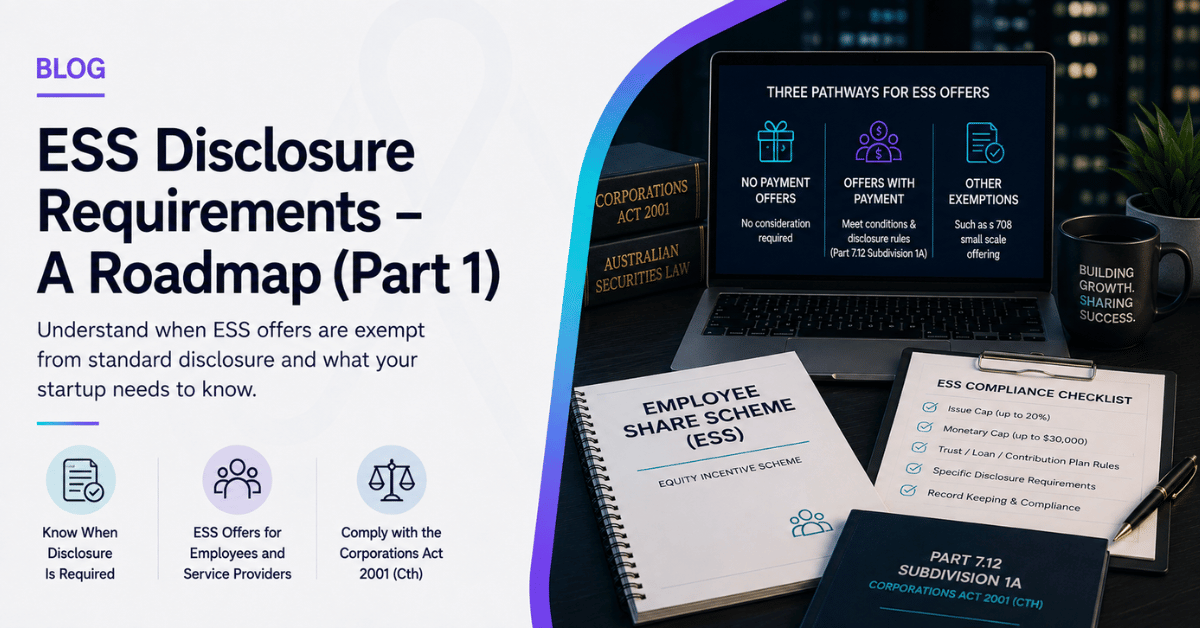
This article is Part 1 in a 3-part series on employee share scheme requirements (ESS Disclosure Requirements) under Part 7.12 Subdivision 1A of the Corporations Act 2001 (Cth) (the Act).
This article looks at how that law applies to private companies, and specifically their disclosure obligations. Read Part 2 here, which covers the general disclosure rules. For loan plans, contribution plans, or plans using an ESOP trust, read Part 3 here.
Introduction
Employee Share Schemes (ESS), often called ESOPs, are a big part of startup culture. They’re a smart, tax-friendly way to give equity to employees and other people helping the business.
The catch? ESS arrangements come with some genuinely complicated legal rules.
A law called Part 7.12 Subdivision 1A started in 2023. It exists to make things easier for companies setting up an ESS – including giving them relief from some of the usual disclosure paperwork required when a company issues shares.
This article breaks down when startups can skip that paperwork, and when they can’t.
Why Normal Disclosure Rules Don’t Usually Apply to ESS Offers
Normally, Part 6D.2 of the Act requires companies to give investors a detailed disclosure document whenever they issue shares. It’s a heavy, expensive process.
The good news: when an ESS offer qualifies under Part 7.12 Subdivision 1A, Part 6D.2 doesn’t apply. That’s a genuinely big relief – without it, setting up an ESS would be far more costly and complicated for most startups.
What Counts as an ESS Under the Law?
Section 1100L defines this broadly. For an unlisted company, it means:
- An “ESS interest” is a share, or an option over shares, in the company.
- An ESS is any scheme that offers these interests to employees, directors, other service providers, or their relatives.
In short: almost every typical startup ESS setup falls under this law.
When Can You Use This Special ESS Rule?
To skip the heavy Part 6D.2 disclosure process, your offer needs to fit one of three pathways:
- Offers with no payment required
- Offers where employees do pay
- Offers that wouldn’t need disclosure anyway, for other reasons
Offers With No Payment Required
This pathway (under section 1100P) applies when:
- no money is paid to receive the ESS interest, and
- if it’s an option or incentive right, no money is paid to exercise it either, and
- if a trust is involved, the trust rules under section 1100S are followed (covered in Part 3).
If your ESS meets these conditions, no disclosure is required at all.
Offers Where Employees Do Pay
This pathway (under section 1100Q) applies when:
- the participant pays money to receive the interest or exercise an option;
- the company complies with any relevant trust, contribution plan, or loan plan rules (also covered in Part 3), and
- the company stays within the issue cap. The company’s constitution may set this cap. If it does not, the default cap is 20% of the company’s issued capital.
- the offer stays within the monetary cap – broadly, no more than $30,000 per participant per year (the exact rules are in section 1100ZA, and the number can vary depending on the situation), and
- the specific disclosure rules under sections 1100W, 1100Y and 1100Z (plus 1100X for unlisted companies) are followed.
If you meet all of these requirements, you can avoid Part 6D.2. However, you must still comply with the specific, lighter-touch disclosure rules outlined below. We cover exactly what those involve in Part 2.
Offers That Wouldn’t Need Disclosure Anyway
This pathway (under section 1100R) applies where another exemption already covers the offer – most importantly, section 708, the “small scale offering” exemption.
For this to apply, the offer generally needs to be:
- a personal offer, meaning only the recipient can accept it, and the company makes the offer to someone who is likely to have an interest in it, such as an employee; and
- unlikely to bring the company’s total new shareholders to 20 or more within a 12-month period, and
- unlikely to raise $2 million or more for the company within a 12-month period.
For most startups, this is genuinely useful – an ESS offer usually doesn’t come close to 20 new shareholders or $2 million raised. But there’s one important exception: if you’re issuing ESS interests in the same year as a capital raise, check these thresholds carefully. It’s easy to breach them without realising, once the raise and the ESS offer are counted together.
The Bottom Line So Far
If your ESS interests are free, or another exemption (such as section 708) already applies to the offer, you are unlikely to have any disclosure obligations.
If the company offers ESS interests for payment and disclosure obligations would normally apply, it must still comply with the law. However, it can follow the simplified requirements in Part 7.12 Subdivision 1A instead of the more onerous Part 6D.2 regime.
Part 2 of this series walks through exactly what those disclosure obligations involve.
Frequently Asked Questions
1. What is an Employee Share Scheme (ESS) under the Corporations Act?
It’s any arrangement where a company offers shares or options over shares to employees, directors, or other service providers (or their relatives), as defined in section 1100L.
2. Do startups need to give a full disclosure document for an ESS offer?
Usually not. Part 7.12 Subdivision 1A generally replaces the heavier Part 6D.2 disclosure process with lighter rules, as long as the offer fits one of three specific pathways.
3. Is there a cap on how much an employee can pay for ESS interests?
Broadly, yes – no more than $30,000 per participant per year for unlisted companies, though the exact detail depends on your circumstances under section 1100ZA.
4. Can a startup rely on section 708 for its ESS offer?
Often, yes – as long as the offer won’t bring the company to 20 or more new shareholders, or $2 million raised, within a 12-month period. This needs extra care if the ESS offer happens in the same year as a capital raise.
5. What happens if my ESS offer doesn’t qualify for any of the three pathways?
Then the usual Part 6D.2 disclosure obligations apply in full, which are significantly more onerous. It’s worth structuring your offer carefully to fit within Part 7.12 Subdivision 1A wherever possible.
Reach Out
If you’re looking to implement an ESS for your company, or you’ve received an ESS offer and want to understand your rights, our team at Allied Legal can help. We regularly assist startups with preparing and implementing ESS offers.
Call us on (03) 8691 3111 or email hello@alliedlegal.com.au.
Related reading: Employee Share Option Plans: A Simple Guide · The ESS Start-Up Concession Explained – worth noting this covers tax treatment of ESS interests, which is a separate question from the disclosure rules covered in this article.
This article is provided for general information only and does not constitute legal advice. You should obtain legal advice specific to your circumstances before acting on any information contained in this article.

Employment Articles
Genuine Redundancy vs Unfair Dismissal: Key Differences

Employment Articles
Understanding Employment Rights in Australia: A Guide to Full-Time, Part-Time and Casual Employment

Employment Articles
Budget Reforms to Employee Share Scheme Reveals Boost for Local Startups
Employment Articles
High Income Threshold and Unfair Dismissal – What is a Non-Monetary Benefit?

Employment Articles