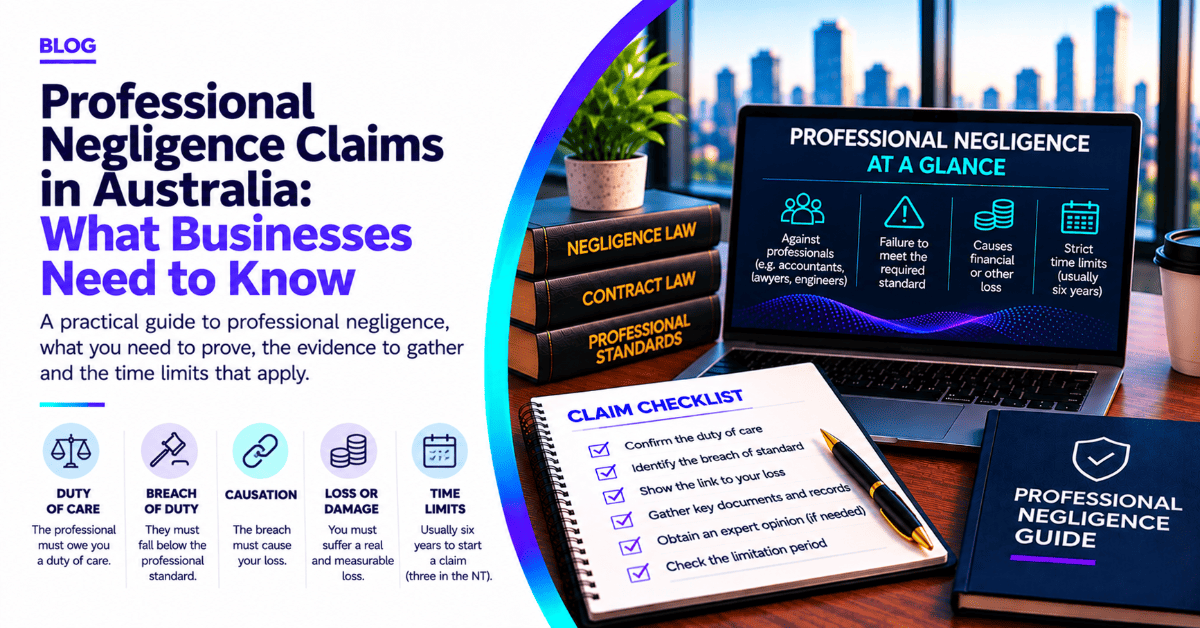
Businesses rely on professionals every day. Your accountant handles your tax, your lawyer reviews your contracts and your engineer signs off on designs. When one of them gets it wrong and your business suffers a loss, you may have a negligence claim.
This guide explains what professional negligence is, what you need to prove, the evidence that helps and the time limits you need to watch.
What Is Professional Negligence?
Professional negligence happens when a professional fails to meet the standard of care expected of someone in their field, and that failure causes you loss. It is not enough that the outcome was disappointing. Instead, the question is whether the professional acted below a reasonable, competent standard.
Professional negligence claims often run alongside a claim for breach of contract, since most professionals act under a retainer or engagement letter. Our guide to breach of contract explains how contract claims work.
Common Examples
Claims can arise against many types of professionals. For example:
- accountants who give wrong tax advice or miss a lodgement deadline
- lawyers who draft a contract that fails to protect you
- financial advisers who recommend an unsuitable investment
- valuers who overvalue a property or business
- engineers, architects or builders whose design or work is defective
- auditors who fail to detect a material problem
For claims involving doctors and other health practitioners, see our separate guide on medical negligence.
What Do You Need to Prove?
To succeed in a negligence claim, you generally need to prove four things.
A Duty of Care
First, the professional must have owed you a duty of care. In most cases, this is straightforward because you engaged them directly. Third parties who relied on a professional’s work can sometimes have a claim too, but the rules are stricter.
A Breach of That Duty
Next, you must show the professional fell short of the standard expected. Courts usually look at what a competent professional in the same field would have done. In most states, the civil liability laws also give professionals a defence if they acted in a way that peers widely accepted as competent practice at the time.
Causation
You must then show that the breach caused your loss. In other words, the loss would not have happened if the professional had done their job properly. This step is often where claims succeed or fail. For example, if a poor investment would have lost money anyway because of a market crash, the adviser’s mistake may not be the real cause of your loss. Courts look carefully at what would have happened if the professional had acted properly.
Loss or Damage
Finally, you need to show you suffered a real loss, such as financial loss, tax penalties or the cost of fixing defective work. Courts award damages to put you, as far as money can, in the position you would have been in without the negligence.
Evidence That Supports Your Claim
Strong evidence makes a negligence claim far easier to run. Start gathering it early. Useful evidence includes:
- the engagement letter or retainer, which sets out the scope of the work
- emails, file notes and advice the professional gave you
- invoices and records of what you paid
- documents showing your loss, such as tax assessments or repair quotes
- an independent expert opinion on whether the work met the required standard
Expert evidence is often essential. A court will usually want to hear from another professional in the same field about what competent practice looks like.
Time Limits for a Negligence Claim
Limitation periods apply to every negligence claim. In most states and territories, you have six years to start a claim for economic loss, while the Northern Territory allows three. Importantly, the clock often starts when you suffer the loss, which may be later than when the professional made the mistake.
Because the rules vary, get advice as soon as you suspect a problem. Missing the deadline can end an otherwise strong claim.
Limits on What You Can Recover
Even a successful claim may not return every dollar you lost. Several rules can reduce your recovery:
- Proportionate liability: if several parties caused the loss, each may only pay their share.
- Contributory negligence: a court can reduce your damages if your own conduct contributed to the loss.
- Liability caps: many accountants, lawyers, engineers and valuers belong to schemes approved by the Professional Standards Councils. These schemes can cap how much a member must pay.
Knowing these limits early helps you decide whether a claim is worth pursuing.
Your Options for Resolving the Claim
Not every negligence claim ends in court. Often, the first step is a formal letter of demand setting out the claim. Many professionals hold indemnity insurance, so their insurer will usually become involved at this stage.
From there, the parties often negotiate or attend mediation. For complaints about financial advice, the Australian Financial Complaints Authority (AFCA) offers a free alternative to court for eligible claims. If the matter does not settle, litigation may be the next step.
How Allied Legal Can Help
Our corporate and commercial litigation team acts for businesses with claims against accountants, lawyers, advisers, valuers and other professionals. We assess whether you have a viable claim, work with experts to test the evidence and negotiate with insurers. If needed, we can take the matter through our broader dispute resolution services and, where appropriate, to court.
To discuss a possible negligence claim, call us on 03 8691 3111 or email hello@alliedlegal.com.au.
Frequently Asked Questions
1. How do I know if I have a negligence claim?
You may have a claim if a professional’s work fell below the standard expected in their field and that failure caused you a real loss. A lawyer can review your documents and tell you whether the claim is worth pursuing.
2. How long do I have to make a negligence claim?
In most states and territories, the limit is six years, and in the Northern Territory it is three. The clock often starts when you suffer the loss, so get advice early.
3. Do I need an expert for a professional negligence claim?
Usually, yes. Courts generally rely on independent expert evidence to decide what competent practice looks like in the relevant profession.
4. Will the professional’s insurer pay my claim?
Many professionals must hold indemnity insurance, so an insurer often handles the claim. However, the insurer will test your evidence just as carefully as a court would.