If you invest in Australian start-ups, you have probably come across the ESIC tax offset. This government incentive encourages investment in innovative start-ups by giving qualifying investors a tax benefit. However, the Australian Taxation Office (ATO) has warned about schemes that abuse it. You might join one without realising. This article explains how the ESIC tax offset works, what worries the ATO, and how you can protect yourself.
What Is the ESIC Tax Offset?
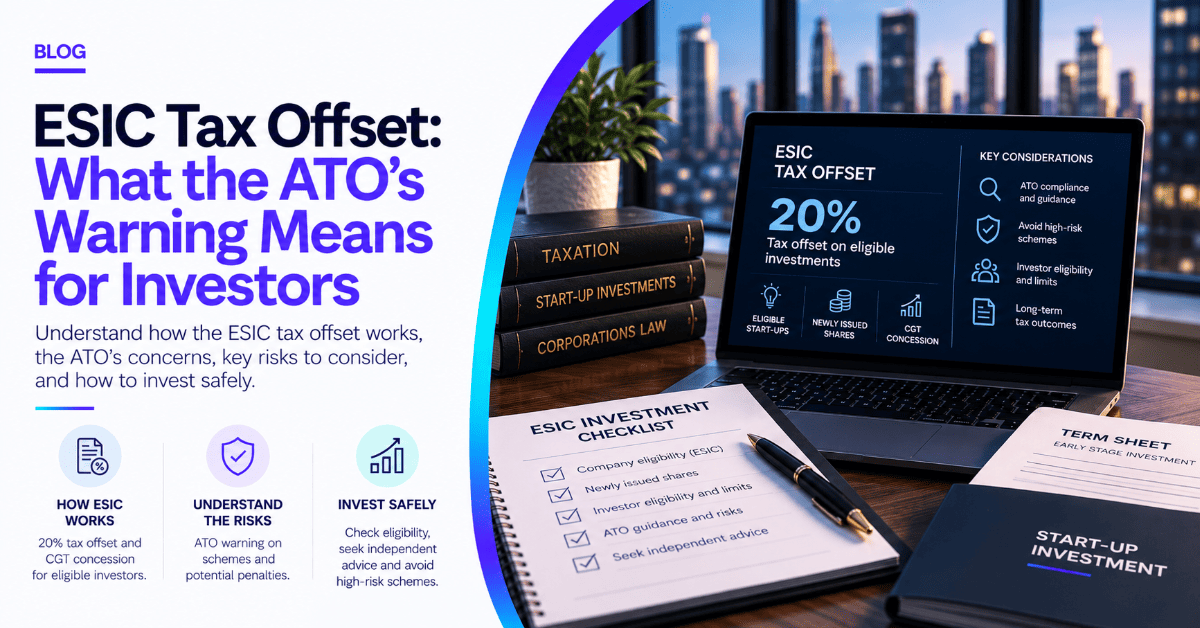
The ESIC tax offset is part of the early stage investor tax incentives. It applies when you invest in a qualifying early stage innovation company (ESIC). The offset is worth 20% of the amount you pay for eligible new shares. For example, a $50,000 investment in a qualifying start-up could give you an offset of up to $10,000.
The offset reduces the tax you pay, but the ATO does not pay out any excess in cash. Any unused amount carries forward to later years, within the annual cap. Some scheme promoters talk about large “refunds”. That language should raise concern.
A second benefit sits alongside the offset. You can disregard a capital gain on qualifying ESIC shares if you hold them for at least 12 months but less than 10 years.
Who Can Claim It, and How Much?
The rules differ by type of investor. A sophisticated investor can claim an offset of up to $200,000 per income year, counting affiliates together. To qualify, you need to meet an income or net asset test that an accountant certifies. Other investors, often called retail investors, face a different limit. Their total ESIC investments must not exceed $50,000 in the income year. If they exceed that limit, they lose the offset and the CGT concession for all ESIC shares acquired that year.
The company must also qualify. An ESIC is a young Australian company with low expenses and income. It cannot trade on a stock exchange. It must also pass an innovation test. You must buy newly issued shares, and you and your affiliates cannot hold more than 30% of the company. Our guide to early stage innovation companies explains these company tests in detail. The ATO also sets out the ESIC qualification tests on its website.
What Is the ATO Concerned About?
The incentive aims to support real, high-risk investment in early stage businesses. Some advisers and promoters have built artificial arrangements around it instead. In December 2024, the ATO issued Taxpayer Alert TA 2024/1 about these schemes. The alert does not apply to genuine ESIC investments. It targets arrangements with three features.
First, they create the appearance of an investment. The “investor” has little or no real financial risk. Second, they misuse the funds. The start-up often cannot use the money freely, because a financier or adviser holds it or it flows straight back through loans and buy-backs. Third, they support improper tax claims. Participants claim the offset without meeting the legal requirements. The ATO also suspects that some of the start-ups involved are not ESICs at all.
How These Schemes Typically Work
The details vary, but the pattern is usually similar. An intermediary promotes a start-up as a qualifying ESIC. Next, the investor borrows money to fund the share subscription, often paying only a small deposit. A financier or adviser then controls the investment funds, so the start-up has little or no access to them. After that, the investor claims the offset on their tax return. Finally, the offset benefit and the money the start-up returns through a share buy-back repay the loan. The investor ends up with little or no financial exposure, yet still claims the tax benefit. Promoters also pitch longer-term versions of this structure to some sophisticated investors.
Why the ATO Is Cracking Down
The ATO has several concerns. Some claims are invalid because the start-up does not meet the ESIC requirements. Australia’s general anti-avoidance rules in Part IVA of the tax law may catch other arrangements. These rules let the ATO cancel a tax benefit from a scheme. Promoters also sell these arrangements as legitimate tax strategies, which misleads investors and start-ups alike.
The ATO followed its alert with a final tax determination, TD 2025/3, in June 2025. It says Part IVA can apply to cancel the tax benefit that participants obtained. The ATO applies that view to arrangements before, during and after the date of the determination. Participants may need to repay the offset, and penalties and interest may apply.
Penalties and Risks
The consequences of taking part can be serious. The ATO can cancel the offset you claimed, and you may have to repay it. If the shares do not qualify, you also lose the CGT concession on them. The ATO may also challenge interest deductions on any loan that funded the investment. Penalties and interest can apply on top of the tax shortfall. These administrative penalties can be significant.
Promoters face a separate set of penalties. Under Division 290 of the Taxation Administration Act 1953, the ATO can seek civil penalties against people who promote tax exploitation schemes. Stronger promoter penalty laws have applied since 1 July 2024. For a company, the maximum is now the greatest of 50,000 penalty units, three times the benefits received, or 10% of aggregated turnover. The Tax Practitioners Board may also receive referrals about registered tax agents who promote these schemes.
What Should You Do?
Act quickly if you have already taken part in one of these arrangements, or if someone has approached you about one.
Get independent advice first. Speak to a tax professional who has no connection to the promoter, so you understand your position and your options.
Contact the ATO. The ATO says proactive contact may reduce penalties. A voluntary disclosure before the ATO starts an investigation may also lead to a lower penalty.
Report suspicious schemes. You can report a scheme or its promoters on the ATO tip-off line, 1800 060 062, or through the online tip-off form.
How to Invest Safely
A genuine ESIC investment looks different from a scheme. You pay for the shares with your own money, and you carry the risk if the company fails. The start-up receives the funds and uses them to build and commercialise its innovation. No arrangement sends the money back to you, or to a financier, behind the scenes.
Before you invest, check a few things. Confirm the company genuinely meets the ESIC tests. Understand where your money goes and who controls it. Question any loan, deposit or buy-back that forms part of the deal. Treat any promise of a guaranteed refund or a risk-free return as a warning sign. The ATO also has general guidance on tax planning schemes that is worth reading.
Tax rules for start-ups continue to change. For the latest on proposed reforms, see our summary of the 2026-27 Federal Budget start-up tax changes.
Frequently Asked Questions
1. What is the ESIC tax offset?
The offset equals 20% of the amount you pay for new shares in a qualifying early stage innovation company. It reduces your tax payable. It is non-refundable, but you can carry unused amounts forward.
2. How much can I claim under the ESIC tax offset?
A sophisticated investor can claim up to $200,000 per income year, counting affiliates together. Other investors must keep their total ESIC investments to $50,000 in the income year. That gives a maximum offset of $10,000.
3. Is the ESIC tax offset refundable?
No. The offset is non-refundable. It can reduce your tax payable, but it does not create a cash payment on its own. Be wary of anyone promising large refunds from an ESIC investment.
4. What is the ATO’s concern about ESIC schemes?
The ATO targets arrangements where investors borrow to buy shares and a financier controls the funds. Buy-backs return the money, and the offset repays the loan. The investor carries little real risk, yet claims the offset.
5. What happens if I took part in an ESIC scheme?
The ATO can cancel the offset, and you may have to repay it. Penalties and interest can apply. Part IVA of the tax law may also apply to cancel the tax benefit.
6. Can promoters of these schemes be penalised?
Yes. Promoters can face civil penalties under Division 290 of the Taxation Administration Act 1953. The ATO can also refer registered tax agents to the Tax Practitioners Board.
7. How do I report a suspicious scheme?
Call the ATO tip-off line on 1800 060 062, or use the ATO’s online tip-off form. Report it as early as possible.
Allied Legal strongly encourages investors to check that every investment complies with the ATO’s guidance and the law. Our team advises investors and start-ups on venture capital and investing and on fundraising. We review subscription agreements, loan and buy-back arrangements, and the investment documents behind an ESIC offer. We work alongside your accountant, who should advise on the tax position. If you are an angel investor, our guide on venture capital and angel investors is a useful starting point. If you are unsure about an investment, or a promoter has approached you with an unusual structure, call us on 03 8691 3111 or email hello@alliedlegal.com.au.
This article is provided for general information only and does not constitute legal advice. You should obtain legal advice specific to your circumstances before acting on any information contained in this article.