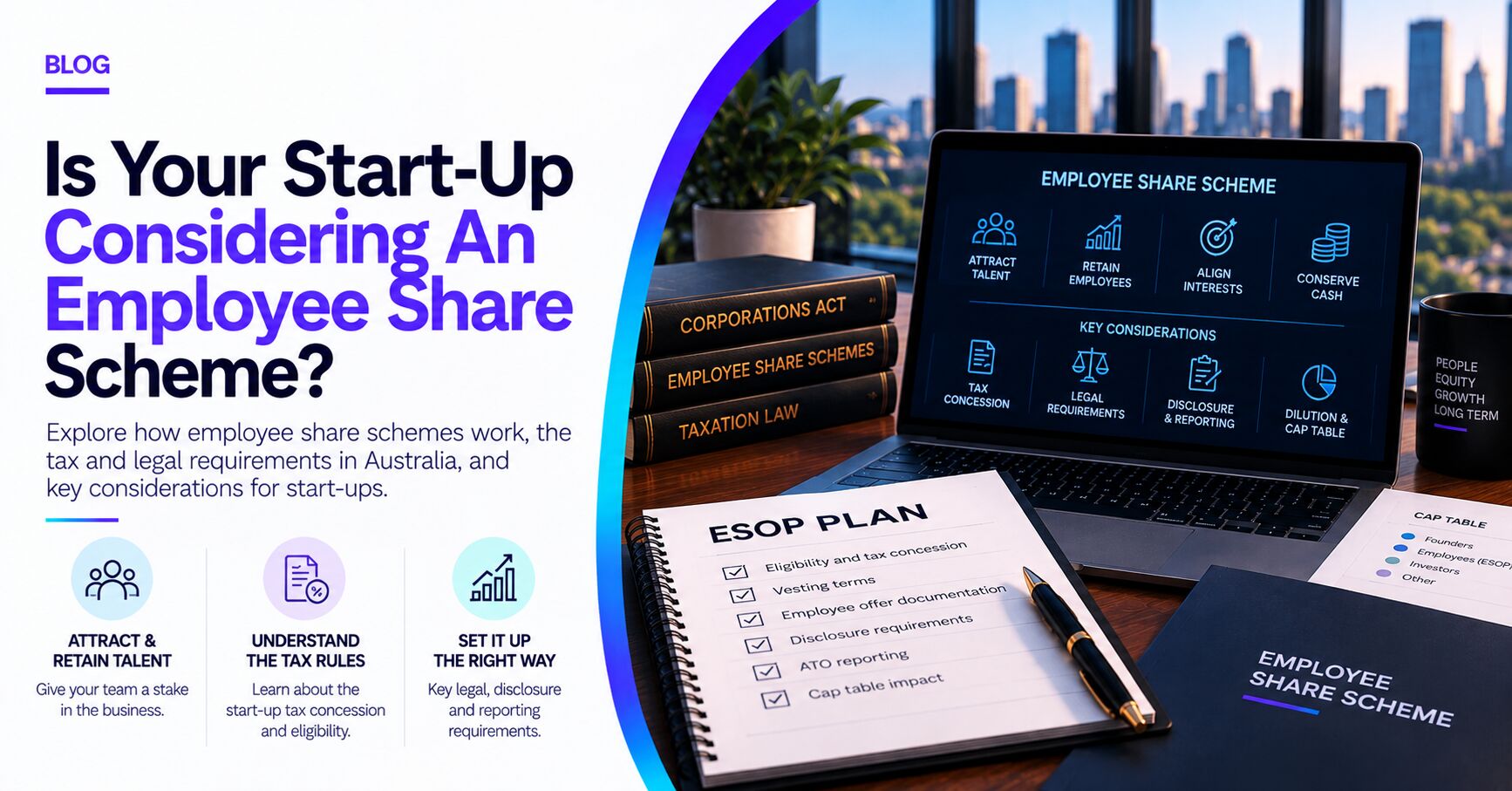
Cash is tight in most start-ups, but you still need to attract and keep talented people. An employee share scheme (ESS) can help. It gives your team a stake in the business, so their interests line up with yours. Employee share schemes for startups also come with a special tax concession, but strict conditions apply. This guide explains how the schemes work, the main tax and legal rules, and how to set one up.
What Is an Employee Share Scheme?
An employee share scheme lets eligible employees acquire shares, or the right to buy shares, in the company that employs them. Most start-ups offer options. An option gives the employee the right to buy shares at a set price later, or once they reach certain milestones. Some start-ups offer shares directly, sometimes at a discount to market value. Many founders call these arrangements ESOPs. Our guide to ESOPs in Australia covers that structure in more detail.
Why Start-Ups Use Employee Share Schemes
Equity helps in four main ways. First, it attracts talent. A start-up can offer a lower salary when cash flow is tight, and senior hires often expect equity as part of their package. Second, it retains high performers. Employees think twice before they walk away from valuable equity, which protects you from rivals poaching your best people. Third, it aligns behaviour. A person who owns a meaningful stake often acts differently from someone who does not. Fourth, it saves cash, because equity replaces part of a cash salary.
Vesting makes these benefits stronger. Employees earn their equity over time, so they stay to earn it. Our guide on what vesting is and why it matters explains how it works.
Options or Shares: Which Suits a Start-Up?
Options suit most early-stage companies. The company can attach milestones or time-based vesting before the employee buys any shares. If the start-up concession applies, the ATO does not tax options when granted, vested or exercised. Shares give the employee ownership, voting rights and dividends straight away. They also put the employee on your share register, which affects your cap table and your shareholder decisions.
Both routes dilute the founders. Model the dilution before you grant anything. Our guide to managing your start-up cap table shows how.
How the Start-Up Tax Concession Works
Australia offers a tax concession for employee share schemes in start-ups. If your scheme qualifies, the employee does not pay ESS tax on the discount when they acquire the interest. They pay capital gains tax when they sell the shares instead. The 50% CGT discount can apply if they sell at least 12 months after acquisition. The ATO sets out the start-up concession conditions on its website.
Your company must meet four tests. It cannot trade on a stock exchange. It must be an Australian resident taxpayer, and it must be less than 10 years old. Aggregated turnover must stay under $50 million in the income year before the grant.
The interests must also qualify. They must be ordinary shares, or rights to acquire ordinary shares. For shares, the discount cannot exceed 15% of market value. For options, the exercise price must be at least the market value of an ordinary share at the grant date.
Each employee faces limits too. The employee must work for you when you grant the interest. Holdings cannot exceed 10% of your shares or voting rights, and options count towards that limit. The employee must also hold the interests for at least three years, with limited exceptions.
For a closer look, read our guides to the ESS start-up concession and eligibility.
Do Not Confuse It With the Taxed-Upfront Scheme
Founders often mix up the start-up concession with a different scheme. The taxed-upfront scheme gives employees a $1,000 tax reduction if their adjusted taxable income is $180,000 or less. Under that scheme, you must offer the plan to at least 75% of eligible permanent employees. The 75% rule does not apply to the start-up concession.
Tax law is also changing. Treasury has released draft legislation for an Innovative Business CGT Concession for early-stage investments. Changes to the CGT discount are also due for gains from 1 July 2027. Run the numbers before you grant, and see our article on ESOP tax modelling.
Corporations Act Rules for Employee Share Scheme Offers
Offering equity to employees also triggers corporate law rules. Since 1 October 2022, Part 7.12 Division 1A of the Corporations Act has contained a dedicated ESS regime. It sets disclosure requirements and relief for offers. ASIC’s older class order relief no longer applies to new offers.
For unlisted companies, the rules depend on what the employee pays. A basic $30,000 cap applies to the money a participant pays, subject to adjustments. Offers that involve money must also come with supporting information. Our ESS disclosure roadmap explains the regime. Get advice on which relief applies before you invite anyone to participate.
Reporting Duties for Employers
Employers have reporting duties to employees and the ATO. Where they apply, give each employee an ESS statement by 14 July after the financial year ends. Then lodge the ESS annual report with the ATO by 14 August. If an employee has not quoted a tax file number, you must withhold tax at the highest marginal rate. The ATO explains the employer reporting requirements. Keep your records for five years.
Common Mistakes to Avoid
Many founders assume the concession applies automatically. It does not, so test every condition before you grant. Others set the exercise price without a proper valuation, which can break the market value rule for options. Some forget the 10% limit when they grant to senior hires.
Leaver terms matter too. Decide what happens to vested and unvested options when an employee resigns or leaves. Since 1 July 2022, the deferred scheme no longer treats ceasing employment as a taxing point. Your plan rules still set what happens to the equity, so draft them carefully.
How to Set Up an Employee Share Scheme
Start with your goal and your budget. Decide how much equity to set aside, which roles qualify, and how vesting will work. Next, choose the tax route. Test your company and each employee against the start-up concession, or pick another scheme if you do not qualify. Then check the Corporations Act position and the disclosure you owe. After that, draft the plan rules and the offer documents. Finally, set up your reporting calendar and update your cap table and share register.
Frequently Asked Questions
1. What is an employee share scheme?
An employee share scheme lets employees acquire shares, or the right to buy shares, in their employer. Start-ups often use options that vest over time or when the employee reaches milestones.
2. Is there a tax concession for employee share schemes for startups?
Yes. If your company and the interests meet the ATO’s conditions, the employee does not pay ESS tax on the discount. They pay capital gains tax when they sell the shares instead.
3. What are the conditions for the start-up ESS concession?
Your company cannot trade on a stock exchange, and it must be an Australian resident taxpayer. It must be less than 10 years old, with aggregated turnover under $50 million. The interests must be ordinary shares or rights to acquire them. No employee can hold more than 10% of the company.
4. Do I have to offer an ESS to 75% of employees?
Not for the start-up concession. The 75% rule belongs to the taxed-upfront scheme, which gives employees a $1,000 tax reduction.
5. How much of the company can one employee hold?
Under the start-up concession, an employee cannot hold more than 10% of your shares or voting rights. Options count towards that limit.
6. Do start-ups need disclosure documents for an ESS offer?
Often, yes, depending on what the employee pays. Part 7.12 Division 1A of the Corporations Act sets the disclosure rules and the relief available. Get advice before you make an offer.
7. What reporting do employers have to do?
Employers generally give employees an ESS statement by 14 July and lodge an ESS annual report with the ATO by 14 August.
Our employee incentive schemes lawyers design and document employee share schemes for start-ups. We check your eligibility for the start-up concession, draft plan rules and offer documents, and advise on vesting and leaver terms. If you want to build an ESOP, see how we set up an ESOP. We work alongside your accountant, who should advise on the tax position. Our startup and scaleup lawyers also help founders with fundraising, cap tables and shareholder agreements. Call us on 03 8691 3111 or email hello@alliedlegal.com.au to discuss your employee share scheme.
This article is provided for general information only and does not constitute legal advice. You should obtain legal advice specific to your circumstances before acting on any information contained in this article.