
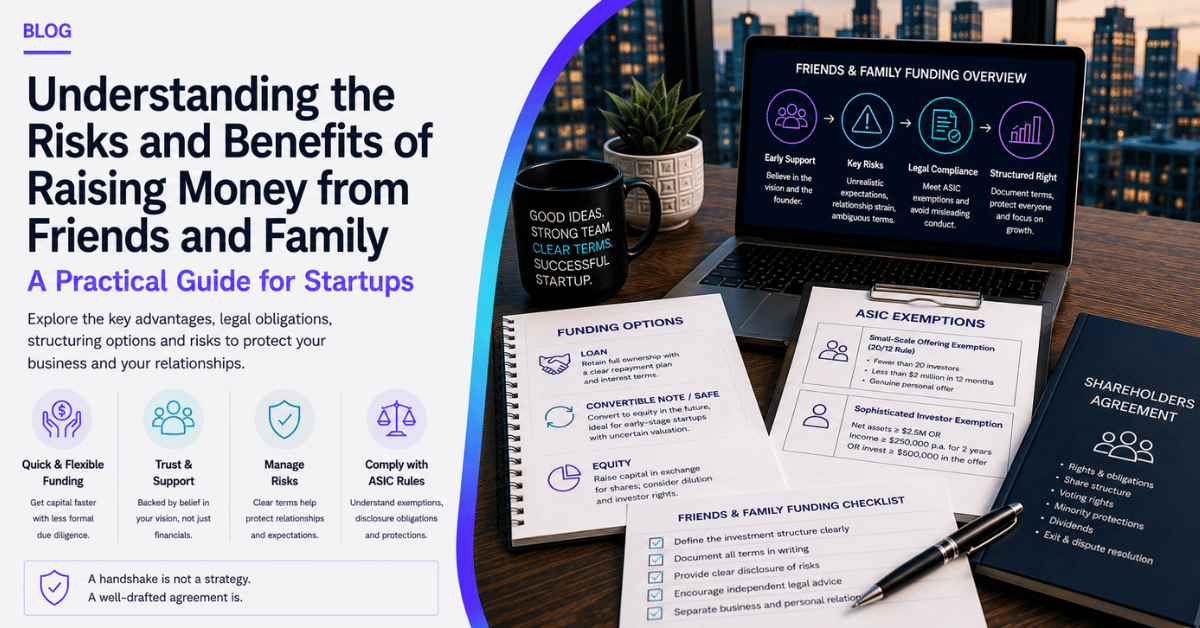
Raising capital is one of the earliest challenges an Australian startup faces. Before venture capital or angel investors come into the picture, many founders turn to their closest circle for the first round of funding. Raising money from friends and family can be quick and supportive, but it carries legal and financial risks that are easy to overlook.
Why Startups Turn to Friends and Family First
Traditional investors are often reluctant to back a business with limited traction, so venture capitalists and banks tend to hesitate at this early stage. Friends and family typically invest on trust and belief in the founder rather than financial projections, which makes them a useful stepping stone before approaching institutional investors.
The Benefits, and the Risks
Friends and family funding brings real advantages. Funds often arrive faster than through formal investors, since there is less due diligence and negotiation involved. These investors also tend to be more patient about returns, giving founders room to focus on growth rather than short-term performance pressure. And having people who believe in the vision provides genuine emotional support through a stressful process.
But the same informality creates real risk.
- Unrealistic expectations: many friends and family investors do not fully grasp startup risk, and may expect guaranteed returns that lead to disappointment if the business struggles.
- Relationship strain: if the venture fails, personal relationships can suffer, sometimes ending in resentment or disputes.
- Ambiguous terms: a verbal or informal arrangement can leave it unclear whether funds were a loan, a gift, or an equity investment, creating room for disputes later.
The fix for all three is the same: treat friends and family investments with the same legal formality as any other investor.
Disclosure Obligations Under the Corporations Act
Raising funds from investors in Australia must comply with the Corporations Act 2001 (Cth), which generally requires disclosure documents such as a prospectus or offer information statement. Exemptions exist for smaller and more informal raises.
The small-scale offering exemption allows an offer to fewer than 20 investors, raising no more than $2 million in a 12 month period, without a formal disclosure document. This exemption is about how the offer is made rather than who you know: it must be a genuinely personal offer, made directly and not through public advertising, to someone likely to be interested.
The sophisticated investor exemption is a separate pathway. An investor generally qualifies if they have net assets of at least $2.5 million, or gross income of at least $250,000 in each of the past two financial years, or if they are investing at least $500,000 in the raise.
Even where no formal disclosure document is required, founders must still avoid misleading or deceptive conduct under section 1041H of the Act. Any statement about growth, profits or likely returns needs to be honest and able to be backed up.
Investor Protections and Licensing
Friends and family investors are not protected under the Australian Consumer Law the way customers are, but they remain protected under the Corporations Act, particularly around misleading conduct and disclosure. Overpromising returns, even unintentionally, can expose the company and its directors to legal liability.
It is also worth watching the scale of your activity. Early-stage friends and family raising usually sits within the exemptions above, but promoting opportunities more broadly, or exceeding the small-scale thresholds, can mean the business needs an Australian Financial Services licence. This is rare for a one-off informal raise, but worth checking before raising larger amounts or marketing more widely.
Structuring the Investment Properly
How the money is structured matters as much as how much is raised.
Loans let founders retain full control of the business. However, they require a proper loan agreement that covers repayments, interest, and any security.
Equity, convertible notes, and SAFEs allow investors to convert their funds into shares later. These structures are often used in early-stage raises where the company’s valuation remains uncertain. Founders should remember that issuing equity can dilute their ownership over time.
Regardless of the structure used, a well-drafted shareholder agreement is essential. It sets out shareholder rights and obligations, share classes, voting rights, minority protections, dividend entitlements, and dispute resolution processes.
Tax considerations are also important. Equity investors may face capital gains tax when they sell their shares. Loan interest is generally taxable to the lender. Investors should also understand whether returns are expected from dividends, capital growth, or both.
A separate fringe benefits tax issue may arise if the company later provides concessional loans to employees. However, this is distinct from the original friends and family investment.
Getting the Basics Right
A few simple practices can help keep friends and family funding on solid ground. Put all terms in writing through a shareholder agreement, loan agreement, or convertible note deed. Give investors a clear and honest explanation of the risks involved. Investors should also be encouraged to obtain independent legal advice.
Avoid relying on verbal promises. Do not accept funds without documenting whether they are a loan, gift, or equity investment. It is also important to keep personal relationships separate from business dealings.
A handshake is not a strategy. A well-drafted agreement is.
Frequently Asked Questions
1. Do I need a prospectus to raise money from friends and family?
Not usually. Most friends and family raises fall under the small-scale offering exemption, which allows offers to fewer than 20 investors and up to 2 million dollars in a 12 month period without a formal disclosure document, provided the offer is genuinely personal and not publicly advertised.
2. Are friends and family investors legally protected the same way as customers?
No. They are not covered by the Australian Consumer Law, but they are still protected under the Corporations Act, particularly the rules against misleading or deceptive conduct and disclosure obligations.
3. Should friends and family money be structured as a loan or equity?
It depends on the founder’s goals. A loan keeps full ownership with the founder but needs a clear repayment structure. Equity, convertible notes or SAFEs suit raises where the company’s valuation is still uncertain, but they dilute the founder’s ownership over time.
4. What happens if the terms of a friends and family investment are only agreed verbally?
Verbal agreements create real risk, since there is no clear record of whether the money was a loan, a gift or an equity investment. This ambiguity is one of the most common sources of disputes when a friends and family investment goes wrong.
5. Do I need an AFS licence to raise money from friends and family?
Usually not. A one-off informal raise generally sits within the small-scale or sophisticated investor exemptions, though this becomes a live question once you promote more broadly or exceed those thresholds.
If you are considering raising capital from friends and family, consult Allied Legal early to ensure your investment structure complies with ASIC requirements and the Corporations Act while protecting your business and relationships.
Related Reading:
- Why Do I Need a Shareholders Agreement?
- What Is a SAFE Note? Australia Guide for Startups and Investors
- ASIC Fundraising Requirements: A Comprehensive Guide
Useful Resources: