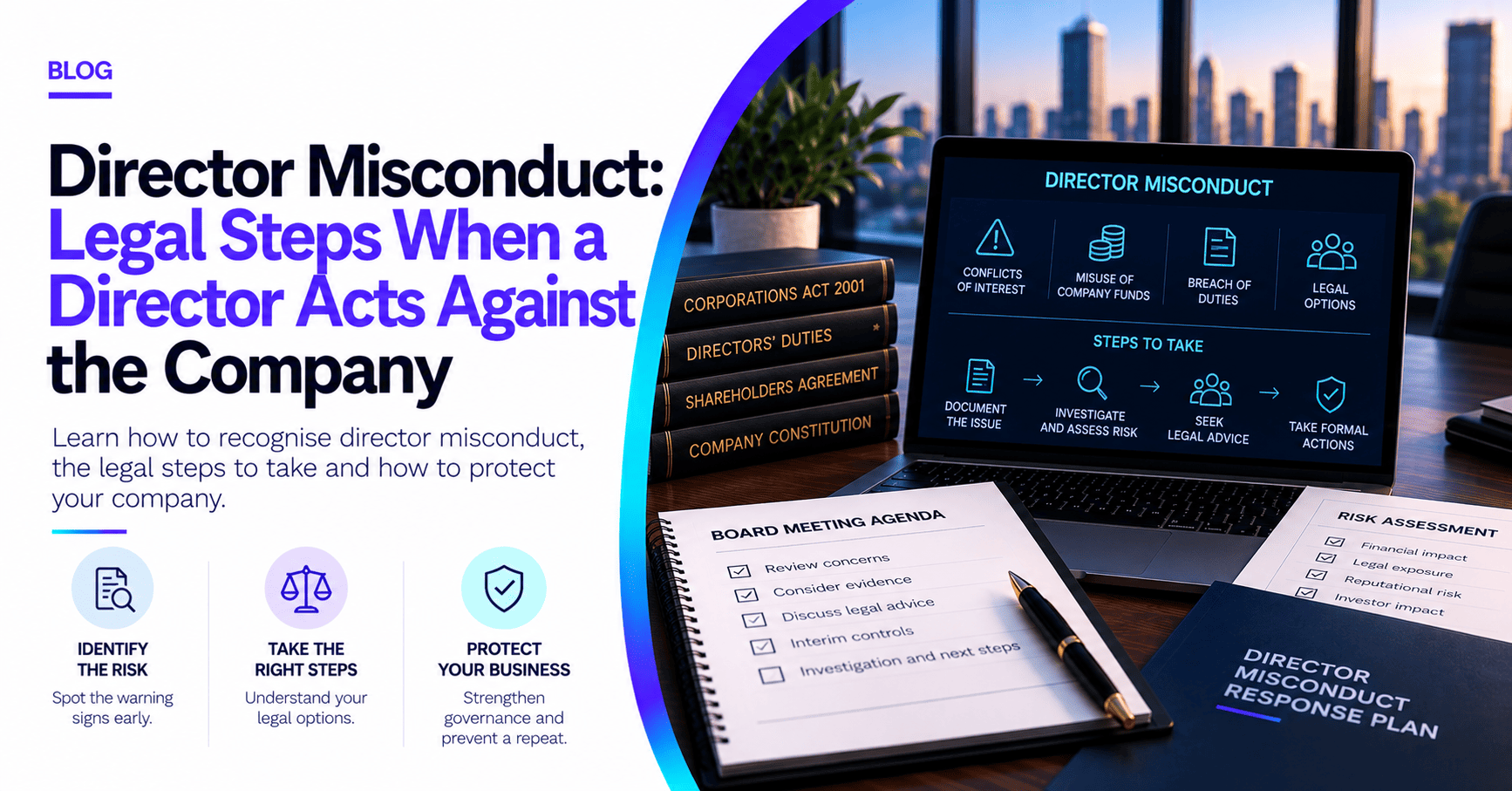
Getting director misconduct legal advice early can protect your company’s money, intellectual property and reputation. Misconduct ranges from undisclosed conflicts to the misuse of company funds. Left alone, it can escalate into a full director dispute. This guide shows founders, boards and shareholders in Australia how to spot the problem, respond in the right order and understand their legal options.
What Counts as Director Misconduct?
Directors owe their duties to the company. The Corporations Act 2001 (Cth) requires them to act with care and diligence, and to act in good faith in the company’s best interests. They must not misuse their position or company information, and they must disclose material personal interests. Our guide to directors’ duties covers each duty in detail.
Misconduct can be deliberate or careless. Even a well-meaning director can breach these duties. Imagine a founder-director who signs a contract with their own supplier without telling the board. The deal may help the company, but the failure to disclose is still a problem. Dishonest conduct can also become a criminal matter.
Common Examples of Director Misconduct
Misconduct is rarely obvious at first. Patterns of behaviour, gaps in reporting and shortcuts around governance are often the first warning signs. Common examples include:
- Hidden conflicts of interest, such as side businesses, related-party deals or family connections.
- Misuse of company funds or assets, including transfers to related entities.
- Diverting intellectual property, clients or confidential information to a competing venture.
- Acting without authority, such as signing contracts or hiring staff without board approval.
- Misleading investors during a funding round or in financial reporting.
Our article on types of director disputes explains how these problems often grow into disputes.
Step 1: Detect and Document the Problem
Start with facts, not accusations. Review bank statements, accounts and related-party transactions for irregularities. Check contracts, emails and board minutes for actions outside the director’s authority. Keep copies of everything and note the dates. A methodical record protects the company if legal action follows.
Step 2: Assess the Risk Before You Act
Before you confront anyone, work out how serious the problem is. Consider the financial and reputational harm, the effect on investors and the urgency. Check whether the company can still pay its debts. If it cannot, other duties, such as the duty to prevent insolvent trading, may apply. A liquidator can also challenge some payments to directors and their relatives, so the timing of any action matters.
Step 3: Get Legal Advice and Check Your Documents
Speak to a lawyer before you take formal steps. Your constitution, shareholders agreement and the director’s employment contract set the rules for removal, access and dispute resolution. Our guide to the company constitution and replaceable rules explains how the default rules work.
Step 4: Raise the Issue Formally With the Board
Call a properly noticed board meeting with an agenda. Present the evidence objectively and give the director a fair chance to respond. Record the discussion, the resolutions and any dissent in the minutes.
Interim controls can limit the damage. Examples include payment limits, dual sign-off on transfers and tighter approval rules. Be careful, though. A director generally has a right to inspect company records, and courts have restored access when a board cut a director off. In Campbell v Jervois Mining, the Federal Court ordered a company to restore a director’s access. A court may restrain access in some cases, for example if the company shows the director intends to misuse the records. Take advice before you restrict anything.
Step 5: Investigate and Consider Mediation
Forensic accountants and corporate investigators can examine financial and operational irregularities. An independent review adds credibility and reduces the risk of bias claims. No law requires mediation before a corporate dispute. ASIC does recommend legal advice or mediation for disputes inside small proprietary companies, and mediation often saves time and money. Our guide to resolving a co-founder dispute explains the process.
Step 6: Understand Your Legal Options
Which option fits depends on the facts, your constitution and who is acting.
Removing the Director
In a proprietary company, members can remove a director by resolution under the replaceable rules, unless the constitution changes that rule. The board alone cannot remove a director unless the constitution gives it that power. In a public company, members remove a director by resolution after giving the company at least two months’ notice of the intention to move it. Members holding at least 5% of the votes can require the directors to call a general meeting. The directors must call it within 21 days, and they must hold it within two months.
Court Action
The company can sue for compensation for breach of the statutory duties. It can also seek general-law remedies, such as an account of the profits the director made. ASIC, or anyone the conduct affects, can apply for an injunction to stop ongoing conduct. A shareholder can ask the court for leave to bring a claim on the company’s behalf, called a statutory derivative action. A shareholder who suffers oppressive conduct can also apply for relief. Our guide to shareholder oppression explains that remedy.
Reporting the Conduct
You can report misconduct to ASIC. ASIC uses reports to find serious misconduct. It does not resolve private disputes or act to recover your money, and it generally does not step into disputes inside small proprietary companies. Theft or fraud may also be a police matter. Our article on organisational fraud explains the warning signs.
Step 7: Put Safeguards in Place and Prevent a Repeat
Once the immediate issue is under control, strengthen your governance. Add conflict-of-interest declarations as a standing item at each board meeting. Update your shareholders agreement with clear removal, information and exit terms. Sign written intellectual property assignments, because ownership of IP does not always follow a director’s role. Our guide on who owns your startup’s IP explains the risks. Review your governance regularly, and train directors on their duties.
A Hypothetical Example
Suppose a director quietly moves product designs to a personal consultancy and signs contracts without board approval. The board first documents the evidence and takes advice. It then calls a formal meeting and tightens payment approvals. An independent forensic review confirms the conduct, and the parties negotiate in mediation. If talks fail, the company can pursue removal, an injunction and a compensation claim. This example is illustrative only.
Frequently Asked Questions
1. What is director misconduct?
Director misconduct is conduct that breaches a director’s legal duties to the company. Examples include undisclosed conflicts of interest, misuse of company funds, diverting business opportunities and acting without authority. It can be deliberate or careless.
2. Can the board remove a director for misconduct?
Not unless the constitution gives the board that power. Under the replaceable rules, members remove a proprietary company director by resolution. In a public company, members must give at least two months’ notice of the intention to move the resolution.
3. Can a company stop a director from accessing its records?
Generally not. A director has a right to inspect company records to do their job, and courts have ordered access restored. A company that wants to restrict access should get legal advice first.
4. Who can sue a director for breach of duty?
The company can sue for compensation. A shareholder can also seek the court’s leave to bring a derivative action on the company’s behalf, or apply for relief from oppression. ASIC can bring civil penalty proceedings.
5. Should I report director misconduct to ASIC?
You can, but ASIC does not resolve private disputes or recover money, and it generally does not become involved in disputes inside small proprietary companies. Report serious misconduct, such as fraud, but plan your own legal response as well.
When should I get legal advice about director misconduct?
As soon as you suspect it. Early advice helps you preserve evidence, follow the right process and avoid steps that expose the company to a counter-claim.
Allied Legal advises Australian startups and private companies on director misconduct. We review your constitution and shareholders agreement, advise on directors’ duties and conflicts, and guide you through a formal board process. We can represent you in negotiation and mediation, and in court if needed.
Learn more about our director dispute lawyers, or contact us on 03 8691 3111 / hello@alliedlegal.com.au.
This article is provided for general information only and does not constitute legal advice. You should obtain legal advice specific to your circumstances before acting on any information contained in this article.