

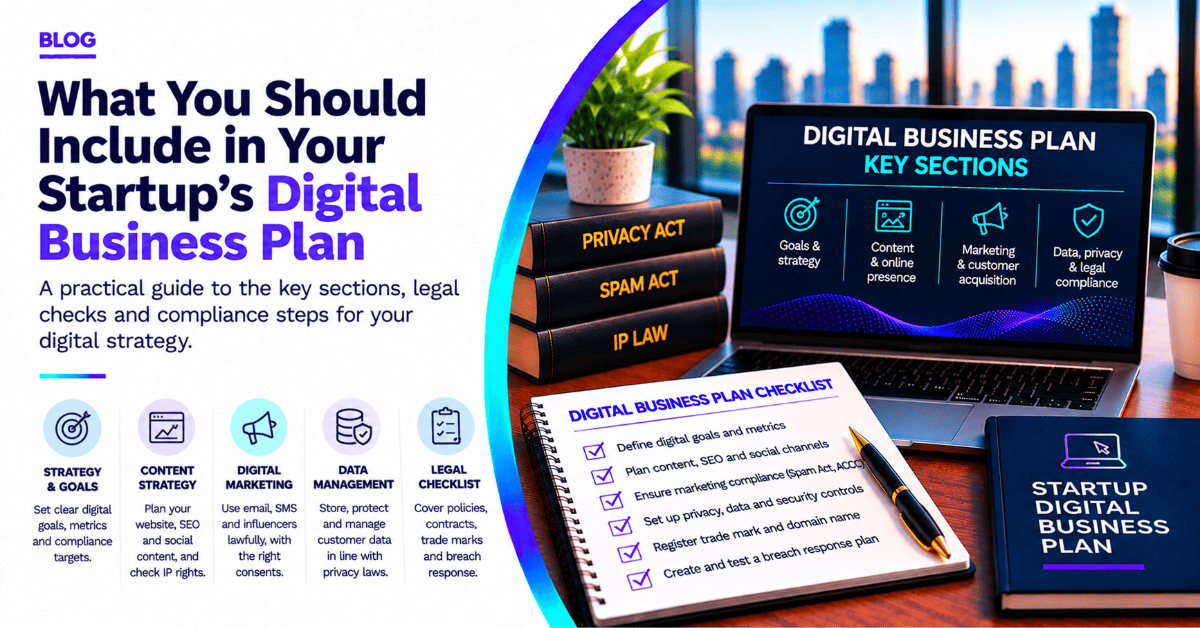
A digital business plan extends your regular business plan. It sets out how you will reach customers, collect data and grow online. Most startups plan the marketing side well but miss the legal side. This guide covers what a digital business plan should include and the legal checks that belong in each section.
What Is a Digital Business Plan?
A digital business plan details your digital initiatives and strategies. It gives your team clear goals and a way to measure progress. It can also show investors how you will win customers online, and that you have thought about risk. Legal risk is part of that picture, because every digital channel creates obligations for a startup. Treat the plan as a living document. Review it each quarter, and update it when your channels, your tools or the law change.
Vision, Mission, Goals and Objectives
Start with the purpose of your digital strategy and the values behind it. Then set goals with a metric for each one, such as email subscribers, website conversions or customer enquiries. Add compliance goals too. Examples include a published privacy policy, a record of every marketing consent and a tested plan for a data breach.
Content Strategy
Your content strategy covers your website, blog posts, search engine optimisation (SEO) and each social media channel. Plan topics, keywords and a publishing schedule.
Legal checks apply to content as well. Copyright protects your own posts automatically, and business.gov.au says you do not need to register it. Third-party images, music and text still need a licence or permission. Only a registered trade mark gives exclusive rights in your brand, according to IP Australia, so register the name you build your content around. A .au domain name needs a genuine connection to Australia, such as an ABN or ACN. Our guides to the difference between copyright and trade marks and trade marks, business names and company names explain the options.
Analysis of Your Online Presence
Review your website, your social media channels such as Facebook, LinkedIn and X, and your Google Business Profile. Ask whether customers can find you, and whether you need more reviews.
Take care with reviews. The ACCC says it is against the law for a business to create fake or misleading reviews, or to arrange for others to do so. Incentives for positive reviews risk misleading consumers. If you offer one, disclose it clearly and offer it whether the review is positive or negative. Do not suppress or edit genuine negative reviews.
Also check accessibility. The Disability Discrimination Act 1992 covers information and online services provided through the web, according to the Australian Human Rights Commission. Ask your web developer which accessibility standard they build to.
Digital Marketing Strategy
The right strategy depends on your offering and your audience. Email and social media marketing can deliver a strong return, but results vary, so set targets and test them.
Email and SMS marketing carry strict rules under the Spam Act 2003 (Cth). ACMA says each commercial message needs the recipient’s consent, an accurate sender name and an easy way to unsubscribe. You must honour an unsubscribe request within five working days. Keep a record of when, where and how each person gave consent, so you can prove it if a complaint arrives. The Act has no general exemption for business-to-business messages, and it bans address-harvesting software. ACMA has taken action in 2026. Lululemon paid $702,900 after it sent more than 370,000 commercial emails without an unsubscribe option, and Latitude Finance paid $3.96 million over missing sender contact details.
Other channels have rules too:
- SMS sender names. From 1 July 2026, unregistered branded SMS sender IDs display as “Unverified”, so register yours.
- Influencers. The ACCC says influencers and brands may break the law if they do not take reasonable steps to disclose paid or gifted posts. The advertising industry’s AANA Code, a self-regulatory code, also expects ads to be clearly identifiable.
- Phone calls. Telemarketing calls to numbers on the Do Not Call Register face restrictions.
Our guides on email marketing and social media for startups add practical detail.
File and Data Management
Plan how you will store and retrieve internal files and client data. Cloud storage supports collaboration, and a customer relationship management (CRM) system helps you organise client data.
Privacy law shapes these choices. The Privacy Act 1988 (Cth) generally exempts small businesses with annual turnover of $3 million or less. The exemption does not apply to every small business, including those that trade in personal information. OAIC also warns that a startup the Act does not cover yet may become covered as it grows. A privacy policy, a collection notice and sound security habits protect you either way.
If the Act applies, these principles matter most:
- Australian Privacy Principle (APP) 1 requires a clearly expressed and up to date privacy policy.
- APP 5 requires you to notify people at or before the time you collect their information.
- APP 8 and section 16C make you accountable if an overseas cloud or CRM provider mishandles the data.
- APP 11 requires reasonable steps to secure personal information and to destroy or de-identify it when you no longer need it.
The Notifiable Data Breaches scheme also applies. If a breach is likely to cause serious harm, you must complete an assessment within 30 days and notify the OAIC and affected people as soon as practicable. OAIC says new automated decision transparency rules for privacy policies start on 10 December 2026.
Keep tax records for five years, according to the ATO. ASIC says companies must keep financial records for at least seven years. Our guides on privacy policies, data breach reporting and data consent cover the detail.
Your Legal Checklist
Add a short legal checklist to your plan:
- Publish a privacy policy and a clear website terms and conditions page.
- Record marketing consent for every contact.
- Review each software vendor’s contract for data location, security and exit terms.
- Register your trade mark and domain name.
- Write a breach response plan, and test it.
Frequently Asked Questions
1. What is a digital business plan?
A digital business plan extends your business plan with your online goals, content, marketing, data management and tools. It sets metrics so you can track progress.
2. What should a startup include in a digital business plan?
Include your vision and goals, a content strategy, an analysis of your online presence, a marketing strategy and a plan for files and data. Add the legal checks that apply to each part.
3. Do I need consent to send marketing emails?
Yes. The Spam Act requires consent, an accurate sender identity and a working unsubscribe option. There is no general exemption for business-to-business messages.
4. Can I offer a discount in exchange for a review?
Take care. The ACCC says incentives for positive reviews risk misleading consumers. If you offer one, disclose it clearly and offer it for positive and negative reviews alike.
5. Does the Privacy Act apply to my startup?
Possibly. Businesses with annual turnover of $3 million or less are generally exempt, but exceptions apply, including businesses that trade in personal information. A privacy policy helps either way.
6. How long should I keep business records?
The ATO says most tax records need five years. ASIC says companies must keep financial records for at least seven years.
How Allied Legal Can Help
Allied Legal helps startups build the legal side of their digital strategy. We can prepare privacy policies, website terms and vendor contracts, and review your marketing practices. Learn more about our data privacy lawyers and our work for marketing and advertising businesses, or contact us on 03 8691 3111 / hello@alliedlegal.com.au.
This article is provided for general information only and does not constitute legal advice. You should obtain legal advice specific to your circumstances before acting on any information contained in this article.

Startup Fundamentals
Calculating Customer Lifetime Value for Startups

Startup Fundamentals
Why Upskilling Your Startup’s Team Has Never Been So Vital

Startup Fundamentals
Understanding Burn Rate A Vital Metric For Startups

Startup Fundamentals
How to Improve Your Startup’s Cross-Cultural Communication

Startup Fundamentals