
- Home
- About
- Services
- Links
- Advisory Board Services
- Business Sales & Purchases
- Business Set Up
- Commercial Law
- Consumer Law
- Contracts & Agreements
- Corporate Governance
- Corporate Law
- Data & Privacy
- Dispute Resolution
- Employee Incentive Schemes
- Employment Law
- Franchising
- Fundraising
- Intellectual Property
- International Business
- Not-for-Profits & Charities
- Regulatory Compliance
- Startup Advisory
- Venture Capital and Investing
- Grant Services
- Image
- Links
- Industries
- Links
- Startups & Scaleups
- SME’s
- Ecommerce & Retail
- Energy & Resources
- Professional Services & Consulting
- Agriculture & Agribusiness
- Health & Wellness
- Construction and Real Estate
- Creative Entertainment
- Education and Training
- Hospitality and Tourism
- Marketing and Advertising
- Travel & Tourism
- Technology & Software Development
- More Links
- Links
- Startups
- Resources
- Contact
What Is a Federal Grant? Understanding Federal and State Grants in Australia
On this page
ToggleChoosing between state and federal grants can feel overwhelming. This is especially true for startups and R&D-focused businesses chasing funding for growth and innovation. Understanding what a federal grant is, and how it differs from a state grant, helps you target the right opportunities. It beats applying broadly and hoping for the best. This guide walks through both funding streams and how to approach each one strategically.
What Is a Federal Grant?
A federal grant is funding provided by the Australian Government. It supports projects that align with national priorities, such as innovation, defence capability, or the energy transition. Federal grants are typically administered by agencies like the Department of Industry, Science and Resources. They tend to offer larger funding amounts than state programs. These grants generally target businesses working on nationally significant projects.
What Is a State Grant?
A state grant comes from a state or territory government instead. It usually supports projects that align with that state’s own economic or innovation strategy. State grants generally involve smaller amounts than federal grants. They often come with a smaller applicant pool and a closer fit with local priorities.
Federal Grants in Practice: The National Reconstruction Fund
The National Reconstruction Fund Corporation (NRFC) supports seven priority areas:
- Value-add in resources
- Value-add in agriculture, forestry and fisheries
- Transport
- Medical science
- Renewables and low-emission technologies
- Defence capability
- Enabling capabilities
The enabling capabilities category covers advanced manufacturing, artificial intelligence, quantum technologies, and biotechnology. This captures a wide range of emerging businesses.
One initiative funded across these priority areas is the Industry Growth Program, which supports early-stage commercialisation through to growth-stage projects. As of publication, the program is paused to new applications. Check its current status on business.gov.au before building an application around it.
Climate and Renewable Energy Grants
Climate policy shapes a large share of Australia’s grant funding. The government has committed to a 43% emissions reduction by 2030 and net zero by 2050. The Australian Renewable Energy Agency (ARENA) funds projects in renewable energy, low-emission technologies, and other solutions that support these targets. Businesses aligning their projects with this direction often find real opportunities here.
State Innovation Strategies and Agencies
Every state and territory runs its own innovation strategy, backed by dedicated agencies. Engaging with these agencies directly, not just applying for their grants, often improves your chances.
Victoria runs its Innovation Statement through LaunchVic. New South Wales follows its Emerging Digital Technologies Strategy through Invest NSW. Queensland runs the Innovation for a Future Economy 2022-2032 Roadmap through Advance Queensland. Western Australia has its own Innovation Strategy, run by the Department of Jobs, Tourism, Science and Innovation. South Australia’s startup and innovation work sits with the Department of State Development. Tasmania’s work runs through the Department of State Growth. The Northern Territory runs its innovation strategy through Innovation Territory, a team within the Department of Industry, Tourism and Trade.
These agencies also run networking events, workshops, and knowledge-sharing sessions. These can connect you to collaborators and future funding well before a specific grant round opens.
Regional Grants
Regional grants sit alongside state and federal grants. They target specific local economic needs rather than state-wide or national priorities. They often focus on boosting local employment, supporting regional innovation, or addressing local infrastructure gaps. If your business operates in or affects a regional area, check for a regional program first. It may fit better than defaulting to a state or federal one.
Federal vs State Grants: Which Should You Target?
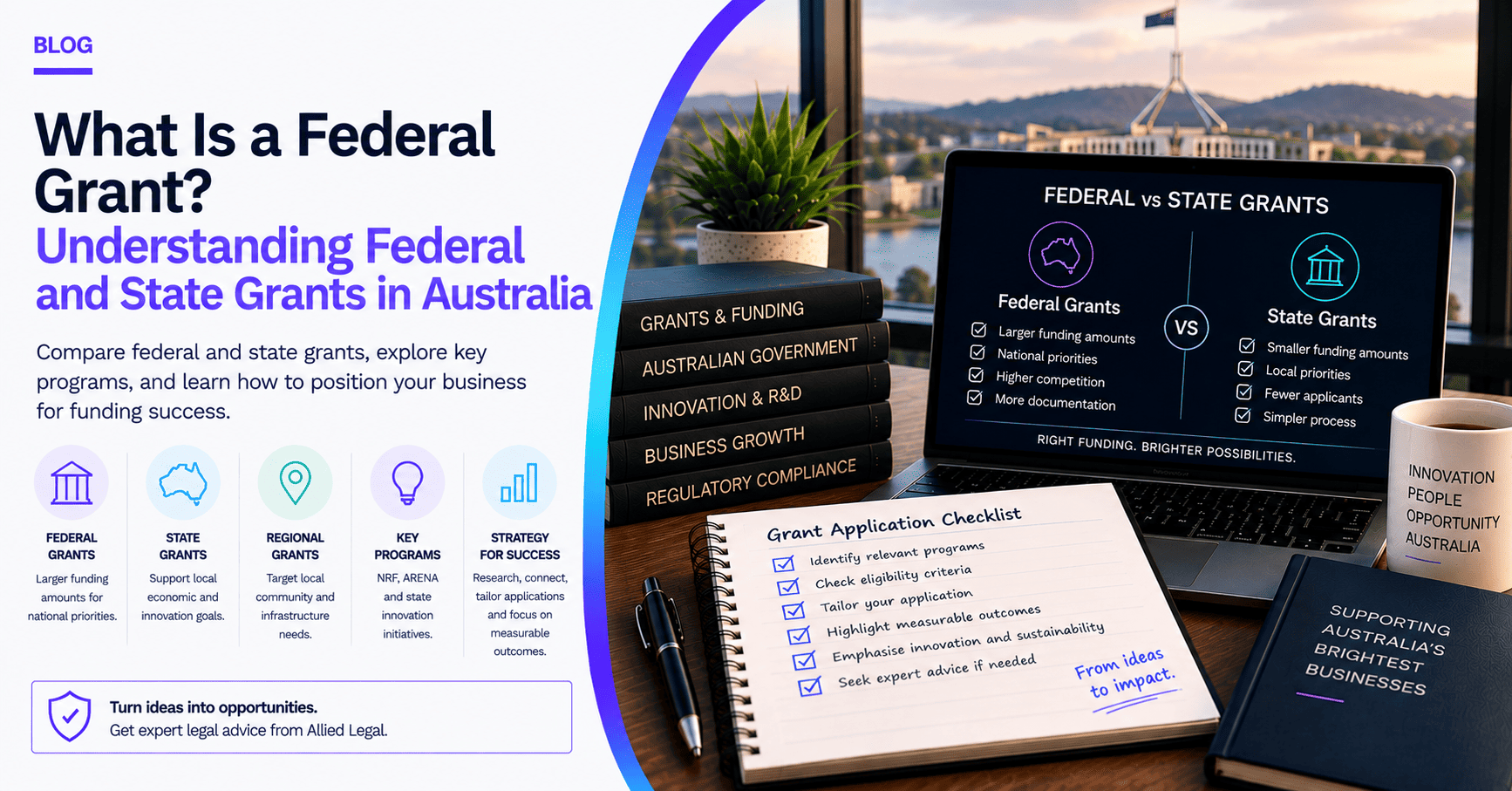
Federal grants generally offer larger funding amounts and address national priorities. They also draw more competition from businesses across the country. Applications tend to require extensive documentation and stringent compliance. State and regional grants often align more closely with local priorities. They also draw a smaller pool of applicants and involve a simpler process. Neither option is inherently better. The right choice depends on your project’s scale, timeline, and how closely it matches a specific program’s goals.
Tips for Maximising Your Chances of Success
Research each program’s objectives and eligibility criteria properly before you start writing. Engage with the relevant state agency early. Workshops and networking events often surface information that never makes it into the published guidelines. Tailor every application to the specific program rather than reusing a generic pitch. Lead with measurable outcomes wherever you can. Emphasise innovation and sustainability where genuinely relevant, since these priorities run through most current funding programs. Finally, consider working with a grants consultant or an experienced lawyer if the process feels genuinely complex. This is particularly worth doing for a larger federal grant.
Frequently Asked Questions
1. What is a federal grant?
A federal grant is funding provided by the Australian Government. It supports projects that align with national priorities, such as innovation, defence, or the energy transition.
2. What is the difference between federal and state grants?
Federal grants generally offer larger amounts and target national priorities, but they draw more competition and require more extensive documentation. State grants usually offer smaller amounts, but align more closely with local priorities and attract fewer applicants.
3. What is the National Reconstruction Fund?
The National Reconstruction Fund supports seven priority areas, including resources, agriculture, transport, medical science, renewables, defence capability, and enabling capabilities. It funds projects across these areas through initiatives like the Industry Growth Program.
4. Is the Industry Growth Program currently accepting applications?
At the time of writing, the Industry Growth Program is paused to new applications. Check its current status on business.gov.au before building a funding strategy around it.
5. Should a startup apply for a federal grant or a state grant first?
This depends on your project. A state grant can be easier to secure, thanks to lower competition and a closer fit with local priorities. A federal grant may suit a larger project aligned with a national priority area instead. Many businesses pursue both over time rather than choosing one exclusively.
6. Can regional businesses access grants that state and federal programs do not offer?
Yes. Regional grants target local economic needs, such as employment or infrastructure, that state or federal programs may not directly address. It is worth checking for a regional program alongside any state or federal options.
Understanding the difference between state and federal grants is about more than knowing where to look. It is about positioning your business to use the funding that actually fits it. For more detail on the application process itself, see our guide on how to secure grants.
If you would like help assessing your eligibility or preparing an application, contact Allied Legal today.
This article is provided for general information only and does not constitute legal advice. You should obtain legal advice specific to your circumstances before acting on any information contained in this article.

Rahul Kumar
Rahul Kumar is the founder of Allied Legal and a seasoned corporate lawyer with over 19 years of experience advising on complex corporate law matters. A recognised specialist in the startup and scaleup space, Rahul has a deep understanding of the legal and commercial challenges faced by high-growth businesses.
Having worked at both national and international firms, his expertise spans corporate structuring, capital raising, shareholder arrangements, mergers and acquisitions, and strategic governance.