
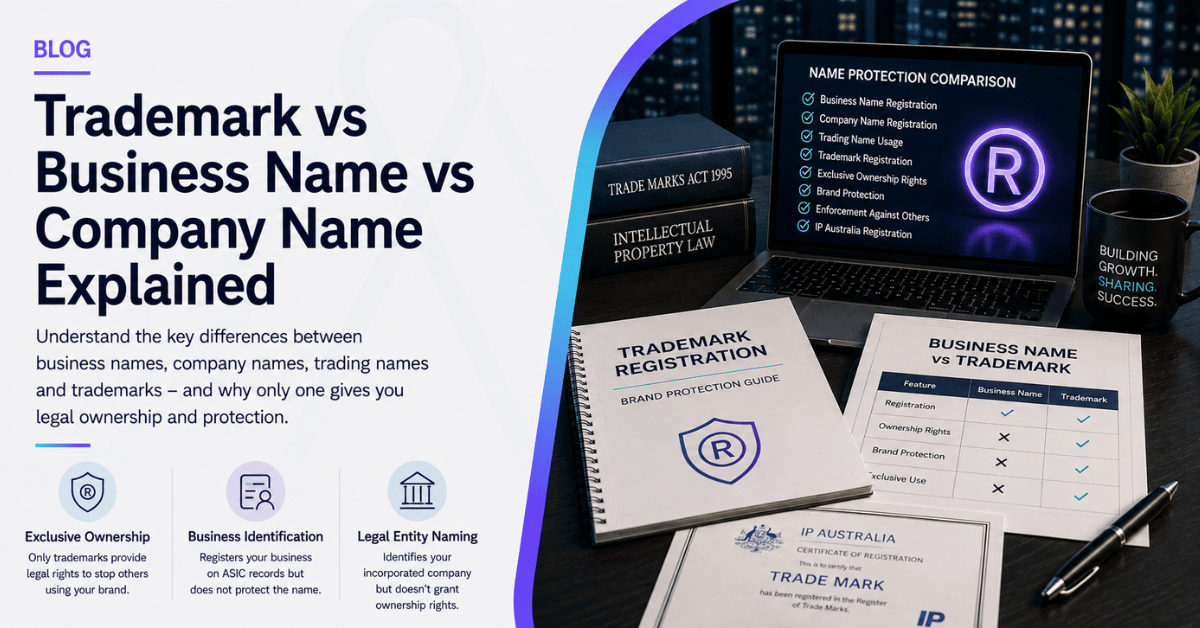
Setting up a business means picking a name, but that’s only step one. Business names, company names, trading names and trademarks all sound similar, and they overlap in confusing ways.
Here’s the short version: only one of them actually protects your name. This guide breaks down the rest.
What is the Difference Between a Trademark and a Business Name?
A business name simply identifies your business on the public record; it doesn’t stop anyone else from using the same name. A trademark is different: it gives you exclusive legal ownership of the name and the right to stop others from using it.
What’s the Difference?
Business names, company names and trading names all serve a different purpose to trademarks. Only trademarks give you exclusive ownership.
| Concept | What it does | Exclusive ownership? |
|---|---|---|
| Business Name | Registers the name of a business, company, partnership, sole trader or trust on the ASIC business names register. Exists so consumers can identify who they’re dealing with. | No |
| Company Name | The name a company is given when it’s incorporated through ASIC. A company is its own legal person, and needs a name and ACN to operate. Its name is also its business name, unless it registers a separate one. | No, treated the same as a business name |
| Trading Name | If a company registers a business name different to its own company name, that’s called a trading name. | No |
| Trademark | A mark owned by a business for a specific purpose. Registering one lets you stop others from using the same or a similar mark. | Yes, the only one of the four that gives exclusive ownership |
So What’s the Point of Registering a Business Name?
Here’s something that surprises a lot of founders: registering a business name gives you no legal protection at all. It doesn’t stop a competitor from using the same name in their own branding. The same goes for a company name. Their job is to identify your business, not protect it.
A trademark works completely differently. It gives you exclusive ownership, backed by legislation. Once your name is trademarked, that protection is automatic, you don’t need to prove anything else to stop someone else from using it.
Without a trademark, stopping a competitor from using a similar name means relying on something called “passing off.” This is a common law protection, meaning it comes from case law rather than legislation. To succeed, you need to prove three things in court:
- Goodwill: your business name has a genuine reputation in your market, linked to your product or service.
- Misrepresentation: the other business’s use of a similar name has misled customers into thinking there’s a connection to you.
- Damage: your business has suffered real losses, or is likely to, as a result.
Proving all three is genuinely hard, and far less reliable than simply owning a registered trademark.
Why Timing Matters: Trademarks Beat Business Names, Regardless of Date
Here’s the part that catches people out: a trademark beats a registered business name, even if the business name was registered first.
That means if you register a business name today, and someone else trademarks that exact same name next year, they can legally stop you from using it, even though you were there first.
It might feel unfair, but it comes back to what each registration is actually for. Business names exist to protect consumers, by making businesses identifiable, not to give the business itself any ownership rights. Trademarks exist specifically to protect intellectual property ownership, which is why they come with real enforceable rights.
Key Takeaway
If you’re setting up a business with a name you care about, register the trademark as early as possible. The process through IP Australia can take 6 months or longer, so starting early matters. Having a commercial lawyer guide you through it makes the process considerably smoother.
Frequently Asked Questions
1. Does registering a business name protect it legally?
No. A registered business name only identifies your business on the public record, it doesn’t stop anyone else from using the same or a similar name.
2. Is a company name the same as a trademark?
No. A company name identifies your company when it’s incorporated, but like a business name, it doesn’t give you exclusive ownership or the right to stop others using it.
3. What is “passing off”?
It’s a common law claim you can use to stop a competitor using a similar name to yours, without a trademark. You need to prove goodwill, misrepresentation, and damage, which can be difficult and costly.
4. Can someone else trademark my business name after I’ve registered it as a business name?
Yes. A trademark takes priority over a registered business name, regardless of which was registered first. This is one of the biggest risks of not trademarking your name early.
5. How long does trademark registration take in Australia?
Generally 6 months or longer through IP Australia, so it’s worth starting the process as early as possible.
Need Help?
If you’re setting up a business with a unique name, consider trademarking it as soon as possible. Our team at Allied Legal can guide you through the process.
Call us on (03) 8691 3111 or email hello@alliedlegal.com.au.
Related reading: Understanding the Difference Between Copyright and Trademark · Guide to Registering Your Brand With IP Australia · Trademarking Overseas: Protecting Your Brand Abroad
This article is for general information only and doesn’t constitute legal advice. You should obtain advice specific to your circumstances before acting on anything discussed here.