
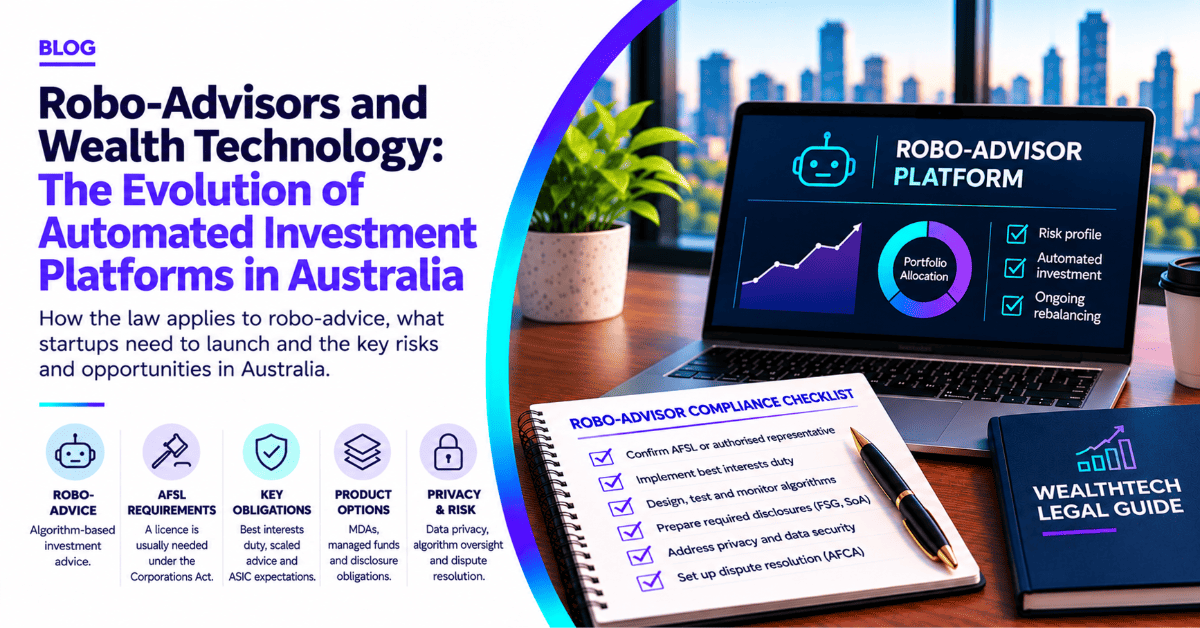
Robo advisors in Australia use algorithms to recommend or manage investments with little or no human involvement. WealthTech founders still face the same financial services laws as a traditional adviser. This guide explains how the law treats digital advice, what a startup needs before launch and where the main risks sit.
What Is a Robo Advisor?
ASIC calls robo-advice “digital advice”. Its Regulatory Guide 255 (RG 255) defines digital advice as automated financial product advice using algorithms and technology, with no direct involvement of a human adviser. A platform might build a portfolio from a risk questionnaire, rebalance it over time or send the client a recommendation.
MoneySmart says robo-advice can offer convenient, low-cost advice and may have lower fees than traditional advisers. It also lists the risks. The advice usually covers one area only. Clients with similar goals often receive the same advice. The result also depends on the information the client enters. Your product copy should reflect both sides.
The Law Is Technology Neutral
The rules come from the Corporations Act 2001 (Cth). ASIC regulates them and explains its expectations in RG 255. ASIC says the Corporations Act is technology neutral. A client who receives advice from an algorithm has the same protections as a client who sits with a human adviser.
Do Robo Advisors Need an AFSL?
Almost always. Under section 911A(1) of the Corporations Act, a person who carries on a financial services business in Australia must hold an Australian financial services licence (AFSL) that covers those services. Providing financial product advice is a financial service under section 766A. Advice counts as personal advice under section 766B if the provider considered the client’s objectives, financial situation or needs. That includes advice given by electronic means.
You have two main routes. You can apply for your own AFSL, or you can act as an authorised representative of an existing licensee. RG 255 says the licensee must hold an authorisation to provide financial product advice. Our guide to the AFSL for fintech startups covers the application. ASIC’s Enhanced Regulatory Sandbox lets some businesses test a product for up to 24 months. See also our summary of the ASIC Innovation Hub and sandbox.
Duties When You Give Personal Advice
A platform that gives personal advice to retail clients must act in the client’s best interests under section 961B(1). Section 961B(2) sets out safe harbour steps that show you met the duty. ASIC also expects the advice to suit the client and to put the client’s interests first. The client should receive a Statement of Advice and a Financial Services Guide.
Most digital advice has a limited scope. ASIC calls this scaled advice, and RG 255 sets out nine steps for it. These include explaining what advice you offer and what you do not, filtering out unsuitable clients, disclosing costs and explaining how to withdraw. Your onboarding flow should build in each step.
What ASIC Expects From Your Algorithms
RG 255 names three issues that are unique to digital advice. They are organisational competence, monitoring and testing of algorithms, and the best interests duty for scaled advice. ASIC expects regular reviews of the advice the algorithm produces. It also expects you to keep records of algorithm changes for seven years.
Cyber security forms part of that duty. RG 255 points to frameworks such as NIST and ISO 27001. In ASIC v RI Advice Group Pty Ltd [2022] FCA 496, the Federal Court found that a licensee breached its obligations through weak cyber controls.
ASIC has acted on poor tools before. In 2019, it reviewed advice files from two online platforms and raised concerns about the quality of advice and the level of client inquiries. One licensee closed both tools. ASIC’s review of AI governance, REP 798, also found that not all licensees had adequate arrangements to manage AI risks. Our guide to AI startup legal basics covers the wider issues.
Opportunities and Costs for WealthTech Startups
Robo advisors can lower the cost of serving small accounts. MoneySmart says this may help people who cannot afford full-service advice. Startups can compete on user experience, fees and product design.
Plan for the compliance cost from day one. A licence application, algorithm testing, record keeping and ongoing monitoring all take time and budget. Investors will also ask how you meet ASIC’s expectations. Our guide to raising funds and investment explains what they look for.
Product Structure and Disclosure
Many robo advisors invest through managed accounts or funds. Each route adds obligations.
- Managed discretionary accounts (MDAs). ASIC made the Corporations (Managed Discretionary Account Services) Instrument 2026/720 on 30 September 2026. It replaces the 2016 instrument and does not substantively change the relief.
- Managed investment schemes. The scheme’s operator, the responsible entity, must have registered as an Australian public company. It must also hold an AFSL that authorises it to operate the scheme.
- Design and distribution obligations. Issuers of retail products must prepare a target market determination. Some of these obligations do not apply to conduct that involves personal advice, so check how they apply to your model.
Privacy, Disputes and Reporting
Digital advice runs on personal data, so privacy law applies. From 10 December 2026, privacy policies must describe automated decisions that could significantly affect a person’s rights or interests, according to the OAIC. Our guides on privacy law in fintech and the statutory tort for serious invasions of privacy cover the detail.
Retail licensees must also belong to the Australian Financial Complaints Authority (AFCA) and run a dispute resolution system. ASIC expects licensees to report certain breaches within 30 days.
Who Gives the Advice?
Existing advisers had until 1 January 2026 to meet ASIC’s qualifications standard. Relevant providers must also sit on the Financial Advisers Register. RG 255 notes that no natural person gives the advice on a purely algorithmic platform, so the training standards do not apply directly. It still expects at least one responsible manager and at least one person who understands the algorithms. Check how the qualifications standard applies to your model before you launch.
Frequently Asked Questions
1. Are robo advisors legal in Australia?
Yes. Robo advisors operate under the same laws as human advisers. ASIC says the Corporations Act is technology neutral, so a platform must hold or act under an AFSL and meet the advice duties that apply to its service.
2. Do I need an AFSL to run a robo advisor?
Almost always. A business that provides financial product advice needs an AFSL or must act as an authorised representative of a licensee. ASIC’s Enhanced Regulatory Sandbox may let eligible businesses test a product for a limited period.
3. Does ASIC regulate robo advisors?
ASIC regulates them. The law comes from the Corporations Act 2001 (Cth), and ASIC explains its expectations for digital advice in RG 255.
4. Are robo advisors cheaper than human advisers?
Often, but not always. MoneySmart says robo-advice may have lower advice fees than traditional advisers. Compare the total fees, including product and platform costs.
5. What are the risks of robo-advice for investors?
MoneySmart lists limited scope, similar advice for clients with similar goals, advice that depends on the information you enter and limited chances to ask questions. Read the scope of advice before you invest.
6. Can a robo advisor give personal advice?
Yes, if it holds the right authorisation and follows the personal advice duties. These include the best interests duty. Many platforms give scaled advice, which limits the scope and explains those limits to the client.
How Allied Legal Can Help
Allied Legal advises WealthTech startups on licensing, product structure, disclosure and data privacy. We can help you decide between your own AFSL and an authorised representative arrangement, and prepare for ASIC’s expectations. Learn more about our fintech lawyers, or contact us on 03 8691 3111 / hello@alliedlegal.com.au.
This article is provided for general information only and does not constitute legal advice. You should obtain legal advice specific to your circumstances before acting on any information contained in this article.